Bauman, Syd. “Interchange vs. Interoperability.” Presented at Balisage: The Markup Conference 2011, Montréal, Canada, August 2 - 5, 2011. In Proceedings of Balisage: The Markup Conference 2011. Balisage Series on Markup Technologies, vol. 7 (2011). https://doi.org/10.4242/BalisageVol7.Bauman01.
Balisage: The Markup Conference 2011 August 2 - 5, 2011
Syd Bauman began working at the Women Writers Project in 1990. Although his title
would have you believe that he is a computer programmer, Syd is fond of pointing out
that
he doesn’t write that much actual code. When he does, it is usually in XSLT, Bash,
Perl,
or Emacs Lisp, and is always copylefted.
Syd became a hard-core computer user in 1982, and a devotee of descriptive markup
two
years later. He began using SGML and the TEI when he came to the Women Writers
Project.
From 2001 to 2007 Syd served as North American editor of the TEI. During his tenure
Syd became interested in the differences among negotiated interchange, blind interchange,
and interoperability, and how these processes inflect our thoughts on document
design.
This paper explores some of the ramifications of the inherent tension between the
desire
to analyze our own data and to share it with others — between our desire to be expressive
and our desire to be conformant — particularly with respect to
interchangeability vs. interoperability,
positing that focusing on interoperability is to focus on sharing at the expense of
analysis.
pussycat in front of Thermes de Cluny, I think. Taken 2006-07-05.
Interchange, interchange, where have you been? / I’ve asked “interoperability —
is it a sin?”
Interchange, interchange, where have you been? / I’ve asked interoperability: “is
it a
sin?”
The two captions above ably demonstrate that markup (in this case
typographical, not XML) has meaning. In both cases, the narrator asks the personified
interchange where she has been. In the first case, interchange responds
by stating that she has asked the question is interoperability a sin.
Whereas in the second case, she replies by stating that she has asked the personified
interoperability whether or not it is a sin (whatever it
is).
Introduction
In the digital humanities, we encode texts for three primary reasons:
to help ensure longevity of the digital object, at least in internet time
to help us analyze or explore the text in a manner congruent with our research or
teaching
to help us share the text with others, whether for reading, similar analysis, or for
analysis we might not have thought of or even imagined (and whether delivered in digital
form or in print; and whether for profit, professional accreditation,
or altruistic reasons)[1]
The first goal (longevity) can be met by using a very common, well-defined, open standard
character encoding (i.e. Unicode), and by sticking to human-readable, well-defined,
open
standard text formats (e.g. TeX or XML). That is, by avoiding any proprietary or binary
formats.[2]
The second goal (analysis) can be met by sticking to what we used to call “descriptive
markup”MarkFut but is now better described as “indicative logical markup”Flaw, and developing a sufficiently detailed description of your data for the
purposes envisioned. That is, to develop a markup system that separates out the parts
of the
document you find interesting and describes that which is interesting about them in
sufficient
detail.
The third goal (sharing) can only be met if the others you are sharing with understand
that which you are sharing. It does you no good whatsoever for me to send you a manuscript
transcription in a proprietary binary format which your computer cannot read, and
not much
good to send it in an open text format you do not understand. In order for you to
make use of
the transcription, we need to have a shared understanding of both the operating details
and
semantics of the markup language used.
However, because the details of humanities texts that scholars wish to engage with
and the
assertions scholars wish to make about these texts are (almost definitionally, I daresay)
so
widely varied, no single markup language could possibly represent them all. That is,
no markup
language can meet the second goal for all scholars simultaneously. A given markup
language can
represent some of the analytic needs of all of the scholars, and all of the analytic
needs of
some of the scholars, but it can not represent all the analytic needs of all of the
scholars.
This holds whether the markup language is a widely used standard language like TEI,
or a
home-grown language specific to the purpose.
Even if the third goal were about sharing data with a particular individual, a shared
language would be required — in order for a language to be shared, both the sender
and the
receiver, regardless of discipline, whether they know each other or not, or whether
they can
even talk to each other or not, must agree on it, even if only implicitly. But in
fact the
third goal is about sharing data in a collaborative fashion with almost arbitrary
interested
parties. In this case, an agreed upon and widely known markup language is required.
The TEI Guidelines try to be that language. The full title of the
impressive and ubiquitous guidelines is Guidelines for Electronic Text
Encoding and Interchange (emphasis provided).
But with the advent of TEI P5, the focus, I claim, has been more on
interoperability than on interchange. This paper
will explore the meaning of the two terms, particularly with respect to the aforementioned
goals of text encoding, and the impact of trying to achieve interchangeability or
interoperability on encoding languages (TEI in particular) and thus the communities
served.
Definitions
Standard dictionary definitions of these terms do not provide a particularly useful
perch.
E.g. the online edition of the Oxford English Dictionary definition of
interchange (as a noun) includes the concept of reciprocity: The
act of exchanging reciprocally; giving and receiving with reciprocity; reciprocal
exchange
(of commodities, courtesies, ideas, etc.) between two persons or parties.oeinch. Merriam-Webster’s definition of the verb
interchange is more succinct, but still has at its core the idea of
reciprocity, i.e. of swapping places: to put each of (two things) in the place of the
othermwinch.
The Guidelines do not formally define the term, but the meaning can be gleaned from
the
operational definition provided: The TEI format may simply be used as an interchange
format, permitting projects to share resources even when their local encoding schemes
differ.http://www.tei-c.org/release/doc/tei-p5-doc/en/html/AB.html#ABAPP2.
As for interoperable, the OED is quite succinct, but somewhat
unhelpful: Able to operate in conjunction.oeinop Merriam-Webster is mildly helpful, although it is not clear whether
their systems include humanities encoding systems: ability of a
system (as a weapons system) to work with or use the parts or equipment of another
systemmwinop.
The Guidelines occasionally use the word interoperability (4 times),
but never define it. I would like to interpret the use of interchange and
interoperability in the Guidelines as implying that they are different:
As different sorts of customization have different implications for the interchange
and interoperability of TEI documents, …http://www.tei-c.org/release/doc/tei-p5-doc/en/html/USE.html#CFOD.
However, it is possible that the author of that sentence thinks of interchange
and interoperability as synonyms, and is just trying to be emphatic or
completely clear.
But moreover, these are not the definitions the designers of TEI (and perhaps other
data
interchange systems) had in mind when they originally discussed interchange, whether
negotiated or blind. E.g., back when TEI P1 was released (1990-07), many of the concerns
about
interchange were concerns about just getting the data from one machine to another
with the
same characters. Only then could you worry about the syntax of the encoding system
and the
semantics of the particular encoding language.
It is no small accomplishment that today character fidelitous
interchange is easy. It has taken the advent of more standardized character
encoding (i.e., ISO 10646 and Unicode), more widely and uniformly supported transport
protocols (e.g., FTP and HTTP), standard encoding schemes to work-around 7-bit mail
gateways
(e.g., base64 encoding), and standard ways to indicate content type (e.g. MIME), for
us to be
able to transport files from one place to another with such ease that we barely think
about
it. These great strides in computer technology allow us to take faithful transmission
of a
series of characters for granted; thus I will not consider it further in this paper.[3] Rather here I consider these terms in light of the syntax and semantics of the
documents in question, rather than in the operational details of how to move the documents
from here to there.
So, for purposes of this discussion of the transfer of encoded information from one
party
to another, I’d like to present operational definitions of these terms as follows.[4]
negotiated interchange
you want my data; we chat on the phone or exchange e-mail and talk about the format
my data is in, and that which your processor needs; eventually you have the information
you need, and I send you my data; last, you either change my data to suit your system
or
change your system to suit my data as needed. Both human communication and human
intervention are required.
blind interchange
you want my data; you go to my website or load my CD and download or copy both the
data of interest and any associated files (e.g., documentation or specifications like
a
TEI ODD, a METS profile, or the Balisage tag library); based on your knowledge of
my
data that comes from either the documents themselves or from the associated files
(or
both), you either change my data to suit your system or change your system to suit
my
data as needed. Human intervention, but not direct communication, is required.
interoperation
you want my data; you go to my website or load my CD and download or copy the data
of interest; you plug that data into your system. Little or no human intervention
is
required, and certainly no direct communication.
Interoperability is not symmetrical. For example, this paper conforms to the
Balisage Conference Paper Vocabulary. If I plug it
into a generic DocBook processor, presto, it works. (That is, I get quite
reasonable output.) This does not imply that a generic DocBook document will work
in the
Balisage workflow. After all, DocBook defines over
380 elements; Balisage uses only 70 or so. It would be
unreasonable to expect the Balisage processor to handle
the ~310 elements which it never expects to see. Thus the Balisage language is interoperational with a generic DocBook processor,
but the DocBook language is not interoperational with the Balisage workflow.
So an interoperable text is one that does not require any direct human intervention
in
order to prepare it to be used by a computer process other than the one(s) for which
it was
created. There are two caveats worth mentioning, here.
Merely for the sake of simplicity, certain lame interventions like
changing the path in the SYSTEM identifier in the DOCTYPE declaration may be exempted.
That is, I am not here going to consider how much human intervention is required to
disqualify a text from being interoperational. I am not suggesting that there is no
line, only that it is a matter for future work and consideration.
Note that I am, however, precluding the possibility that any
human intervention disqualifies a text from being interoperational. E.g., I would
not
consider a human issuing the command needed to ask a given process to operate on a
particular text human intervention for this purpose.
In many cases of document exchange, the recipient of a file will write a program
such that future iterations of the same process do not require human intervention.
In
this case, the target process has changed from P to P′, such that the document, which
can be considered interchangeable with respect to P, is interoperational with respect
to
P′.
Variants of Interoperability
Using these definitions of interoperability, of course, means that whether or not
a
document can be considered interoperational depends very much on the process with
which we
would like to interoperate. For simple enough processes, every XML file
is interoperational. That is, any XML file will operate with the process. Consider,
e.g., the
process that counts elements in a file (count(//*)): no matter what
non-conformant, arbitrarily invalid, or silly TEI documents you send this process,
no human
intervention will ever be needed.[5]
But there are cases toward the other end of the spectrum, as well. It is hard to imagine
a
process that could read in an arbitrary conformant TEI file and typeset a book matching
the
publisher’s house style from it. Take, for example, just the case of getting headings
into the
proper case. If house style is that headings should be title-cased with acronyms in
small
caps, some of the following perfectly reasonable, valid, conformant TEI
<head> elements will be very hard to process properly.
<head>Surgery via LASER: right for you?</head>
<head>Surgery via LASER: Right for You?</head>
<head>SURGERY VIA LASER: RIGHT FOR YOU?</head>
<head>Surgery via <abbr>LASER</abbr>: right for
                                 you?</head>
<head>Surgery via
                                 <choice><abbr>LASER</abbr><expan>Light Amplification by
                                 Stimulated Emission of Radiation</expan></choice>: right for
                                 you?</head>
<head>Surgery via
                                 <choice><abbr>LASER</abbr><expan>light amplification by
                                 stimulated emission of radiation</expan></choice>: right for
                                 you?</head>
<head type="main">Surgery via LASER</head><head
                                 type="sub">right for you?</head>
<head type="main">Surgery via LASER</head> <head
                                 type="sub">right for you?</head>
<head type="main" rend="post(: )">Surgery via LASER</head><head
                                 type="sub" rend="break(no)">right for you?</head>
<head type="main" rend=":after{content(: )}">Surgery via
                                 LASER</head><head type="sub">right for you?</head>
The point here is that being interoperable is not a static, independent feature of
a
document. Being written in French, being a standalone XML document, these are static,
independent features. But being interoperational depends entirely on which application you are trying to interoperate with. That is,
interoperationality is very context dependent.
Interoperability is Difficult
Many XML user communities will at least bristle at my assertion that interoperability
is
difficult, and some people will even object, using their own projects as counter-examples.
For
example, it may be quite easy to take documents in SVG or Triple-S and use them in an application other than the one for which they were
originally written. But I hold that interoperationality is not just about use of XML
data in
current predicted applications (I will want to use this file in an SVG viewer),
but rather is also concerned with the use of data with both unintended applications
(e.g.,
linguistic analysis of survey questions) and future applications (e.g., submitting
a set of
vector graphics images to software that makes a mosaic of them).
Notice that I am being (deliberately) self-contradictory, here. I am suggesting that
interoperability is always contextual, that we need to know what application we are
trying to
operate with in order to measure our success at interoperationality; and simultaneously
that
in order to be considered interoperational, a document should work with applications
that are
not only unforeseen, but haven’t even been written yet. If the application has not
been
written yet, it is obviously impossible to know whether or not our data will work
with it. It
is this very contradiction that drives me to say that interoperationality is hard.
We cannot
know the various contexts in which we would like our files achieve interoperationality.
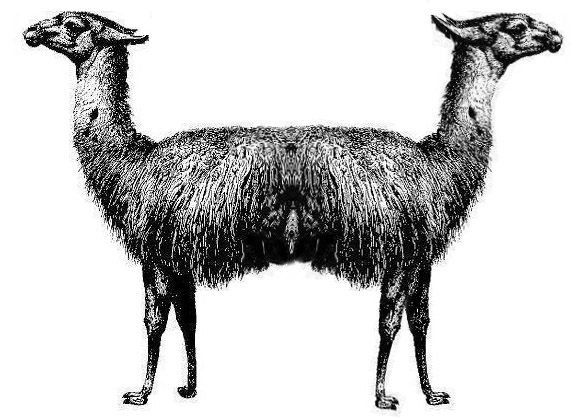
Figure 2: Pushmi-Pullyu
One take on the Pushmi-Pullyu. A somewhat more authentic take (IMHO) as available
as a
video on
YouTube
This contradiction does not necessarily make interoperationality difficult for a language
like SVG, which has both very tight operational (as opposed to declarative) semantics
and a
sharp focus on particular kinds of processing. But TEI is a declarative language that
is
intended to record, for various disparate purposes, an enormously wide array of texts
(to wit,
those of interest to humanities scholars). Thus its semantics are necessarily somewhat
looser,
its ambitions are sky-high, and its field of view is very wide.
For example, consider an application (present or future) that for some purpose wishes
to
process the authorial words in the main content of a TEI-encoded document; that is,
we need to
parse out the words, but ignore things like metadata, running heads, editorial notes,
chapter
titles, etc. Many TEI projects have had reason to extract the words in this
way, and have found it not particularly difficult to do. But doing so for a generic TEI file turns out to be impossible, and many people find
this surprising. (Remember that TEI, like many languages, is really a framework for
building a
particular markup language with many, but not all, features in common with other TEI
languages.)
Before demonstrating that this is impossible, I will first elaborate on one of the
reasons
it is hard: end-of-line hyphenation. In order to parse words out from the input document,
we
need to know whether a hyphen at the end-of-line is hard or soft. In many cases this
is
obvious to a human (pro-tection vs. pro-choice), but in some it
is not at all clear (e.g., Sea-markCeHx), and it is generally
harder for computers than for humans. The TEI currently (P5 v. 1.9.1) provides at
least five
different methods for encoding soft hyphens at end-of-line, three of which might use
different
characters for the representation of the hyphen itself (which is displayed as a hyphen
(U+002D) in the listing below), and some previous releases of TEI allowed even more.
This may
strike some as silly or even excessive, but in most cases these choices make sense.
For
example, the TEI cannot prescribe to scholars who are not remotely interested in original
lineation or soft hyphens that they record these features.
The multitude of encoding methods for soft hyphens at end-of-line would not be a problem
if an application could easily query the document and ascertain which encoding was
used. The
good news is that TEI does actually provide a specific construct[6] for encoding how end-of-line hyphens are handled. The bad news is that the
vocabulary available to describe the different encodings is insufficient to the task;
furthermore, it is optional, and many, if not most, projects do not use it.
End-of-line hyphenation is but one of many problems that make extracting just the
words from generic TEI files difficult. Some, however, actually make it impossible.
For example, in TEI annotations or notes are recorded in a <note> element,
whether the note is an aside, an annotation, a footnote, marginalia, a textual note,
a comment
to the encoder’s manager, or whathaveyou. The TEI provides a @type attribute for
differentiating these different kinds of a note; but since there is no
pre-determined controlled vocabulary for this attribute (rather, projects are expected
to come
up with their own vocabularies), and furthermore the attribute is not required, generic
TEI
processing software cannot really do much with it (at least not without human intervention).
Thus while it is easy for any given project (which knows how annotation vs. textual
notes were
encoded) to differentiate, it is impossible for general-purpose TEI software to do
so.
Interchange is (not) Difficult
Some might think that, on the surface, interchange is harder than interoperation.
After
all, it requires human intervention. And certainly dropping a file into a system and
presto it works is far easier than doing work to get your system to process
the file as desired. But we’re talking here about the effort needed to make a file
that is
interoperable vs. interchangeable. As I’ve just described, for many purposes it will
be
impossible to process a random TEI file with a given system without intervention.
Thus however
difficult it is to make interchangeable files, it is easier than making interoperable
ones.
The bad news is that it can take quite a bit of work to make a file easily interchangeable
with generic future processes. The good news is that the effort put into making it
interchangeable does double-duty, and simultaneously increases the data’s longevity
by making
curation of the file easier. (After all, porting a file forward to a different platform
of
some sort is a process, and we can think of the file as being interchangeable with
that
process.)
The reason it takes work to make a file interchangeable is because (in general) it
requires that the semantics, not just the syntax, of the encoding be explained to
the humans
involved with consuming the file. In order to know which <note> elements
should be ignored, our prospective word-counter needs to know what the various possible
values
of the @type attribute mean. Yes, one can imagine a system in which the values
are inherently obvious to one who speaks the natural language which the values (which
are
arbitrary NCNames) are designed to mimic ("authorial",
"transcriptional", etc.), but this is not the general case, and moreover there
is no guarantee that the future consumer of the file speaks that natural language
or uses
those terms the same way.
Thus contemporaneously generated detailed prose documentation of the indicative logical
markup constructs used to mark up a text can significantly facilitate the use of the
text in
future systems and processes, both those we can predict and those we cannot, both
by those
that generated the text and by unforeseen recipients of it. Put more succinctly, providing
descriptions of the descriptive markup can make future interchange of a document possible
where it might have been impossible, or easy where it might have been hard.
Interoperability vs. Expression
Inequality will exist as long as liberty exists. It unavoidably results from that
very
liberty itself.
It is an old chestnut of political theory that liberty and equality are at least at
odds
with one another, if not completely incompatible societal goals.[7] Any economic system, social engineering, regulation, or legislation that enforces
equality will limit liberty, and any that encourage liberty will make equality less
likely to
obtain.
Liberty in general, and freedom of thought, speech, and the press in particular, drive
both individuals and (more importantly) society to improve.
It is not by wearing down into uniformity all that is individual in themselves, but
by
cultivating it and calling it forth, within the limits imposed by the rights and interests
of others, that human beings become a noble and beautiful object of contemplation
In society at large, the free expression of ideas — be they true or false, good
or bad — improves the society as a whole and the condition of mankind in general,
for in the
marketplace of ideas eventually the true and good win out.
That said, there are societal advantages to equality as well. A pure communist society
eliminates not only relative poverty and hunger, but also alienation and class
oppression.
Likewise (I claim), interoperability and expressiveness are competing goals constantly
in
tension with each other. While the analogy is far from exact, interoperationality
is akin to
equality, and expressiveness is akin to liberty. And the very advantages ascribed
to political
liberty in the social sphere can be ascribed to the liberty of expressiveness in the
encoding
of humanistic texts. The free expression of scholarly ideas embodied in the encoding
of a text
puts our encoding systems to the test, and helps to improve them.
Those areas of an encoding system that are designed to make the resulting documents
more
equal to all the other documents that will be used in the target process and thus
more
interoperational are going to curtail the encoder’s liberty to be expressive. Those
areas of
an encoding system that are designed to permit the liberty of expressiveness (e.g.,
the
@type attribute of <tei:note>) are going to permit documents
that are less like (i.e., less equal to) the other documents intended to be consumed
by the
target process, and thus less interoperational.
Said another way, to make her document (more) interoperational, an encoder either
needs to
know the application semantics of interest ahead of time, or needs to stick rigidly
to
prescriptions (sometimes, but not always, expressed as schemas) that she believes
the target
application (which may not be known) will be able to understand. But rigidly sticking
to the
encoding that (she thinks that) the target application needs, or encoding to the
stylesheet robs the encoder of the ability to be expressive in ways that (she
believes) might not be correctly handled by the target application. Common sense says
this
could result in, and my experience says this often does result in, encoder’s deliberately
using encodings that are substandard, less faithful to the document, or outright incorrect
per
the encoding language, in order to achieve the desired results.
In the general case, interoperationality (at least of random TEI-encoded files) is
impossible. But that does not stop encoders from striving for it, and in so doing
curtailing
their own ability to express the features of interest to them in individual ways.
While this
is not always a bad thing, differing expressions of content are part of the force
driving
scholarship forward and cannot be entirely forsaken for the short-term goal of avoiding
the
work needed for interchange as opposed to interoperation.
Expression and Interchange
Freedom is nothing else but a chance to be better
— Albert Camus
For humanistic scholarship variation of expression is a necessity. Ask a room full
of
scholarly editors to examine a document in their field, and you will have as many
interpretations (i.e., encodings) of the document as there are editors. And no matter
how
expressive your underlying language is, if you ask enough scholars you will come across
cases
where the interpretation of the document cannot be straightforwardly expressed in
the standard
language. Additional expressiveness, a deviation from the standard, will be required.
Just making such deviations silently is a recipe for disaster. Consumers of the document
will presume that it adheres to the standard and will find the more expressive bits
either
uninterpretable or, worse, will interpret them incorrectly.
But carefully documenting such deviations has multiple benefits:
the process of creating the documentation focuses the encoder on the essentials of
the interpretation
the documentation can help push the standard in a certain direction, or be used by
others with similar needs to avoid re-inventing a wheel
the documentation will help future consumers of the document avoid incorrect
interpretations
the documentation will help future custodians of the data to curate it
Conclusion
Order without liberty and liberty without order are equally destructive.
— Theodore Roosevelt
Whereas an attempt to make a document interoperational with a particular process or
application is likely to result in tag abuse;
Whereas an attempt to make a document interoperational with any (or an array of)
unforeseen and future processes or applications is likely to result in decreased
expressiveness (perhaps to the point of defeating the initial purpose of the
encoding);
Whereas relying on real-time or near real-time human-to-human communication to relay
the information required in the exchange of (non-interoperational) documents can be
inefficient and limits the potential set of document recipients to those with the
capability to communicate with the encoder;
And whereas generating sufficient formal and natural language documentation to make
blind interchange at least possible if not easy is useful to the current encoders
writing
the documentation, to current and future recipients of the encoded documents, and
to
future curators of the documents;
Let us hereby decree our common goal of supporting blind interchange over mindless
interoperability and chatty negotiated interchange.
In summary, since interoperationality (equality) is often bought at the expense of
expressivity (liberty), interoperability is the wrong goal for scholarly humanities
text
encoding. Practitioners of this activity should aim for blind interchange. This still
requires
a lot of adherence to standards (e.g., TEI), but eschews mindless adherence that curtails
expression of our ideas about our texts.
Acknowledgments
I would like to thank Paul Caton, C. Michael Sperberg-McQueen, and Kathryn Tomasek
for
their assistance.
References
[tri] Baer, Susanne. “Dignity, liberty, equality: A fundamental rights
triangle of constitutionalism” in University of Toronto Law
Journal, 59:4, Fall 2009, pp. 417-468. E-ISSN: 1710-1174; Print ISSN: 0042-0220.
http://muse.jhu.edu/journals/tlj/summary/v059/59.4.baer.html.
[MarkFut] Coombs, James, Allen Renear, Steve DeRose.
“Markup Systems and the Future of Scholarly Text Processing” in Communications of the ACM, 30 (November 1987); 933–47. doi:https://doi.org/10.1145/32206.32209.
[Flaw] Renear, Allen. “The Descriptive/Procedural
Distinction is Flawed”. Presented at Extreme Markup Languages 2000, Montréal, Canada,
2000-08-16T14:00. In Conference Proceedings: Extreme Markup Languages
2000, Graphic Communications Association; 215–218.
[WProc] Walsh, Norman. “Investigating the streamability
of XProc pipelines.” Presented at Balisage: The Markup Conference 2009, Montréal,
Canada,
2009-08-11/14. In Proceedings of Balisage: The Markup Conference
2009. Balisage Series on Markup Technologies, vol. 3 (2009). doi:https://doi.org/10.4242/BalisageVol3.Walsh01
[1] Note that a very strong fourth reason is to be able to achieve multiple
instances of goals 2 & 3 from the same source — the build once,
use many1 to ∞ principle.
[2] Actually, I suppose avoiding proprietary binary formats is the double negation of
using open standard text-based formats.
[3] Although it is worth mentioning that this interchange is easy only for those who have
no need to use characters that are not (yet?) in Unicode.
[4] In a previous version of this paper I coined an additional term,
interfunction, for one-way interoperability. I chose that term in
order to evoke both the idea that something (in this case a text document) works,
or
functions, across some boundary; and the fact that in mathematics as well as computer
science a function is not (in general) commutative:
Equation (a)
y = f(x) ⇏ x = f(y)
or, more precisely
Equation (b)
f(x,y) ⇏ f(y,x)
However, I am uncomfortable with my use of that term: we need to think about
one-way interchange, as well. Thus I believe more consideration is required in this
area,
and have removed it from this paper.
[5] Yes, that may be too trivial for words. But in a 2009 talkWProc
Norm Walsh presented the results of a study counting which steps were used in XProc
pipelines. He didn’t care what the pipelines did, only what steps
(i.e., XML element types) they used. For his purposes, any valid
XProc document was interoperational.
Baer, Susanne. “Dignity, liberty, equality: A fundamental rights
triangle of constitutionalism” in University of Toronto Law
Journal, 59:4, Fall 2009, pp. 417-468. E-ISSN: 1710-1174; Print ISSN: 0042-0220.
http://muse.jhu.edu/journals/tlj/summary/v059/59.4.baer.html.
Coombs, James, Allen Renear, Steve DeRose.
“Markup Systems and the Future of Scholarly Text Processing” in Communications of the ACM, 30 (November 1987); 933–47. doi:https://doi.org/10.1145/32206.32209.
Renear, Allen. “The Descriptive/Procedural
Distinction is Flawed”. Presented at Extreme Markup Languages 2000, Montréal, Canada,
2000-08-16T14:00. In Conference Proceedings: Extreme Markup Languages
2000, Graphic Communications Association; 215–218.
Walsh, Norman. “Investigating the streamability
of XProc pipelines.” Presented at Balisage: The Markup Conference 2009, Montréal,
Canada,
2009-08-11/14. In Proceedings of Balisage: The Markup Conference
2009. Balisage Series on Markup Technologies, vol. 3 (2009). doi:https://doi.org/10.4242/BalisageVol3.Walsh01