Introduction
As XML approaches 30 [XML 1996], and its parent technology approaches 60 [Goldfarb 1996], the peaks and valleys of its existence keep getting clearer. XML soared to great heights in its first few years, dipped during the dot-com bust, climbed again for a burst of AJAX and REST API use, and then faded again after JSON took much of its audience. Like many mountains, though, technological pinnacles leave behind powerful remains that keep marking the landscape long after they stopped being the biggest thing around.
What is a pinnacle?
A pinnacle is generally a more exciting word for a peak, often reflecting slightly
more extreme circumstances. In architecture, for example, roofs can have peaks, but
pinnacles are usually towers extending above the roof. Pinnacles are often, though
not always, seen as less secure places to be than peaks. Pinnacles are often admired,
seen as the culmination or greatest expression of something [Pinnacle Definition]. Annual Pinnacle Awards, for example, are meant to honor companies, products, and individuals that have demonstrated exceptional innovation,
creativity, and impact in their fields
[Pinnacle Awards]. As the annual nature of that award suggests, a technology pinnacle is often a temporary
state.
On the peaks
Unlike many technologies, XML had two huge moments. The first peak was early, when
XML was going to transform the Web, ecommerce, and everything [Bosak and Bray 1999]. The second peak arrived when XML thrived on REST APIs and its association with
Ajax [Garrett 2005], before JSON took its data serialization crown away. Google Books' Ngram Viewer
[Ngram-XML] provides a rough presentation of this pattern, shown in Figure 1, though two caveats are important. First, book publication often adds a year or
two year delay. Second, the Ngram viewer is reporting the frequency of occurence
of XML
in books. If a book simply mentions Asynchronous JavaScript and XML
to expand Ajax, or includes code using XMLHTTPRequest with any kind of payload, that
will set off the counter. The hits in the first peak are likely more solid.
Figure 1: Ngram for XML, 1995-2022
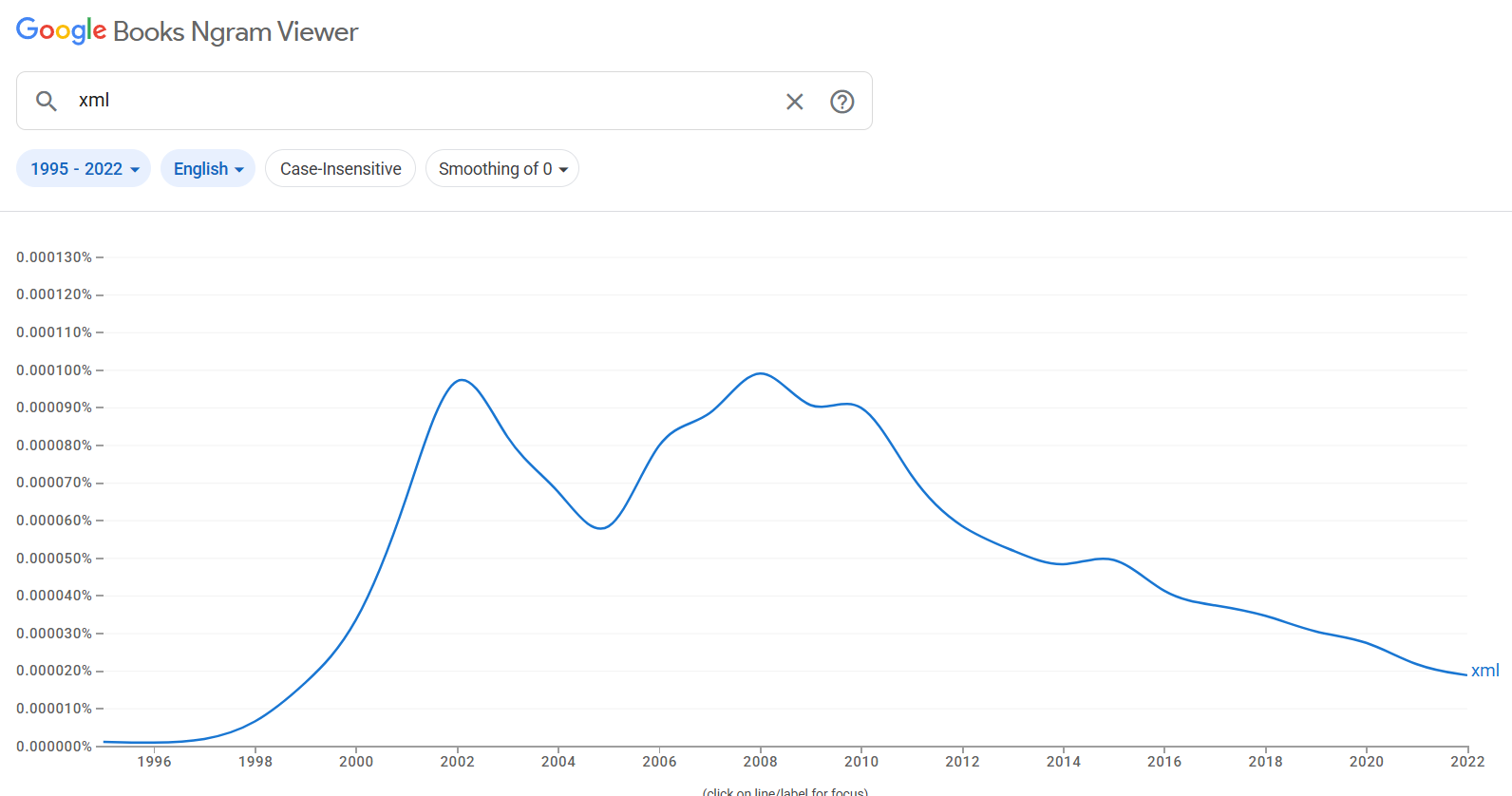
Google Books shows two peaks for the use of XML
, in 2002 and 2008, followed by a long slow fade.
While Ngrams are fairly blunt instruments, two additional searches can clarify what was happening in each peak. Both have many fewer appearances than XML, but they do show intersecting trends. XSLT, shown in Figure 2, was strongly associated with the first story, and Ajax, in Figure 3, with the second.
Figure 2: Ngram for XSLT, 1995-2022
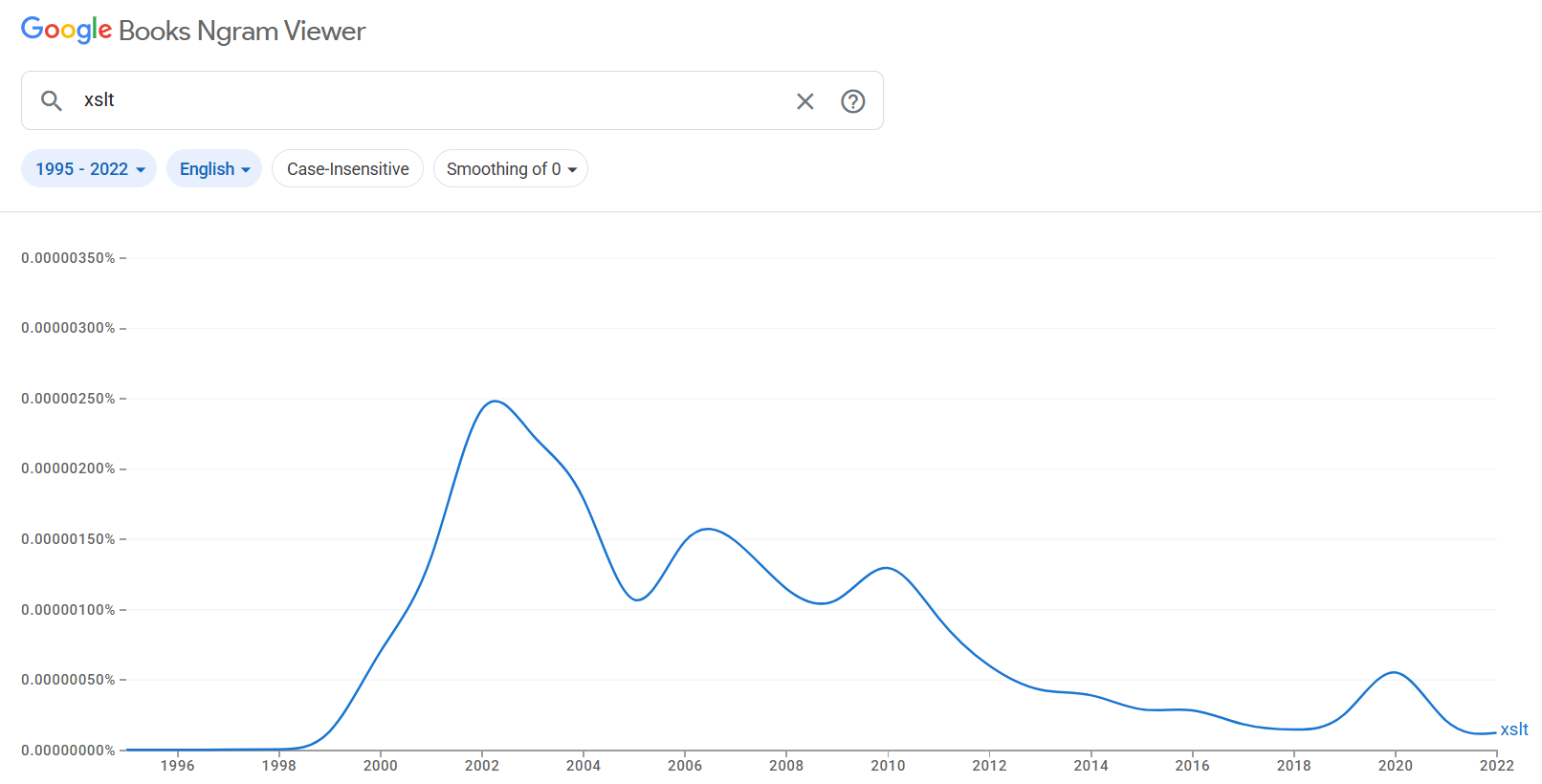
Google Books shows one peak for the use of XSLT
, in 2002, followed by a bumpy fade.
Figure 3: Ngram for Ajax, 1995-2022
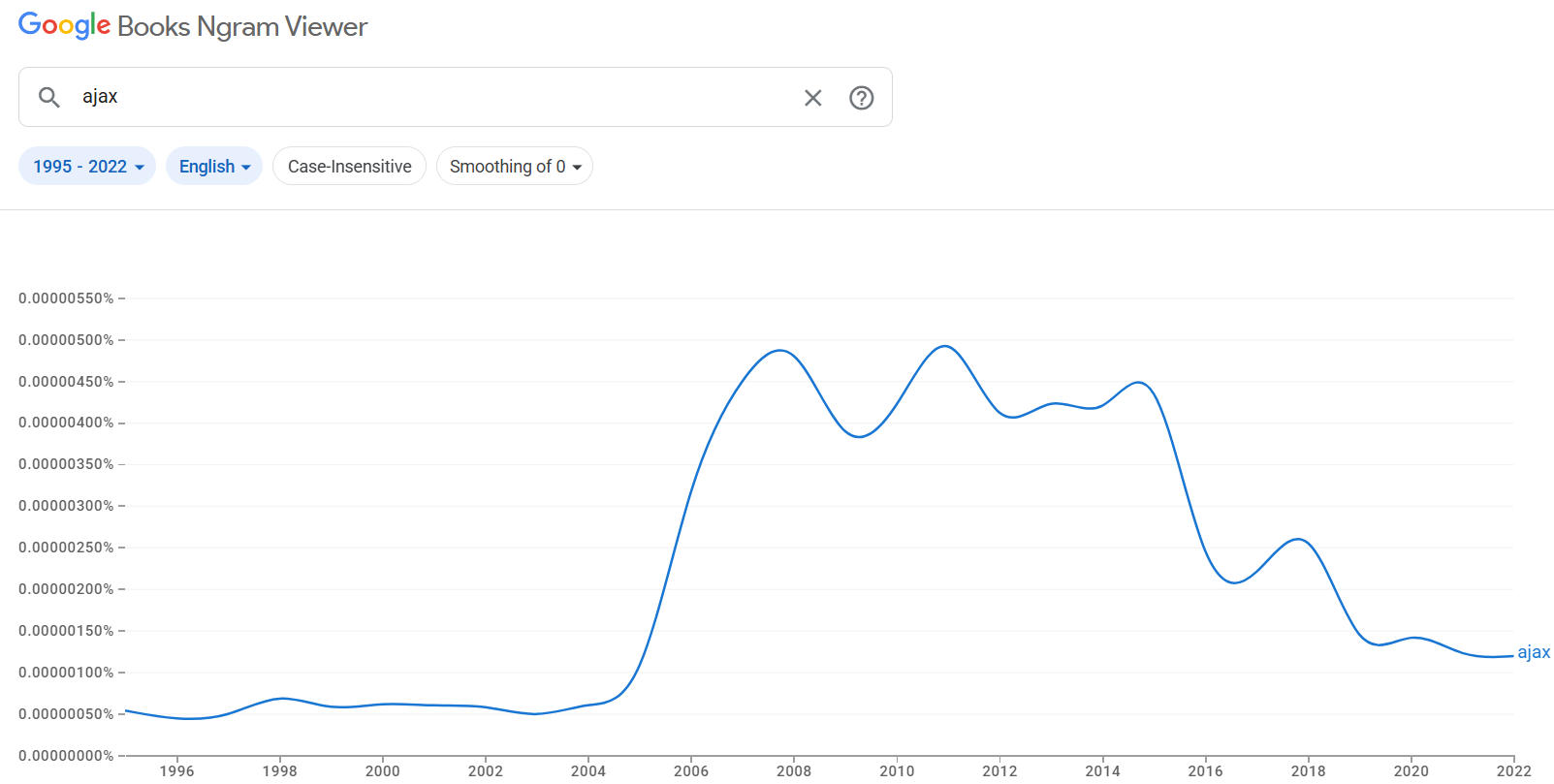
Google Books shows a double peak for the use of Ajax
, across 2007-11, really only dropping in 2016.
All of these technologies are still in use, of course, but all of them have descended from their peaks.
Pinnacles after the peak
Pinnacle technologies have a habit of lasting much longer than anyone expects, often even much longer than anyone especially wants. (COBOL is a legendary case, while Java is a more ordinary complaint.) Even in software, where the costs of change seem like they should be much smaller, technologies that had a good run can linger apparently forever. Data has even lower transition costs because of ubiquitous transformation tools, but people and companies hold on to their technologies as long as there remains enough community to support them.
One classic way that old pinnacles stay relevant is by staying close to related technologies. The Java Virtual Machine (JVM), for example, is used for languages far beyond the original language. Kotlin, Scala, Groovy, and Clojure are all built around the JVM, and dozens of other languages have implementations that use it [Urma 2014].
XML does not have this kind of a posse. In fact, the early design decision that XML documents must be well-formed makes it difficult to reuse XML tools on SGML, HTML, or a variety of other formats. However, a different approach, through techniques like Invisible XML [Invisible XML], makes it possible to bring XML tooling and transformations to other formats. XML itself remains largely unbeaten in applications that need the flexibility it provides, especially for custom structures and mixed content.
Just as regular expressions have remained themselves through decades of use in multiple environments, so XML will likely hold on. Regular expression tooling has drilled deeper into programming languages than XML parsers and other tools, so hasn't had to deal with as much turmoil [Posch 2025]. XML's early efforts to join the world of the Web browser got XSLT 1.0 into the browser, but even that is fading now [Freed 2025]. XML 1.0 itself seems safe there for now, too tightly bound into APIs and other processing, its notable naming of XMLHTTPRequest [XMLHttpRequest] still respected as legacy.
So which will it be? Will XML end up an isolated monolith like COBOL, requiring dedicated support while managers plot its long-term removal, or will it remain so integral to so many technologies that it lasts like the JVM?
References
[Posch 2025] Posch, Maya. Libxml2 Narrowly Avoids Becoming Unmaintained
. https://hackaday.com/2025/12/23/libxml2-narrowly-avoids-becoming-unmaintained/
[XMLHttpRequest] Mozilla Developer Network. XMLHttpRequest
. https://developer.mozilla.org/en-US/docs/Web/API/XMLHttpRequest
[Freed 2025] Freed, Mason, and Röttsches, Dominik. Removing XSLT for a more secure browser
. https://developer.chrome.com/docs/web-platform/deprecating-xslt
[Invisible XML] Pemberton, Steven. Invisible XML Specification: Community Group Editorial Draft
. https://invisiblexml.org/current/
[Urma 2014] Urma, Raoul-Gabriel. Alternative Languages for the JVM
. https://www.oracle.com/technical-resources/articles/java/architect-languages.html
[Bosak 2003] Bosak, Jon. The Birth of XML
. Sun Developer Network. https://web.archive.org/web/20120804024400/http://java.sun.com/xml/birth_of_xml.html
[Ngram-XML] Google Books Ngram Viewer. XML: 1995-2022
(July 2024 dataset). https://books.google.com/ngrams/graph?content=xml&year_start=1995&year_end=2022&corpus=en&smoothing=0&case_insensitive=false
[XML 1996] Bray, Tim, and Sperberg-McQueen, Michael. Extensible Markup Language (XML): W3C Working Draft 14-Nov-96
. https://www.w3.org/TR/WD-xml-961114
[XHTML 1.1] Altheim, Murray, and McCarron, Shane. XHTML 1.1 - Module Based XML
. https://www.w3.org/TR/2001/REC-xhtml11-20010531/
[Berners-Lee 1999] Berners-Lee, Tim. Weaving the Web: The Original Design and Ultimate Destiny of the WORLD WIDE WEB by Its Inventor. New York: Harper San Francisco, 1999.
[Bosak and Bray 1999] Bosak, Jon, and Bray, Tim. XML and the Second-Generation Web
. Scientific American, May 1999. Pages 89-93.
[XML 1.0] Bray, Tim, Paoli, Jean, and Sperberg-McQueen, Michael. Extensible Markup Language (XML) 1.0: W3C Recommendation, 10-February-1998
. https://www.xml.com/axml/
[Connolly 1997] Connolly, Dan, et al. The Evolution of Web Documents: The Ascent of XML
, in XML: Principles, Tools, and Techniques. Sebastopol, CA: O'Reilly Media, 1997. http://www.xml.com/pub/a/w3j/s3.connolly.html
[JSON] Crockford, Douglas. Introducing JSON
. http://www.json.org/
[No Tags] Dodds, Leigh. Doing It Simpler
. https://www.xml.com/pub/a/2001/08/01/simpler.html
[DuVander 2012] DuVander, Adam. Leading APIs Say 'Bye XML' in New Versions
. https://web.archive.org/web/20150104191603/https://www.programmableweb.com/news/leading-apis-say-bye-xml-new-versions/2012/12/17
[Ensign1997] Ensign, Chet. SGML: The Billion-Dollar Secret. Boston: Pearson, 1997.
[Manifesto 2013] Extensible Web Manifesto. http://extensiblewebmanifesto.org/
[Garrett 2005] Garrett, Jesse James. Ajax: A New Approach to Web Applications
. https://web.archive.org/web/20150910072359/http://adaptivepath.org/ideas/ajax-new-approach-web-applications/.
[Goldfarb 1990] Goldfarb, Charles. The SGML Handbook. Oxford: Oxford University Press, 1990.
[Goldfarb 1996] Goldfarb, Charles. The Roots of SGML -- A Personal Recollection
. https://web.archive.org/web/20121220071917/http://www.sgmlsource.com/history/roots.htm
[Graham 1995] Graham, Ian S. The HTML Sourcebook. New York: John Wiley & Sons, 1995.
[WASP 2013] History of the Web Standards Project
. https://www.webstandards.org/about/history/index.html
[Hopgood 2001] Hopgood, Bob. History of the Web
. https://www.w3.org/2012/08/history-of-the-web/origins.htm
[Jia 2018] Jia, Xueyuan. XSLT and XML Query Working Groups now closed
. https://lists.w3.org/Archives/Public/public-xsl-wg/2018Oct/0000.html
[JSON Alternative] JSON: The Fat-Free Alternative to XML
. http://www.json.org/xml.html
[Katz 2013] Katz, Yehuda. Extend the Web Forward
. http://yehudakatz.com/2013/05/21/extend-the-web-forward/
[La Quey 1999] La Quey, Robert E. SML: Simplifying XML
. https://www.xml.com/pub/a/1999/11/sml/
[Marcotte 2008] Marcotte, Ethan. Where Our Standards Went Wrong
. https://alistapart.com/article/whereourstandardswentwrong/
[Pinnacle Definition] Pinnacle
, Merriam-Webster.com Dictionary. Merriam-Webster, https://www.merriam-webster.com/dictionary/pinnacle. Accessed 12 Jul. 2026.
[Pinnacle Awards] Pinnacle Awards: About Us
. https://www.pinnacle-award.com/about-us. Accessed 12 Jul. 2026.
[Meiert 2020] Meiert, Jens Oliver, Rosu, Catalin, and Devlin, Ian. Markup
. https://almanac.httparchive.org/en/2020/markup
[Miłowski 2009] Miłowski, R. Alexander. XML in the Browser: the Next Decade
. Presented at Balisage: The Markup Conference 2009, Montréal, Canada, August 11 -
14, 2009. In Proceedings of Balisage: The Markup Conference 2009. Balisage Series on Markup Technologies, vol. 3 (2009). doi:https://doi.org/10.4242/BalisageVol3.Milowski01
[Patterson 2013] Patterson, Matt. Where did all the markup kids go? Open-source, markup, and the casual developer
. Presented at Balisage: The Markup Conference 2013, Montréal, Canada, August 6 -
9, 2013. In Proceedings of Balisage: The Markup Conference 2013. Balisage Series on Markup Technologies, vol. 10 (2013). doi:https://doi.org/10.4242/BalisageVol10.Patterson01 (Open source shrinkage)
[St. Laurent 2007] St. Laurent, Simon. JSON on the Web, or: The Revenge of SML
. https://www.xml.com/pub/a/2006/07/05/json-on-the-web-or-the-revenge-of-sml.html
[St.Laurent 2021] St.Laurent, Simon. Semantics and the Web: An Awkward History
. Presented at Balisage: The Markup Conference 2021, Washington, DC, August 2 - 6,
2021. In Proceedings of Balisage: The Markup Conference 2021. Balisage Series on Markup Technologies, vol. 26 (2021). doi:https://doi.org/10.4242/BalisageVol26.StLaurent01
[Walsh 2016] Walsh, Norman. Marking up and marking down
. Presented at Balisage: The Markup Conference 2016, Washington, DC, August 2 - 5,
2016. In Proceedings of Balisage: The Markup Conference 2016. Balisage Series on Markup Technologies, vol. 17 (2016). doi:https://doi.org/10.4242/BalisageVol17.Walsh01
[WHATWG parsing] WHATWG. Parsing HTML Documents
. https://html.spec.whatwg.org/multipage/parsing.html
[Namespaces] World Wide Web Consortium. Namespaces in XML 1.0 (Third Edition)
. https://www.w3.org/TR/xml-names/
[W3C 2001] World Wide Web Consortium. World Wide Web Consortium Issues XML Schema as a W3C Recommendation
. http://www.w3.org/2001/05/xml-schema-pressrelease.html.en
[XHTML 1.0] World Wide Web Consortium. XHTML 1.0: The Extensible HyperText Markup Language (Second Edition)
. https://www.w3.org/TR/xhtml1/
[XHTML 2.0] World Wide Web Consortium. XHTML 2.0
. https://www.w3.org/TR/xhtml2/
[XHTML 2.0 WG] World Wide Web Consortium. XHTML2 Working Group Home Page
. https://www.w3.org/MarkUp/
[W3C 2016] World Wide Web Consortium. XML Core Working Group Public Page
. https://www.w3.org/XML/Core/.
[YAML] YAML: YAML Ain't Markup Language
. http://www.yaml.org/