Forty years ago this summer was an event without which we probably would not be holding this conference today: the publication of ISO 8879, the Standard Generalized Markup Language, SGML.
The idea of generic coding in publishing was not new in 1986; it had arisen almost as soon as programmable computerized document formatters were introduced in the 1970s – indeed enabling generic coding was a major reason for making such software programmable. Macro systems were developed for Scribe, Troff, IBM’s Document Composition Facility, and most notably for Donald Knuth’s TeX, the latter case being Leslie Lamport’s LaTeX, which appeared at almost the same time as SGML.
Generic coding took another important direction with Bill Tunnicliffe’s organizing of the GenCode committee at the Graphic Communications Association, a gathering of end users seeking a generic solution independent of any particular formatting software. Their work led to the forming of an ISO study by the Experts Group on Computer Languages for Processing Text, and that evolved into the committee that created SGML.
Before the completion of the standard, GCA published the balloted 1983 draft as GCA Standard 101, GenCode; and Tunnicliffe convinced the Department of Defense to adopt it as a trial usage.
Figure 1: Cover of the Gencode Standard
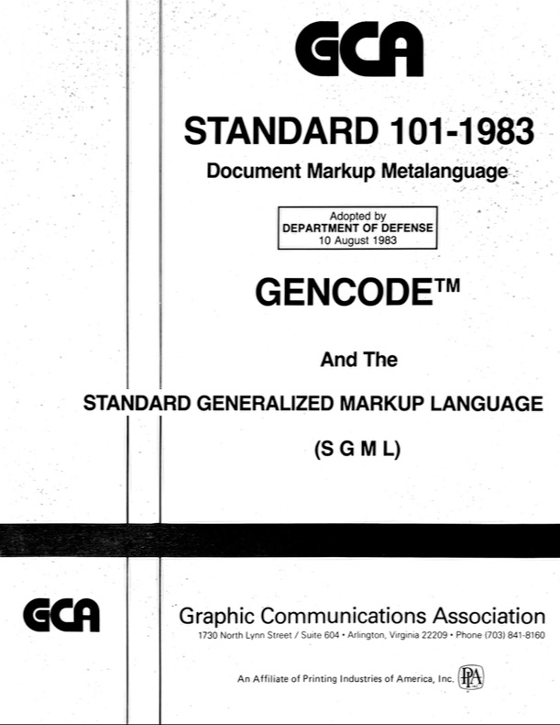
This set off a surge of development that meant that there were working implementations of SGML by the time the standard was finished.
SGML differed from earlier generic projects in that it did not simply catalogue generic elements of text, but rather gave users the tools to create their own sets of elements. Much of the credit for the design of SGML belongs to the project editor, Charles Goldfarb. He should be remembered particularly for the choice to create a language and for giving it a formal definition through a production grammar.
Figure 2: Cover of the ISO 8879 1996 Standard
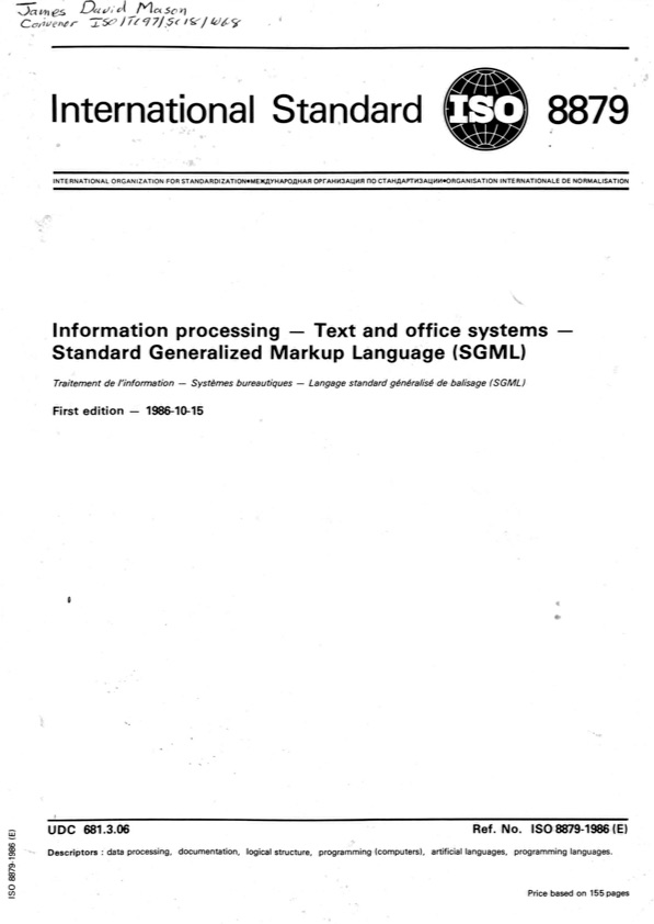
SGML also differed from other information technology standards in that it was created by end users, for end users, not by vendors or software designers, although many of us on the committee had programming experience. We did this because we needed it, not because someone wanted to sell us something.
Figure 3: Example of SGML Features
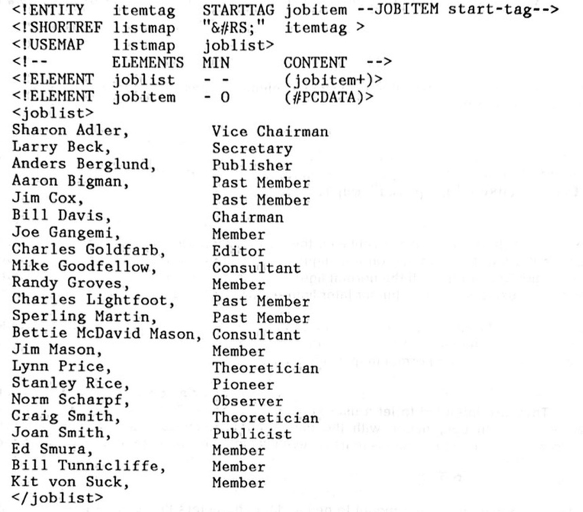
(This table, which officially is an example of some SGML features in the appendices to the ISO standard, is more or less the membership of the ANSI committee, with a few ISO and honorary members thrown in. It’s Goldfarb’s way of memorializing some contributors in a supposedly anonymous ISO standard. The list dates to 1983, before I came to chair the ISO committee.)
While this background perhaps explains some of the quirks of the standard, it still drives the current world of markup, as can be seen by the typical population of this conference.
The publication of ISO 8879 set off a cascade of standards development, user implementations, and GCA conferences. Balisage has been the heir to the latter.
Having finished SGML, the ISO committee began work on the Document Style Semantics and Specification Language (DSSSL). Though it is little used today, DSSSL led to the development of XSLT and XSLFO, which many of us use.
When challenged to design an SGML representation for the Office Document Architecture standard, Goldfarb came up with the concept of Architectural Forms, and that led to the development of HyTime, SMDL, and Topic Maps, about which we will hear later this week. And philosophically, if not technically, this pattern has influenced DITA.
And of course there is HTML. When he was trying to create an encoding for the Web, Tim Berners-Lee turned to Anders Berglund, CERN’s representative to the ISO committee, who recommended SGML syntax and the basic element set.
Then there is this conference itself whose name, Balisage, is the last word of the French title of the SGML standard.
Figure 4: Title and Subtitle of the SGML Standard
