Piez, Wendell. “Scholia 2026: DIY study aids with TEI, XProc, browser and printer.” Presented at Balisage: The Markup Conference 2026, Washington, DC, August 3 - 7, 2026. In Proceedings of Balisage: The Markup Conference 2026. Balisage Series on Markup Technologies, vol. 31 (2026). https://doi.org/10.4242/BalisageVol31.Piez01.
Balisage: The Markup Conference 2026 August 3 - 7, 2026
Balisage Paper: Scholia 2026: DIY study aids with TEI, XProc, browser and printer
Wendell Piez
Wendell Piez is an independent consultant specializing in XML, XSLT and XProc, based
in Rockville MD.
Efforts to create digital hypermedia tools for the study of second languages run aground
until the author finds a way forward with new tools and old methods.
The content of any medium is always another medium
— Marshall McLuhan, Understanding Media
1964 (MIT Press 1994), p. 8
This adage, although still quoted, is now even more opaque than when it was written,
for a
bygone audience for whom the word content, used in this sense, had to be guarded
with quotation marks. For us, this is a normal word that appears without irony in
normal prose;
in 1964, it seems, it was remarkable to think of content as something distinct
from its medium, or from (as we now also say) its platform. For us, content is
already separate from the medium, before it is even published. Sixty years ago McLuhan
helped
introduce this conceptual separation, but in a way that emphasized the continuity
and relation
among successive media, as each new one adopts the languages of its predecessors in
its attempts
at legibility.
In accordance with this idea, electronic media and especially networked text-based
hypermedia have developed for 50 years and more. Yet it is still not fully settled
how the
affordances of (for example) XML and the web can come into their own, not as containers
and
imitators of media that precede them (or pictures of those media, like word
processor documents), but as media in their own right, which afford normal users
(who used to be called readers) capabilities that complement and complete, rather
than simply
replicate, the most sophisticated media of the past. In some areas – dictionaries,
directories,
market feeds, real-estate listings, sports-betting apps? – we are inevitably further
ahead than
in others.
In this paper I explore one line of investigation spanning decades, bearing on this
question
in a narrow (but interesting) domain, namely the study of second or third languages
and
literatures. Only in a world of content can we have application
domains. Now we are in such a world, we look back at the old media for examples of
design excellence in information technology. Many better-executed graded or
assisted readers serve as such examples, and all of them are ambitious.[1]
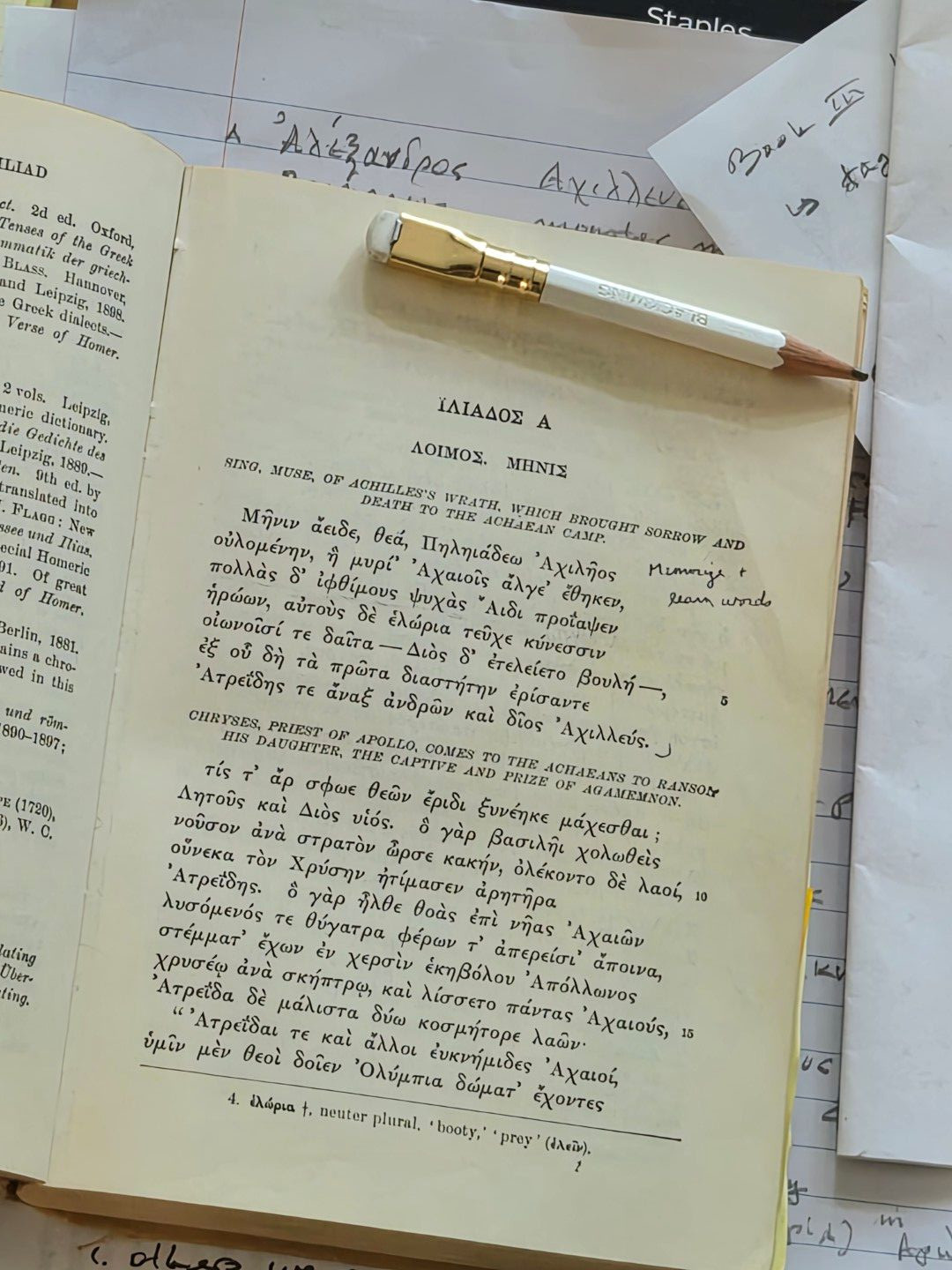
Figure 1: An assisted reader
A snapshot of one of many assisted readers in the author's collection, and a well-worn
one (even showing some markup by a previous owner). These are commonly used in intermediate
foreign language study; they require only a knowledge of orthography and basic grammar
to
begin with, and frequently take the form of editions or collections of literary works.
An
edition with a parallel translation is a close relative: the boundaries of the genre
are
blurry, between text books on one side, scholarly-critical editions on the other,
and
dictionaries close by. The genre is also affected and constrained by the codex format
(the
reader's user interface, as we would call it) – limits of composition, layout and
typography
often dictated by materials, processes and production technology. Footnotes are commonly
supplemented by end notes, sometimes of several varieties. (This illustration does
not show
the extensive vocabulary and notes offered in this 1932 reprint of a 1902 production.)
Perhaps the genre's defining characteristic is an apparatus in the
learner's language, keeping translation and notes aligned with the core text.
Twenty-five years at the drawing board
Hitting the wall in 2002
In 2002, at a memorable ACH/ALLC 2002 conference in Tübingen, Germany, I presented
a poster on a project I named Scholia.[2] That summer I was lucky to be in Germany for several reasons; as far as the
demonstration was concerned, its purpose was to find for myself, and show to colleagues
in
the Digital Humanities community (still known at the time as Humanities
Computing), some of the potentials and practical limits of technologies that were
then in their infancy or early childhood, namely TEI XML[3] for data description, the web browser for display (hence, HTML), and XSLT
1.0.
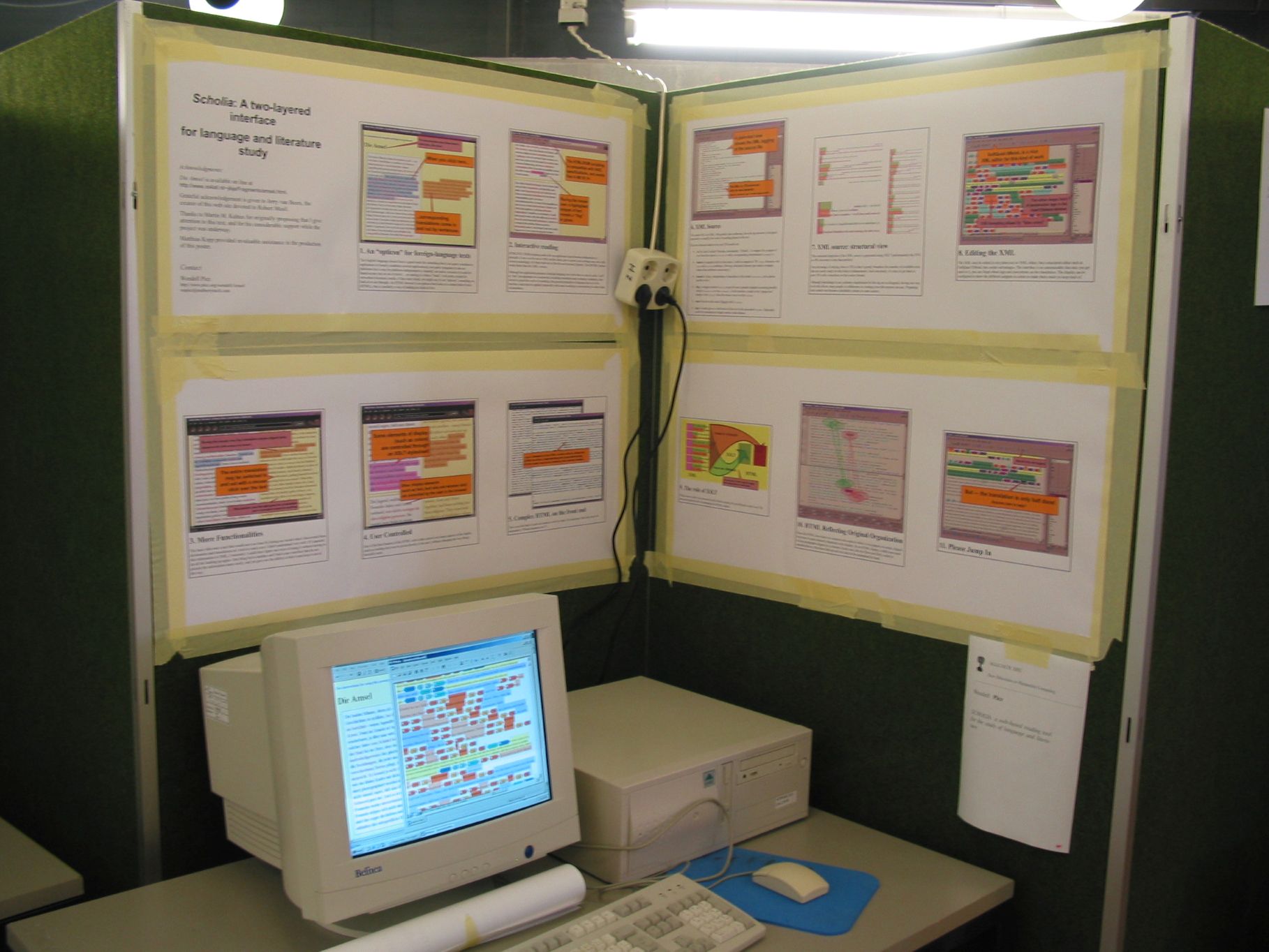
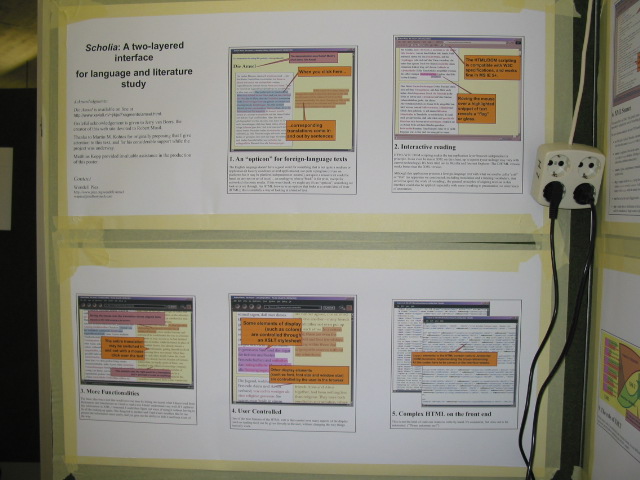
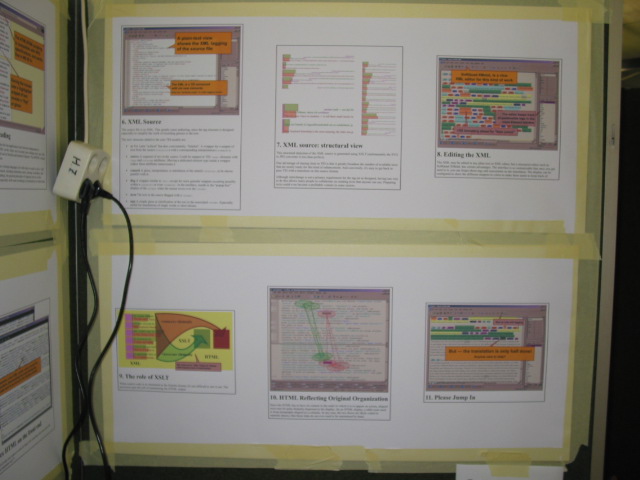
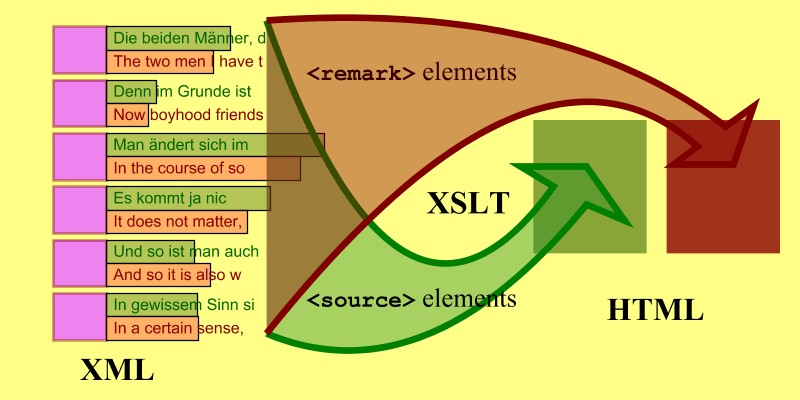
Figure 2: ACH/ALLC 2002 conference poster
The images in the poster were created with SVG, semi-automated where possible. One
of them is given for illustration.
How far could I go? What practical limitations could I find for a solo operator (myself)
to acquire a text, mark it up using TEI (slightly extended), and display it in a useful
way
that specifically explored, and exploited, the affordances of the electronic interface,
specifically the screen coupled with pointer and mouse, running a commodity web browser?
Within this reduced environment, basic primitives of typography and color (offered
by HTML
and CSS) were enhanced with a small amount of scripting logic (Javascript manipulating
the
DOM), in order to realize, using the smallest possible technical pallet, the
greatest possible useful effect. Greatest possible in this case keeps in mind
that the basic architecture – XML source data, XSLT transformation for logical and
presentational projection, and HTML/CSS/JS at the display layer – provides
leverage in its layering. In this case, elements kept as siblings in the source code
could
be placed far apart in the display, while retaining (and enacting) their relations
in their
scripted behavior. More simply put: the data in source and result were organized
differently, but a single transformation could provide for all the necessary sorting
and
sifting, linking and tracking.
The application itself (as should be readily apparent on inspection) is a variant
of
what educators and publishers call a graded reader or assisted
reader, that is to say (and as described above), a text that is provided with
apparatus and commentary designed to help the language learner, or anyone who finds
such an
apparatus more helpful than not.[4]
So far this is a description of something that seems unremarkable, when viewed in
2026
(now it has been done many times over), but keep in mind this was 2002, when almost
all web
pages were either crafted by hand, or scripted database reports.
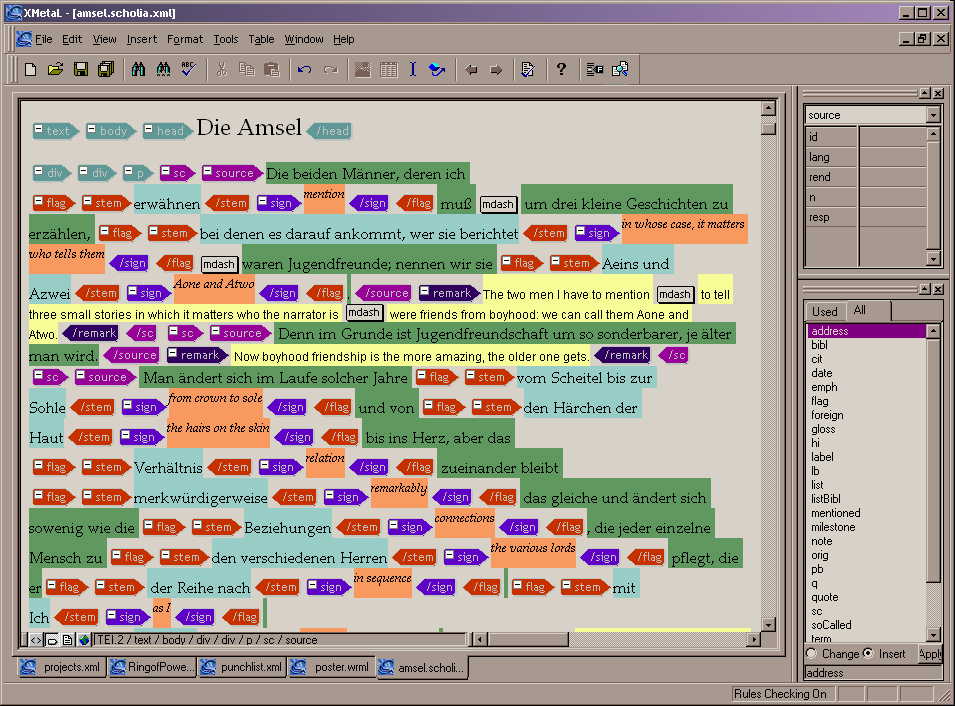
One screenshot shows the text (with a couple of bespoke element types) being edited
using XMetaL Editor in 2002, supporting standard XML tagging validated with a TEI
DTD.
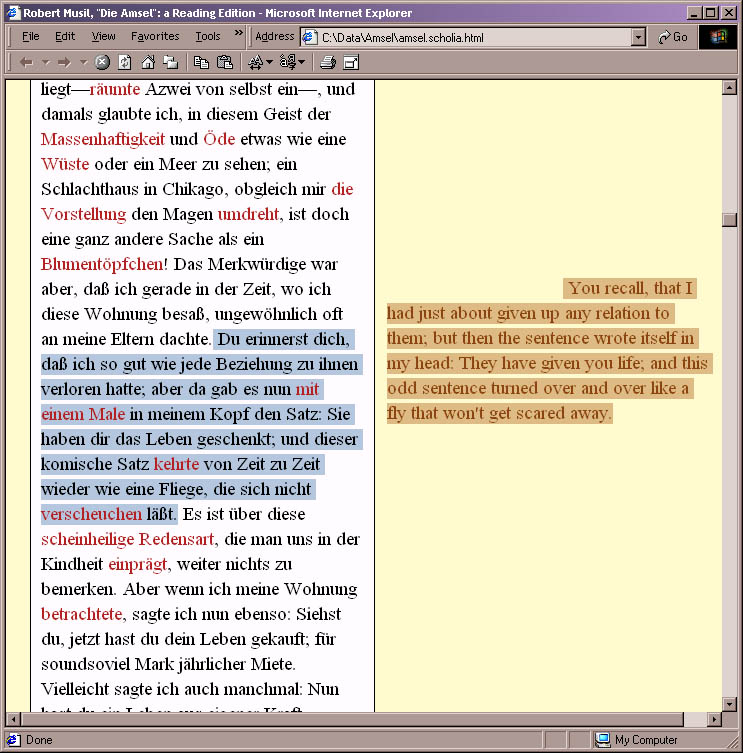
Another shows the presentation view in 2002 using a browser current at the time,
Internet Explorer. (Compatibility across browsers was also a requirement met by the
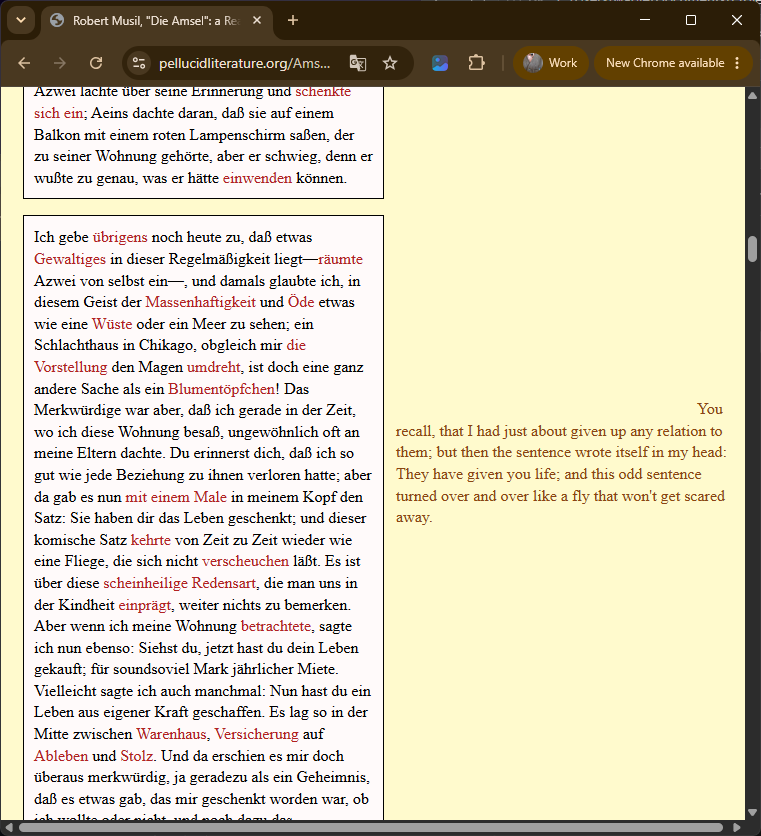
demonstration); while the last image shows the same view of the document in July 2026,
using today's browser. See the demonstration on line at https://pellucidliterature.org/
What it really taught me, however, was how far we still had to go. Having built the
technology prototype and worked up a plausible example to demonstrate the principles,
I then
set the project aside. The main reason was that however successful it was on its own
terms,
there were a number of key features missing in the design, which I was not (or not
then) in
a position to implement. And these were features more or less impossible to address
using
only the web and XML technologies of that time:
Two levels of annotation were not enough. I had room for translations aligned with
sentences (or phrases), and again, at the word level. (In the source data these are
marked with remark and flag elements, respectively, which I had added to my TEI DTD for this
purpose.) But the application clearly needed a third level, at least, for glosses
and
interpretive commentary, which needed to be clearly distinguished from translations.
These sometimes might even have their own metadata.
Related to this: the method of alignment between related parts is over-constrained
and constraining. It works well enough for texts showing such closely parallel
structures, and which could be created and maintained (like the example given) in
such a
rigid form. But texts in the wild are not like that.
In other words – and in 2002 this was already clearly apparent, even
obvious, as we had already written papers on the topic – I had an overlap
problem.
What a difference a decade makes
In 2025 I was looking at an altogether changed set of circumstances. By then, my effort
of 2002 with XSLT 1.0 had been far outstripped by electronic tools, systems and services,
both on line and off, that serve language and literature students. To be sure, comparisons
are at risk of forgetting that the Amsel project was the initiative of one solo developer
working in spare time on a deadline, for experimental purposes, deliberately using
only
commodity, standards-based technologies. Nonetheless it needs to be acknowledged that
the
2002 demonstration today appears rather quaint, if not crude, in both design and
realization, and not only due to its amateur typography (hitting the limits of the
CSS of
the day). At the same time this crudeness is possibly a reflection of its strength,
as well,
namely its relative simplicity even while, to be anything at all, it relies on a complex
assemblage of inventions of others: TEI, HTML, XSLT etc., to say nothing of the computer
and
the network itself.
Since that time, however, for practical purposes the overlap problem as
we fondly called it, gradually disappeared – or more accurately, the pains related
to it
subsided as we benefited from better tools and techniques in the XML technology stack.
Just
the most important:
XSLT 2.0 (2007) included grouping, including group-adjacent, group-starting-with and
group-ending-with; string handling (xsl:analyze-string); tunnel parameters; stylesheet functions;
features from XPath 2.0/XQuery including regular expression handling and the positional
operators << and >>.
XProc 1.0 (2010) brought efficient and maintainable, cross-platform (portable)
pipelining; with XProc 3.0 (2022) it is extended to handle non-XML data sources
including other forms of structured, and marked up, inputs.
XQuery/XPath 3.0 (2014), 3.1 (2017) and XSLT 3.0 (2017) gave us maps, arrays,
higher-order functions and xsl:accumulator
(huge).
Invisible XML (2020) enables us to parse inputs encoded in arbitrary (text-based)
formats, exposing their structures (as defined by a grammar) in XML-based
toolchains.
HTML, CSS, the DOM API and Javascript have all been implemented, refined, extended
with new features and capabilities, and tested well beyond the primitive state of
2002.
During this same period, along with much else, I continued to work intently, if
sporadically, on developing a more comprehensive approach to the overlap problem that
would
be simple enough (or so it was hoped) to support new forms of complexity. With Jeni
Tennison, starting at Extreme Markup Technologies 2001 (the predecessor conference
to
Balisage, the Markup Conference), I developed a proposal we called LMNL, the Layered
Markup
and Annotation Language. In subsequent years Jeni, myself, and a gratifying number
of other
developers had opportunities to show meaningful outcomes, based on both our ideas
and on
proposed alternatives. Implementations and later demonstrations (such as Frankenstein Trans
formed) were received and generously entertained at this conference and elsewhere,
even while the larger conversations increasingly, and inevitably, moved on.[5]
As the headaches were alleviated and the problems gave way, it made sense for the
community's attention to shift. To my mind then and now, the test always had to be
the
actual needs of actual users, presented to developers as functional requirements.
To the
extent that there were needs unmet, we could tell, if we kept listening for the stories
not
being told. In other words, which research agendas were we not exploring, because
we have no
good way to deal with what we see (whether overlap or anything else)? While I welcomed
and
used all the new tools and solutions, I was always interested to see where and when
things
did not improve, and in the background I remained mindful of
applications that continued to resist automation – like drawing diagrams of structures
implicit in literary works such as sonnets, where overlap is interesting.
Thus the technologies improved at the same time as my early efforts were being overtaken
and outflanked. What came as a surprise to me in 2025 was that this did not, in fact,
make
the unfinished Amsel demonstration less interesting: on the contrary, relieved of
any need
to be what it was not, this demonstration was showing me what it really was – not
necessarily or not only a graded or assisted reader – an electronic version of the
kind of
helper text I had used in school – but a kind of digital learning platform of its
own
distinctive type, in a nascent or inchoate form.
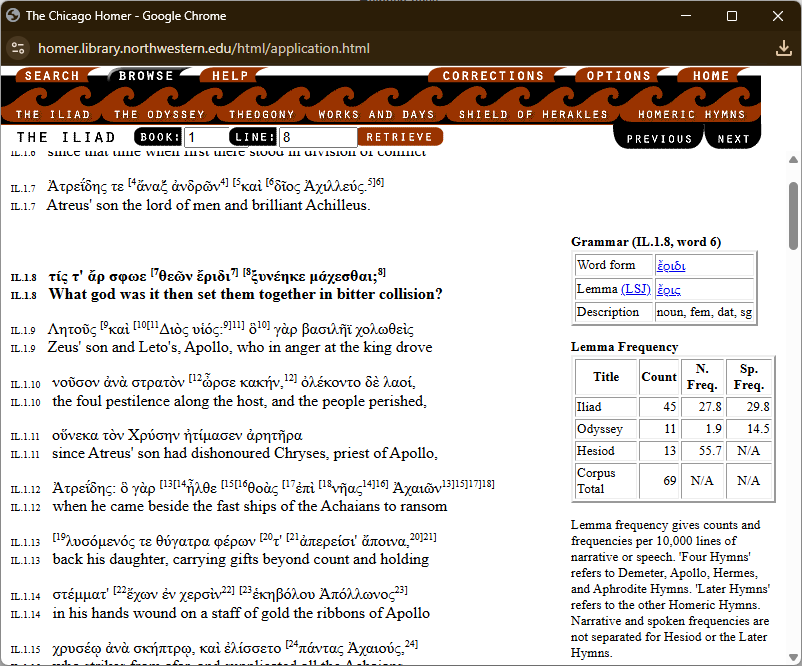
Figure 4: Chicago Homer (published 2000)
Digital classicists have been not less innovative than their analog professors, in
developing better ways to present to scholars and students what we need to know, when
we
need to know it. The screenshot shows the Chicago Homer, a Java application built
in
2000 by Craig Berry, Bill Parod (technical editors), Ahuvia Kahane and Martin Mueller
(editors).
Scholia 2026
This did not happen all at once. In 2026 I was turning my attention, after a long
hiatus, back to studying Ancient Greek, and specifically (this time) to the works
of Lucian
of Samosata, a satirist of the 2nd Century CE who wrote in Athens. After browsing
fairly
widely I settled on his Life of Demonax for close
scrutiny.
If I had found a graded reader or school edition already published for this text,
I
would have acquired it.[6] As it was, I did have access to more than one excellent electronic reading
interface, with helper apparatus (some listed in the bibliography). Despite their
own
(typically) experimental status, these were all better than anything I could
build myself: they were already baked and available, and I availed myself
accordingly (like the philosopher Demonax, plied with honeycakes by the women of Athens).
Yet paradoxically, these estimable tools also fell short, as I discovered by contrast
how
effective it was not only to use such a reader, but to
build one.
And I was now in the fortunate place where I did not have to show anything or convince
myself or anyone that it was possible: I had only to start working at it.
Using Demonax as my example, the results can now be
seen on a demonstration web site, Raven
Tracks (https://raventracks.org). As I was completing it, the
project grew: in addition to the reader a PDF version of the translation in English
is
offered (for the reader who wants no Greek), produced again from XProc (using XSL-FO
this
time).
In building this, the work we had done with the LMNL model proved to be crucial, since
among other features of Scholia 2026 is its support for the third level of annotation
it
needed (as described above). Additionally to the editorial layers provided in Scholia
2002
(given to word- and phrase-level translations), arbitrary ranges or spans of text
can now be
annotated, and these annotations too (called gloss in the Scholia model) can be
managed and maintained with the rest. Thick markup.
At the same time the basic Scholia architecture remains what it was: XML (TEI) source
data (model), HTML/JS/CSS (view) and XML-based processing (controller) - now no longer
a
single XSLT transformation, but an XProc pipeline as long and complex as necessary
to do the
job. The job itself is more complex, but this complexity is effectively screened from
the
user.
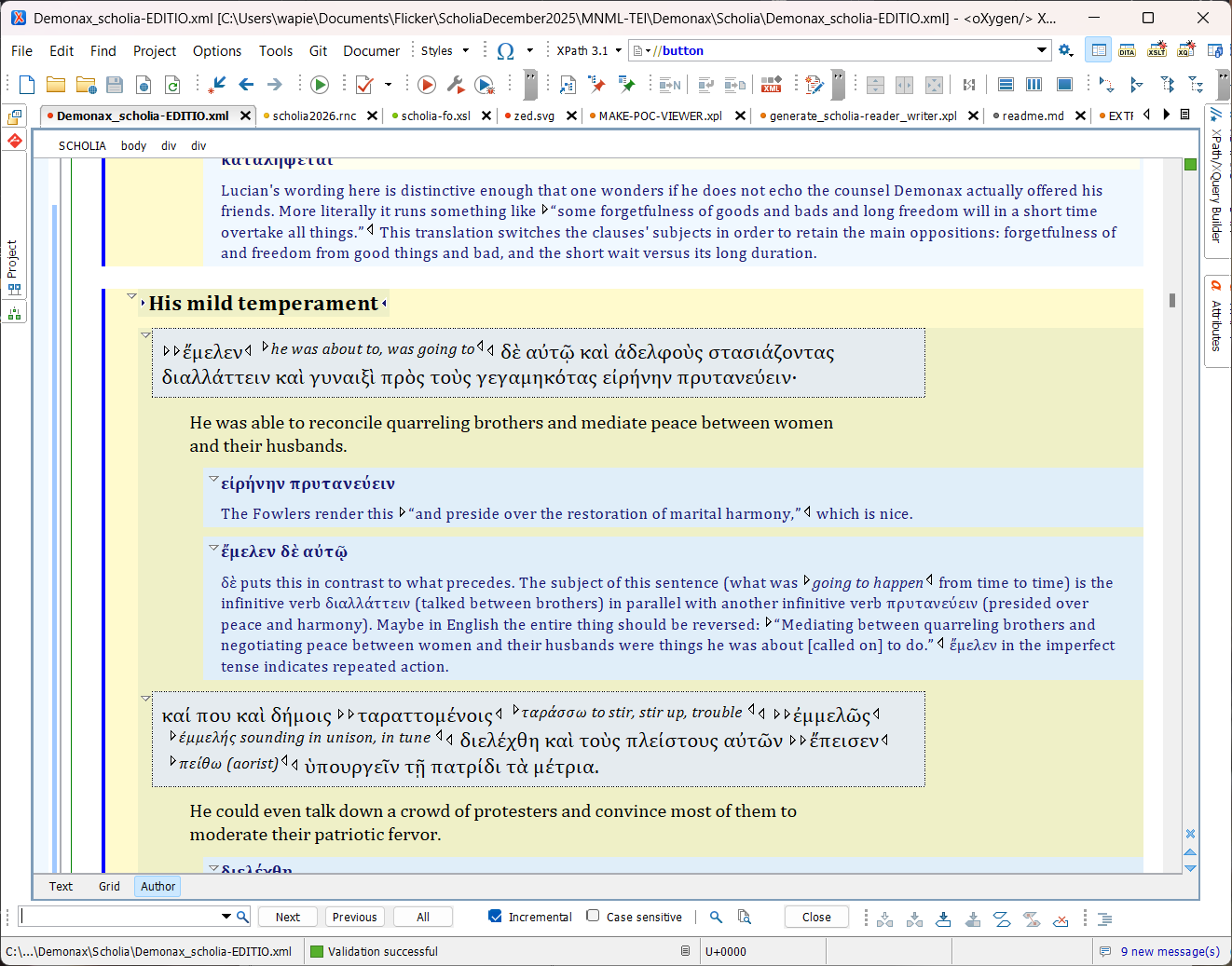
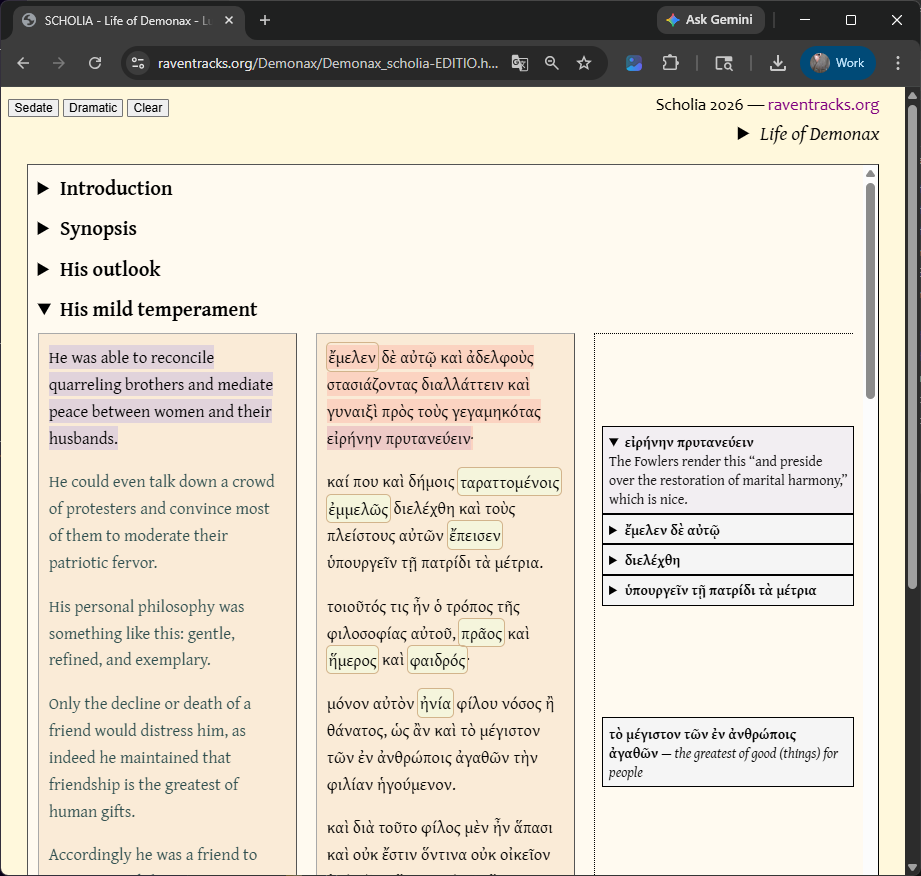
Figure 5: Scholia 2026 - Life of Demonax
Depicted here are the editorial platform for Scholia 2026 (no longer XMetaL, but
oXygen XML Editor) and the same passage in the rendered view. The model still aims
for
simplicity and usability, but a third layer is added. Readers are invited to refer
to a
live copy at https://raventracks.org/Demonax/Demonax_scholia-EDITIO.html, since a screenshot does no justice to
the interactivity of the interface.
Old methods and new opportunities
Those who have insinuated that Menard devoted his life to writing a contemporary Quixote
besmirch his illustrious memory. Pierre Menard did not want to compose another Quixote, which surely is easy enough -- he wanted to compose the Quixote. Nor, surely, need one be obliged to note that his goal
was never a mechanical transcription of the original; he had no intention of copying it. His admirable ambition was to produce a number of pages
which coincided -- word for word and line for line -- with those of Miguel de
Cervantes.
— J. L. Borges, Pierre Menard, Author of the Quixote,
Collected Fictions trans. Andrew Hurley (Penguin 1998,
p. 91)
Far from being able to put the job to rest, I found this was only a new beginning.
Having
completed my work with the Life of Demonax, I turned next to Homer's
Iliad.
There were many reasons for the choice of text here; one of the most determinative
is that
high-quality modern electronic editions of Homer already exist – in a great range,
including
both original texts and various translations, many of them open access or in the public
domain. Indeed the encoded TEI Homer available from PerseusDL includes not only full
text, but
also morphological analysis that provided much more thick description of the
data, offering the Scholia stack more grist to mill.
But who needs another graded reader of this text? which is surely among the best served
today on the public web. My notes and translations were not particularly interesting
(as
content) as they are revelatory only to me; and unlike in the case of
Lucian's Demonax, should one happen to need a translation of
Homer's Iliad, there are already many to choose from. Yet the
exercise of making the Demonax reader had shown me the value of working the
text, in annotating and translating, sometimes multiple times. The effect was proportional
–
this effort was not futile – moreover, the form these productions took
seemed to matter much less than doing the work itself. This being the case, I could
begin to
think about what I could build.
What sorts of things would be useful? The requirements for the user – me – were not
so
hard to discover. They had to do, generally speaking (or so I thought at first), with
information retrieval, not information retention. My memory is pretty good and I have
no shame
in relying on crutches (as we called assistive technologies in former times – a crutch
being a
good thing to have when you need it). The problem wasn't even unwillingness to look
anything
and everything up, so much as the capability – how many steps, swipes, pages, clicks
can one
turn in a morning?
That analysis seemed right, but not quite complete, until I posed it again in the
context
of writing, and found a better answer inside the question. I actually had two problems.
One
was known: how to make it easier to look everything up. Less effort. The other had
been
unknown, but my writing was starting to show it to me: by helping me lock it all down
and
raising my satisfaction, it was also improving my retention. More reward. Even more,
these
efforts were complementary, as I was starting to crave the writing and the learning
that
supported it. Unbeknownst to myself, I had already pioneered both approaches with
Die
Amsel, and revived both with the Life of Demonax.
The first approach is to build the tools that help the reader look up the words and
take the
notes. The second approach, also necessary: – the tool that facilitates writing it
all down
again.
Now, the goal became not only to read Homer's Iliad, but
to write it. This is less grand, and indeed less odd, than it sounds. Aspiring to
become the
Iliad's author, as Pierre Menard must become Cervantes in order to write Don
Quixote in the Borges story, would be unreasonable and unrealistic. Still
unreasonable, but perhaps not so unrealistic, would be to join the long line of the
scribes of Homer's poem.
Scriptorium Technique
As it happens, this is a serious approach to language learning developed and recommended
by professional polyglots: the Scriptorium Technique. Of course, the method of learning
by
transcription is as old as writing, but this modern formalization of the approach
is
noteworthy for a number of reasons.[7] First, it is approachable, even for challenging languages – easy to start, easy to
continue. It can be practiced solo – this is important. Since it focuses on writing,
it is
especially good for literary languages, literature and poetry. It works by creating
opportunities for the fun part (which indeed may prove to be different for
different learners), which in turn creates opportunities for the learning feedback
loop.
My efforts to support the Scriptorium technique by means of a web-based
apparatus, specifically as applied to Homer's Iliad, can also be seen on the Raventracks web site,
https://raventracks.org. They take several different forms. What they have in
common is that they are focused on enabling transcription. But transcription
in this context implies something more than a simple copy. It is possible to make
a copy,
even by hand, without transcribing. A copy qualifies as a transcription only if as
one
copies, one is conscious and intentional with respect to the meaning of the writing.
Simply:
Are you able to mean it? which generally entails knowing – actively – what it means.
Without
transcription, copying can still be an art, and a beautiful one – whose form transcription
takes. Beyond making the copy, according the Scriptorium method, a passage is considered
complete when the student can write it and pronounce it, aloud, with
comprehension. Not recite it (or not only), but speak it, first with the hand, then
with the
voice, engaging the entire attention. At the same time, every student gets to decide
what
this means and what degree of comprehension and fidelity is required to meet the other
important (in some ways overriding) goal[8]: to write another passage the next day. Accordingly the system is adaptable to both
the limiting factors, and the goals.
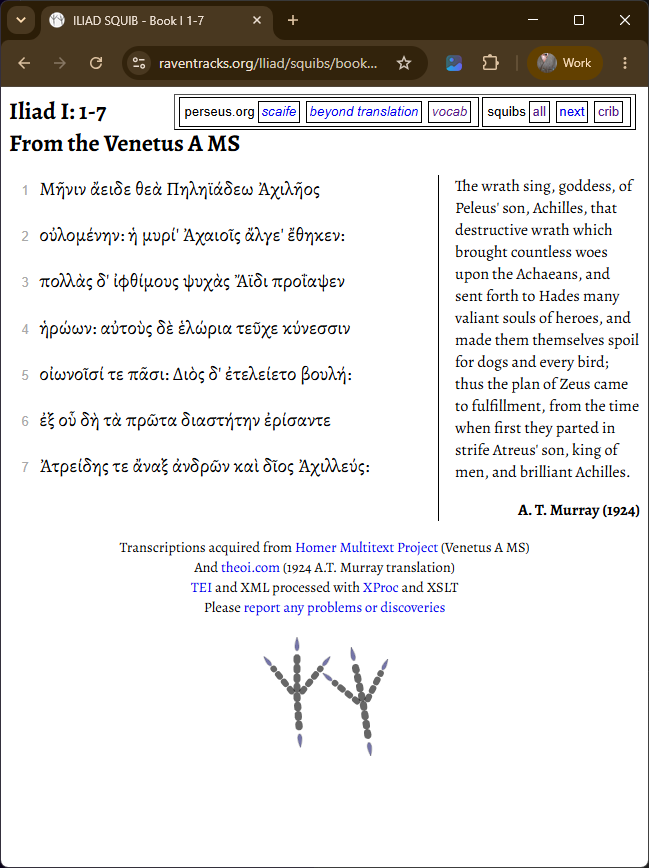
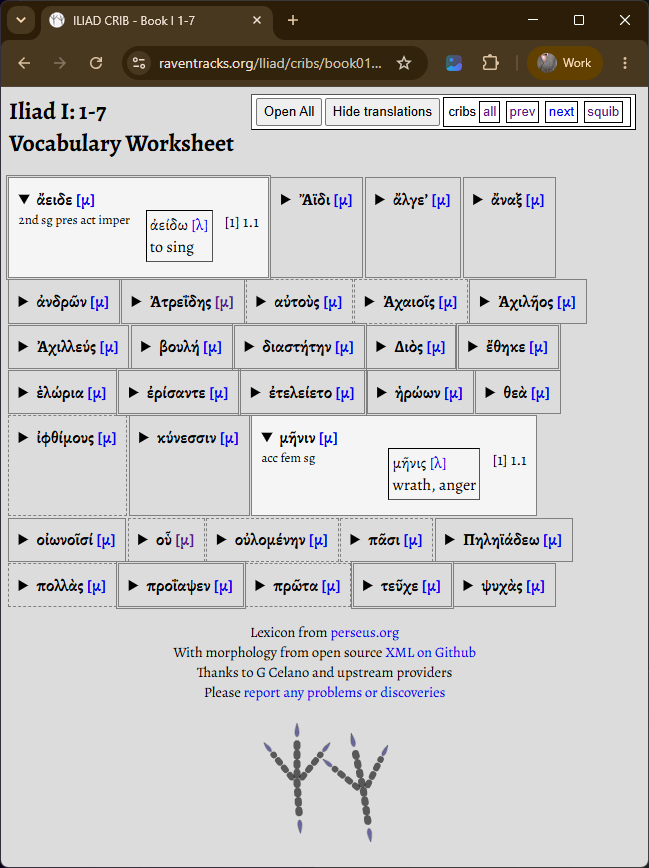
Figure 6: Raventracks pages for Scriptorium (Homer's Iliad)
Two pages on the Raventracks web site show two different aids to practicing
reading and transcribing Homer's Iliad. On the first page, an excerpt is shown with
an
English translation (in the public domain) aligned. The page can be printed to serve
as
a blank for the student to annotate and transcribe. (In my practice I
annotate on the page and then make a fair copy onto another.) The excerpts for printing
– excerpta scribenda or squibs – vary in length
following the translator's editorial decisions (in producing paragraphs). Along with
each squib is a corresponding crib which presents a running vocabulary,
that is a page of vocabulary and grammar notes that can be consulted and quizzed.
Squibs
and cribs are available covering all 24 books of the epic (1137 squibs in all, averaging
between 10 and 15 lines each).
These are two of a growing number of learning aids I am making – for the Iliad, enabled by the combination of publicly-available texts
(in many cases funded by NEH or other US Government entities) with open-source power
tools such as XSLT and XProc. Readers are invited to look at the site for more – at
time
of writing, an easy reader is under development that combines lightweight
glossing (morphology and short definitions acquired from the sources) with concordancing
of verbs, nouns and adjectives.
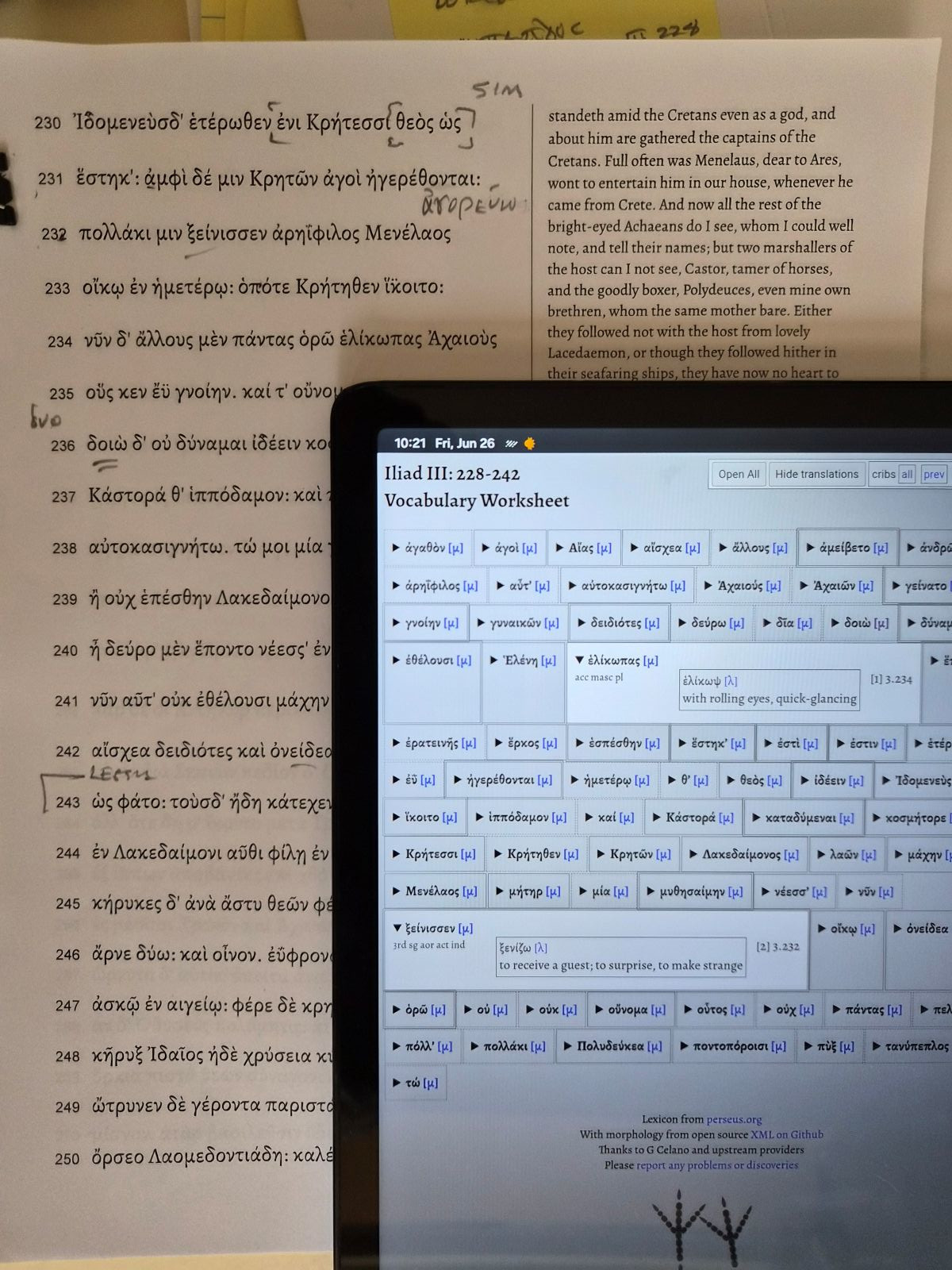
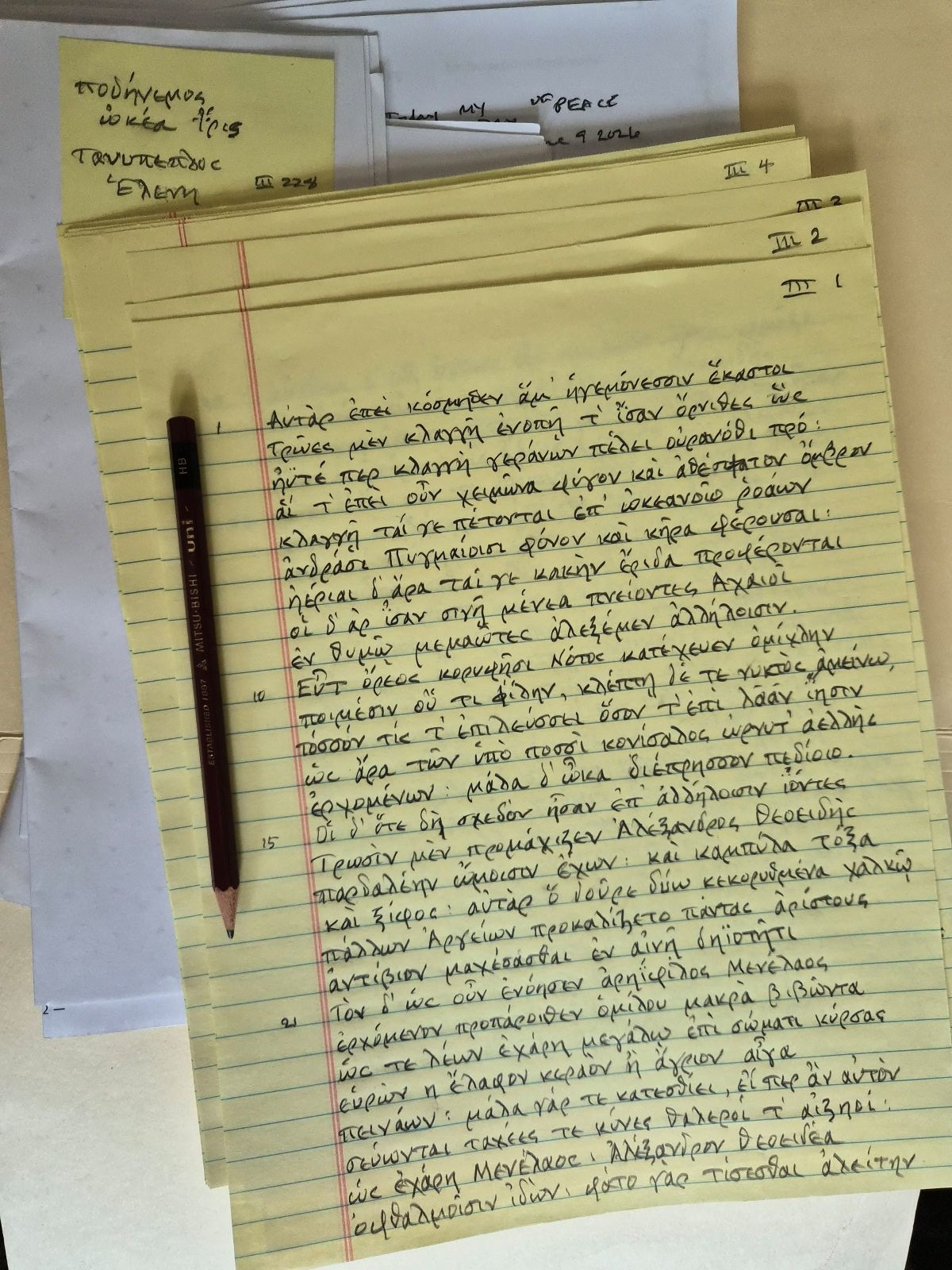
Figure 7: Scriptorium workflow
The author's Scriptorium workflow starts with printing the squib (each day brings
a
new one) and marking up the passage under study with a pencil. The markup activity
is
supported with the crib for the passage (for easy vocabulary lookup) along with any
and
all reference materials and commentaries I have to hand. Once I feel I comprehend
the
passage sufficiently well, I write it out on a yellow pad, trying to be legible enough
to read it back again.
Exploratory markup - towards an illuminated Iliad
This much can be done with XML, TEI, XSLT and XProc. Add iXML and we can also include
LMNL (or to be more precise, the MNML LMNL subset variant, defined for the Laminator).[9] At least in this, LMNL already works; it is not tomorrow's technology. A LMNL
Iliad is an easy and obvious next step to take. See some
examples here: https://github.com/wendellpiez/EpicMarkup/tree/main/data/Iliad/lmnl
The vocabulary is close to TEI with a couple of small exceptions, which can be
mapped to TEI equivalents. The important feature is that ranges can start in the middle
of other ranges, the way the scene marked to start in the middle of line 12 does not
end
for several paragraphs (and speeches).
It might be argued that we hardly need such a rewrite today; and in any case, producing
LMNL from XML can be done with a simple syntactic mapping. But overlap has always
confronted
us with a paradox: because it is tricky to deal with in XML, we have learned tricky
ways of
dealing with it. Does this make it any less tricky? LMNL might be said to isolate
and hide
the tricky part, making it simple and more straightforward as syntax, allowing operations
(such as building a tree) to happen down the line and out of sight. Parsing and handling
a
bespoke format such as LMNL can be challenging, but tools available today including
the
Laminator (with its iXML component) do more than show it can be feasible: once the
data can
be parsed into a structured representation, we are off and running.[10] There is less urgency to the project, but the limits have not really been found
either. Thus it remains enticing.
In particular, since LMNL works without a schema and the model (and syntax) permits
tagged ranges to overlap, it is an especially good tool for adding meaningful markup
to a
text even before that markup is regimented and regulated.
Even prior to LMNL, this has been part of the project. In a paper I gave many years
ago
at Extreme Markup Languages I called this approach to markup exploratory
markup.[11] Unlike its forerunner technology SGML, XML provided for documents that could be
parsed without a schema defined ahead of time – simply following the rules of its
syntax and
the important end-tag matching rule. Effectively, this meant that XML could be used
without
a schema – arguably an essential feature of the language, whether the schema done
without
was simply unavailable, or had never been written. LMNL was designed to be similar
to XML in
this way, only more so, as we had even relaxed the end-tag matching rule (a match
must occur,
but any range can be closed by and end tag, not only the most recently opened), so
overlap –
whether accidental and temporary, or logical and necessary – does not inhibit modeling,
instead becoming a feature.
Exploratory markup frames the task as an improvisation, not an enforcement action.
Instead of following rules for what to tag, we can tag anything or everything. We
aim for
consistency, but seek for a consistency that reflects and expresses the phenomena
at hand,
not a paradigm imposed from outside. When we do this comprehensively, the schema that
emerges describes the text itself, without reference to abstracted sets of rules.
The
relation of this implicit and emergent schema to related schemas, including paradigmatic
ones, would be a topic of research.
Back to editing markup in a text editor, the idea that the LMNL model (and syntax)
could
be enabling in a very practical hands-on way, was hard to shake. Even in contrast
to
now-familiar XML workarounds (and even in combination with them) this would be instructive,
and in the best way. It would teach us not only about XML, but about markup and about
our
texts.
Since we have good TEI data, making a LMNL Iliad is fairly trivial,
and even in a different syntax this will still be TEI in essence, at least arguably
or in
some sense. And once it is tagged with the barest LMNL markup, the imperative becomes
clear:
use LMNL to mark up the Iliad, overlap and all.
And there is overlap. In addition to its lines and reference structures, the Iliad
has
grammar, rhetoric (extended similes) and narrative structures, at least. These many
questions - the application of markup to narrative and rhetorical structures, irrespective
of the requirements of hierarchies – belong on yet another Github repository: https://github.com/wendellpiez/EpicMarkup. Here the goals, although open-ended, include
a number of interrelated objectives:
Test and demonstrate the Laminator to provide meaningful LMNL processing
This includes producing XML and SVG among other results
Start discovering a model for a Homeric epic, with multiple concurrent hierarchies
(MCH)
Learn about the Iliad by marking it up (in addition
to and in preparation for transcribing it)
Learn about the Iliad by developing and studying
representations of the text (such as range maps)
Produce spin-off study aids of various kinds including, but not limited to,
Raventracks Scriptorium exercise materials (squibs and cribs):
Mini Iliad (PDF): print on paper, very small, for
annotation with pencil, ink, stamps and adhesive notes
Iliad Elucidated: a streamlined reader (HTML/CSS/JS) in
your browser, for review and exploration
Variant forms of TEI and HTML with different aspects or
optimizations?
Analytical extracts? All the speeches of Achilles, Agamemnon, Zeus,
Athena....
Give forward and back where possible
Winged words
What are the lessons? At least –
It hasn't been about having or even using a graded reader, but about making one, and
about learning by making
Open data and open tools really work
(Thank you digital classicists! thank you XML, TEI, Unicode and more –)
I can join others in recommending the Scriptorium technique, for your choice of
language, literature or scripture
We have only barely started: there is more to learn about markup – and about the
works we can mark up
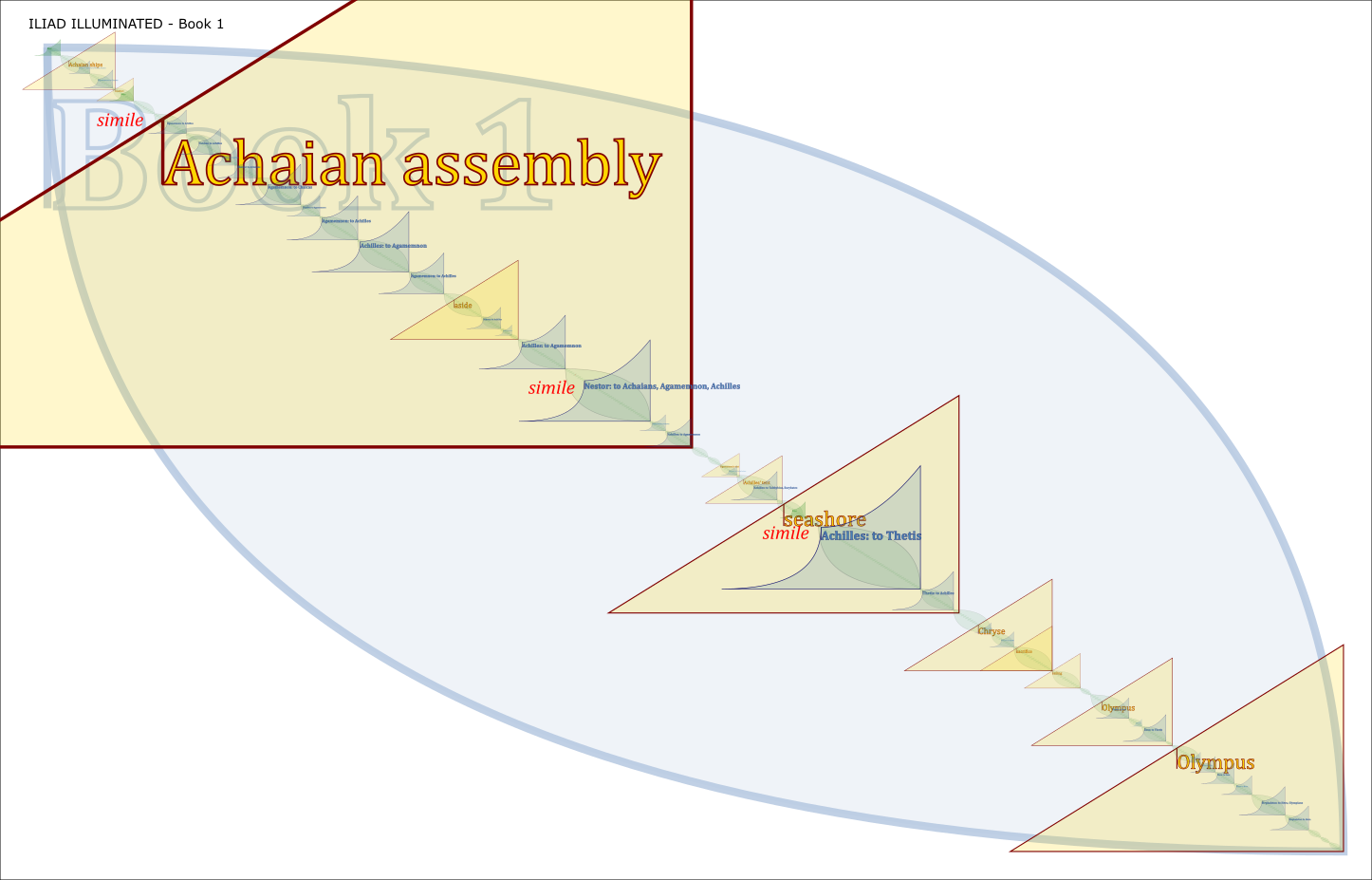
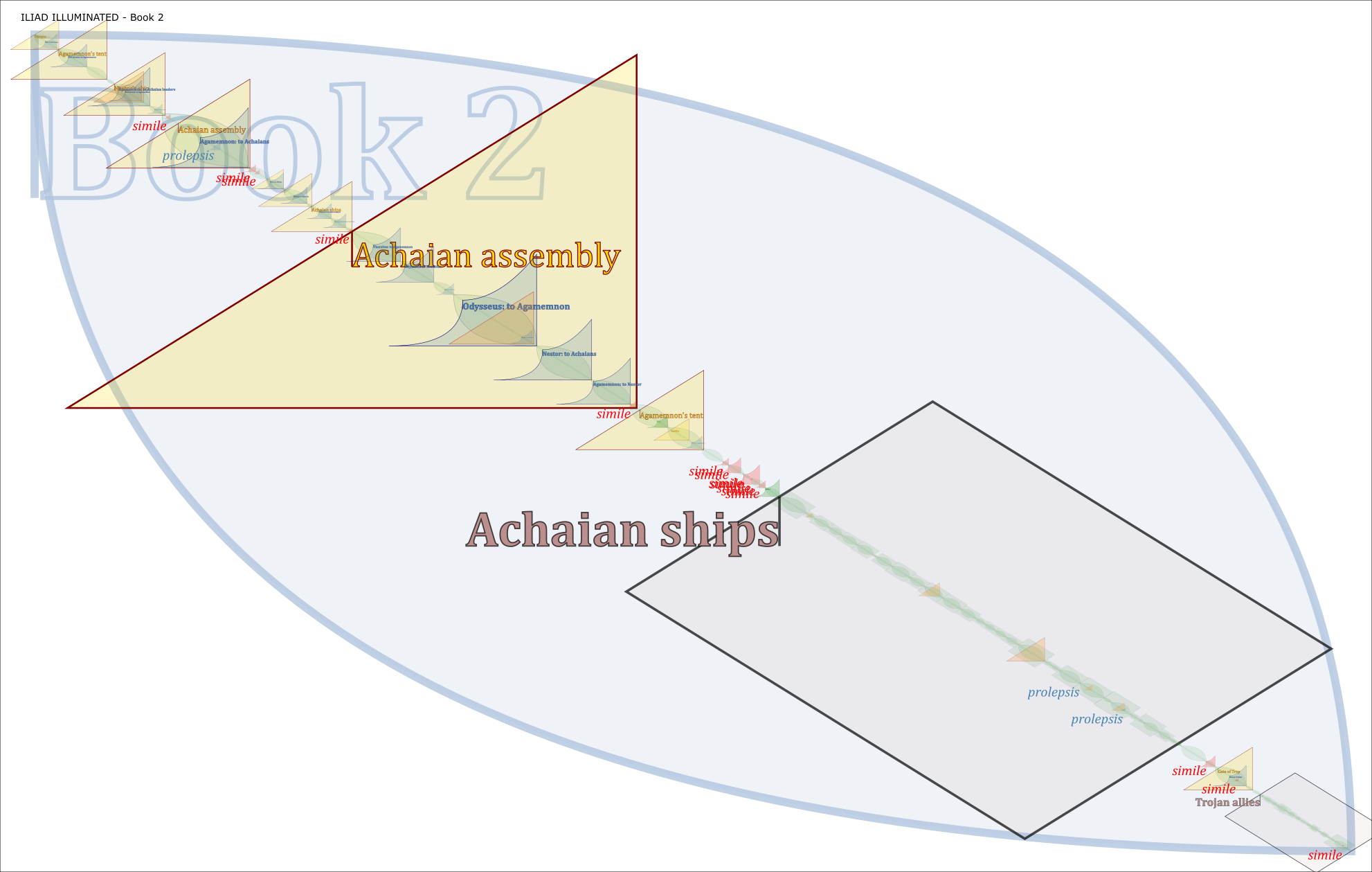
Figure 9: Range maps of Homer's Iliad
A range map depicts the extent of ranges (character subsequences) within a LMNL
document such those under development in the EpicMarkup repository. These images show
the first two books of the Iliad, out of 24 total. The shapes indicate the location
and
extent of scenes, speeches and rhetorical tropes within the text, as well as its
normal division into paragraphs (which are editorial, in this case) and
lines. As the original (not this copy) is encoded in SVG (Scalable Vector Graphics),
the
text can be magnified (or reduced) to see component structures at any level. See the
repository at https://github.com/wendellpiez/EpicMarkup/ for more information.
Acknowledgements
The work described here, as this paper tries to show, is not that of one person.
My Greek teachers in school were Thomas F. Gould and C. John Herington, who remain
an
inspiration.
The Scholia poster at ACH/ALLC 2002 became necessary when Michael Sperberg-McQueen
arranged to have me brought to Tübingen, to assist him teaching XSLT. I couldn't accept
(and
let him do all the work) with nothing serious to offer in return.
LMNL would not have existed were it not for my colleagues at Mulberry Technologies
Inc.,
along with the support of the Extreme Markup Technologies (later: Balisage) community,
especially the conspirators Jeni Tennison, John Cowan, Walter Perry and many others
who saw
what I saw and helped convince me it was real. And it could not have taken shape if
Michael,
Claus Huitfeld, Andreas Witt, Fabio Vitali and others had not also been staring at
the abyss
from whence it was born.
Just as they owe their existence to the XML-based standards mentioned and the tools
implementing them, these projects including Scholia 2026, the Laminator, EpicMarkup
and the
rest would not exist were it not for the indefatigable support and encouragement of
David
Birnbaum, Amanda Galtman and Kim Tryka.
References
Alpheios, https://alpheios.net/. Online assisted reader including Iliad
and Odyssey renditions.
Kahane, Ahuvia, Martin Mueller, Craig Berry, Bill Perod (2000). The Chicago Homer,
https://homer.library.northwestern.edu/. Pioneering assisted reader including
Iliad and Odyssey passages.
[1] With respect to Ancient Greek (specifically Homeric) studies, a partial survey is
offered in the bibliography of current digital developments, but readers will have
to
interpolate, or find, proper studies of this genre and technology. Confessedly (and
obviously) most of my own expertise is as a user and critic, not a creator or student,
notwithstanding all the assertions and claims in this paper. Fortunately, nearly anyone
who
has studied a second language in school already has a perspective of their own and
thus a
place to start.
[2] ACH and ALLC are the Association for Computers in the Humanities and the Association
for Literary and Linguistic Computing, since formerly joined as ADHO (the Alliance
of
Digital Humanities Organizations), cf. https://adho.org/. For a citation to the poster described
here, see https://dh-abstracts.library.virginia.edu/works/235.
[4] Aside: in 2026, it may seem that this kind of tool, like much else, is obsolescent,
as generative AIs and large language models (LLMs) are deployed to provide similar
kinds
of support to readers, language learners and classrooms. To this author the likelihood
seems far greater that the LLMs will require assisted readers (in some sense) of their
own – not that the promises being made for AI are empty, but that they will not have
quite the obsolescent effect being attributed to them.
[6] Indeed the Loeb Series published by Harvard University Press is now out (in 2026)
with two new volumes of Lucian, edited and with translations by Peter Thomassen, which
include a rendition of Demonax; but this was a few
months too late for me. See https://www.hup.harvard.edu/books/9780674997707.
[8] For example, since my work on the Iliad starts from an MS copy whose punctuation is
highly doubtful, my transcription freely improvises punctuation and even accent marks
-
while I also want it to be correct, and will correct my source where I find it to
be
wrong (generally having consulted other sources).
[9] In order to help make the prototype implementation feature-complete early, the
feature set for this iteration was reduced to MNML LMNL, a formal subset
of the 2001 LMNL model. While the syntax still supports overlap, structured annotations
are left for another day. Even with simple name-value pairs for annotations, MNML
LMNL
is useful, as annotations on ranges can do everything XML attributes can do for in
semantic description. See the Laminator project at https://github.com/wendellpiez/Laminator.
Kahane, Ahuvia, Martin Mueller, Craig Berry, Bill Perod (2000). The Chicago Homer,
https://homer.library.northwestern.edu/. Pioneering assisted reader including
Iliad and Odyssey passages.