Connell, Sarah, and Syd Bauman. “It's Complicated: Holistic Approaches for Considering Complexity in XML Documents.” Presented at Balisage: The Markup Conference 2026, Washington, DC, August 3 - 7, 2026. In Proceedings of Balisage: The Markup Conference 2026. Balisage Series on Markup Technologies, vol. 31 (2026). https://doi.org/10.4242/BalisageVol31.Connell01.
Balisage: The Markup Conference 2026 August 3 - 7, 2026
Balisage Paper: It’s Complicated: Holistic Approaches for Considering Complexity in XML Documents
Sarah Connell is the Associate Director of the Women
Writers Project and the NULab for Digital Humanities and
Computational Social Science at Northeastern University. Her
research focuses on text encoding and computational text
analysis, national identities in medieval and early modern
literature, and pedagogies of digital scholarship. She is the
editor of the Women Writers in Context scholarly publication
series and Co-Director of the Digital Integration Teaching
Initiative at Northeastern.
Syd Bauman became a hard-core computer user in 1982, and
a devotee of descriptive markup two years later. He began
using SGML and the TEI when he came to the Women Writers
Project in 1990. Although his title would have you believe
that he is a computer programmer, Syd is fond of pointing out
that he doesn’t write that much actual code, but usually
writes in XSLT, and his programs are always free (as in
speech). From 2001 to 2007 Syd served as North American editor
of the TEI, and is currently on the TEI Technical Council.
This paper explores the impacts of complexity on the
creation and use of XML documents, with a focus on human
experiences of complexity. In order to discuss this topic in
detail, it would be helpful to have a method of measuring
complexity, which we assert does not (yet?) exist. Furthermore,
complexity in the markup itself does not always correlate with
complexity in writing, proofing, reading, and processing the
XML — what one might call
operational complexity. Thus, measurements
of complexity that focus purely on
metrics — counting elements or attributes,
comparing the density of markup relative to textual contents,
measuring the diversity of elements used — provide
only a partial view of complexity from the perspective of the
projects and individuals using the XML. In this paper, we will
discuss some features of complexity as it impacts the sharing
and reuse of XML files, the longevity and sustainability of XML
projects, the consistency and quality of encoded texts, and the
planning and implementation of encoding projects.
A link to an updated version (or even a newer edition) of
this paper may be available on
the WWP
bibliography page.
Introduction & argument
This paper explores the impacts of complexity on the
creation and use of XML documents, with a focus on human
experiences of complexity. In order to discuss this topic in
detail, it would be helpful to have a method of measuring
complexity, which we assert does not (yet?) exist. Furthermore,
complexity in the markup itself does not always correlate with
complexity in writing, proofing, reading, and processing the
XML — what one might call
operational complexity. Thus, measurements of
complexity that focus purely on metrics — counting
elements or attributes, comparing the density of markup relative
to textual contents, measuring the diversity of elements
used — provide only a partial view of complexity
from the perspective of the projects and individuals using the
XML. For example, the Text Encoding Initiative provides an
<lb> element for marking the beginning of new
lines. Using <lb>s to encode each new line from a
printed source text might expand the number of elements in a
document by the tens of thousands, but this also makes the
document dramatically easier to proofread, navigate, and compare
with the source file. In this paper, we will discuss some features
of complexity as it impacts the sharing and reuse of XML files,
the longevity and sustainability of XML projects, the consistency
and quality of encoded texts, and the planning and implementation
of encoding projects.
While the authors must confess an interest in measuring
complexity for its own sake, increased precision around
understanding and weighing the sources of complexity faced
by XML projects is also essential for anticipating and mitigating
these. As we discuss below, it is often the case that projects can
choose to relocate complexity from one process or stage of project
development to another — for example, making the
encoding more complex in order to simplify processing, or the
reverse. Approaching such decisions strategically requires that
projects are able to: 1) recognize the full spectrum of locations
in which complexity will manifest, 2) measure (or, at least,
evaluate) those sources to determine where relocating complexity
will most impact the project’s efficiency, 3) recognize both where
complexity is unavoidable and where any processes or decisions
will lead to unnecessary complexity, and 4) iteratively
revisit the project’s processes to determine
where these may need to be adjusted. By offering a framework for
identifying sources of complexity in XML project work and
suggesting additions to syntax-based complexity metrics, this
paper hopes to offer some considerations that will be useful to
XML project planning and discussions around understanding
complexity in XML work.
As C. M. Sperberg-McQueen argues in his closing keynote from
Balisage 2021, complexity is an issue that most XML projects need
to address. Sperberg-McQueen writes:
There is more than one subjective notion of simplicity and
more than one subjective notion of complexity. But however we
perceive it and however the users of the systems we build
perceive it, we need to deal with complexity. We need to control
it. We need to find ways to minimize it.
Sperberg-McQueen outlines several approaches to minimizing
complexity, which include reducing functionality or generality,
drawing boundaries around a project’s areas of focus, using
abstractions to mask complexity, delegating particularly thorny
aspects of a project’s workflow, and improving both the markup
itself and the abstractions used to apply that markup. We wish to
extend on Sperberg-McQueen’s insights to provide some frameworks
for measuring the different forms of complexity that impact work
with XML, with particular attention to the ways that complexity
in the perspective of humans writing and interacting with XML
diverges from complexity in the perspective of computers
processing XML.
This paper is far from the first to consider the ways that
complexity in XML documents and schemas can be measured. Numerous
studies, especially in the computer sciences, have offered metrics
for evaluating XML complexity. For instance, Ruellan (2012) offers a comprehensive formal study of
the quantity of information contained in XML documents,
classifying XML complexity according to three metrics:
Size
measured according to the size in bytes of the XML document’s serialization,
Information density
measured as as the ratio between the content size and the size, in bytes,
of the XML document, and
Structure regularity
computed by taking one minus the ratio of the total number of distinct elements over the total
number of elements in the XML document.
(Ruellan (2012))
These are eminently reasonable ways to begin taking stock of XML
complexity, especially if one is interested in storing or
processing XML files. And, indeed, other studies have offered
similar methods for XML complexity metrics that rely on counting
elements and attributes, measuring the diversity of elements and
attributes used, calculating the depth of the markup, comparing
proportions of markup and content, and so on.
In this paper, we will refer to such metrics as
syntactic complexity. In no way do we wish to
suggest that syntax is not useful for understanding the impacts
of complexity on work with XML files; indeed, we offer several of
our own approaches for measuring a wide variety of syntactic
features. However, we wish to expand upon syntactic metrics to
explore several other sites of complexity in XML workflows,
including the semantics of the markup, the ways that markup is
edited and processed, and the lifecycles of XML files. As might be
clear already, this paper is situated within our own perspective
of working with XML files primarily in the context of digital
humanities projects. We think that this perspective is
generalizable enough to be relevant in
many — although, of course, not
all — other applications. We offer this framework as
a resource for continued work on studying the impacts of
complexity on the use and sustainability of XML files.
We locate several sources of complexity within XML files and
related systems. These include measures that evaluate XML files
directly:
Syntactic complexity
as measured by counting and comparing XML
structures. Syntactic complexity may be evaluated through
raw counts or through “fuzzy” measures that take into
account the idea that some elements and the phenomena they
formalize are inherently more complex than others.
Semantic complexity
as measured by considering how difficult XML files are
to understand. That is, semantic complexity takes into account the
idea that information formalized through
markup might be complex or deeply theorized, even if it is
expressed through a small number of elements or otherwise simple encoding.
We also locate several other sites at which complexity impacts the
systems used to create and process XML files (again, with a focus
on the humans interacting with the XML). These include:
Processing complexity
complexity that becomes evident when XML files are
processed. As we discuss, there are often significant
differences between how complex XML is to write and how
complex XML is to process.
Application complexity
complexity that is not inherent to the markup
itself but instead manifests in the human languages to which
the markup is applied. Here, we include any features that
demand extensive documentation to ensure that
encoding remains consistent.
Version complexity
complexity within a document’s version history. Here,
we examine complexity that is external to the XML but that
can significantly impact the creation and use of encoded
files, since even very simple files may have complex version
histories.
Schemas are another essential site for understanding XML
complexity, as examined in several previous
studies.[1] In considering schema complexity, we discuss complexity within
schemas themselves; we also look at several ways that schemas
impact operational complexity. And finally, we locate complexity
within the minds of the humans writing and
interacting with XML files. Relevant to the human element of
complexity in XML is what we call visual
complexity, as experienced due to the appearance and layout
of the markup. This is a space where humans and computers can
diverge dramatically, since features such as indentation and
whitespace can strongly impact complexity as perceived by
humans.
Having outlined our approaches to understanding and
beginning to measure complexity, we offer two brief case studies
that reveal further complications that emerge through the
intersection of human activities and XML
syntax. Here — again, starting from the perspective
of digital humanities project work — we think about
ways that XML files can become complicated in terms of being
difficult to work with, with attention to
cases in which the things that make XML files challenging do not
correlate with the obvious forms of syntactic complexity. First,
we consider the usage of “renditional defaults” in TEI files. From
some perspectives, renditional defaults make TEI files
dramatically simpler, since they can reduce the number of
attributes specifying rendition for individual elements by the
tens of thousands. However, renditional defaults have a dramatic
impact on operational complexity, since they mean that encoders
must remember to override them where necessary, proofreaders need
to keep them in mind when reading encoded files, and systems for
processing the encoded files must take into account the fact that
rendition might be specified locally or through defaults.
And second, we consider the use of
sequence vs. containment
as information storage methods with respect to complexity,
positing that neither is particularly complicated on its own, but
that mixing the two may increase complexity without any obvious
benefit.
As the above indicates, this paper is deeply invested in
seeking to understand where complexity is located within XML
systems. This goal requires that we also address how complexity is
defined. As with its measurement, the definition of complexity has
received considerable scholarly attention; a thoughtful and
comprehensive overview of this work can be found in a recent
article by Beale, Dazzi, & Tryfonas (2024).[2] This
article characterizes the definition of complexity as
“contentious,” outlining sources and usages of several definitions
before offering the following definition, based on the authors’
analysis of usage insights: “complex(ity) is when relationships
between elements are weaved together such that they are not fully
comprehended, leading to insufficient certainty between cause and
effect” (Beale, Dazzi, & Tryfonas (2024)). The relationship between “complicated” and “complex” is
also an important definitional touchpoint: as Beale et
al. explain, the majority of dictionaries treat these terms as
synonyms, reflecting their most widespread usages, while
complexity theory treats the two terms as fundamentally
distinct. The precise difference between “complex” and
“complicated” is yet another space where there is considerable
divergence of thought — generally, systems or processes can be
described as complicated whenever they possess many components,
while there is a higher threshold for ascribing complexity,
usually involving unpredictability or a whole that cannot be
comprehended by examining its parts. Another useful framework for
distinguishing these terms is published in the “Complex Systems
Frameworks Collection” by Diane Finegold (Finegold (2022)). Here, complicated systems are described as
predictable, controllable, and designable (that is, possible to
design around). Complex systems, by contrast, are inherently
unpredictable, heterogeneous, non-linear, and with interdependent
parts that impact each other’s behavior.
These distinctions can be useful in recognizing which
strategies will work best to manage any aspects of a project,
whether complex or complicated, that are not conveniently
simple. That said, in the authors’ experiences, complexity and
complication exist on a spectrum — for the individuals working on a
project, anything that becomes complicated enough will also be
complex to work with. Our primary goal for this paper is to locate
and assess the complexities that are experienced in XML project
work so that these can be better anticipated and managed. Thus,
for us, the most important meaning of “complexity” would be the
one used and experienced by the individuals designing and
implementing XML projects. In the discussions that follow, we
treat complex systems as ones involving multiple component parts
that interact in ways that are difficult to predict. Since we
recognize that so much of the direct experience of complexity
is perspectival — given that one project’s
“complicated” will be another project’s “complex” — we use the term
“complex” when it seems likely that the phenomenon under
discussion might be either complex or complicated, depending on the
circumstances. We reserve the term “complicated” for situations in
which it seems clear that the features under discussion are only
complicated.
If we may be forgiven the potential tautology, this paper
argues that complexity is complicated — complexity itself comprises
many individual components. Here, we wish to expand our understanding of XML complexity
by thinking
seriously about how these various components interact. Despite our
interest in measurement, we are keenly aware that there is no
single “yardstick” that can be used to quantify
complexity — as Sperberg-McQueen notes, “complexity
is sometimes in the eye of the beholder” (Sperberg-McQueen (2021)). The weight and impacts of complexity will
depend on the XML, the person reading the XML, the data, the needs
of the project, and so on. Nevertheless, we think that having more
precise vocabularies for describing complexity — in
addition to more detailed understandings of how these different
forms of complexity interact with human work — can
only help. This paper is an effort to begin developing such
vocabularies and understandings.
Locations of complexity
In the XML instance
We find complexity (and simplicity, but that’s not
important right now) in various places in our lives in general,
and in our XML in particular. The first “complexity” that most
of us think of is the syntactic complexity of the XML instance
itself. This notion is supported by the fact that all of the
prior work we discovered in a literature review of XML complexity
metrics was about the complexity of XML instances.
Syntactic
But we submit that, even when only talking about
syntactic complexity — which should be the
easiest to define — that we (at least we, the
authors, if not we, the entire XML community) do not know what
makes an XML instance more or less complex. Nonetheless, there
is no doubt that some documents are simple:
And there is very little, if any, doubt that some are
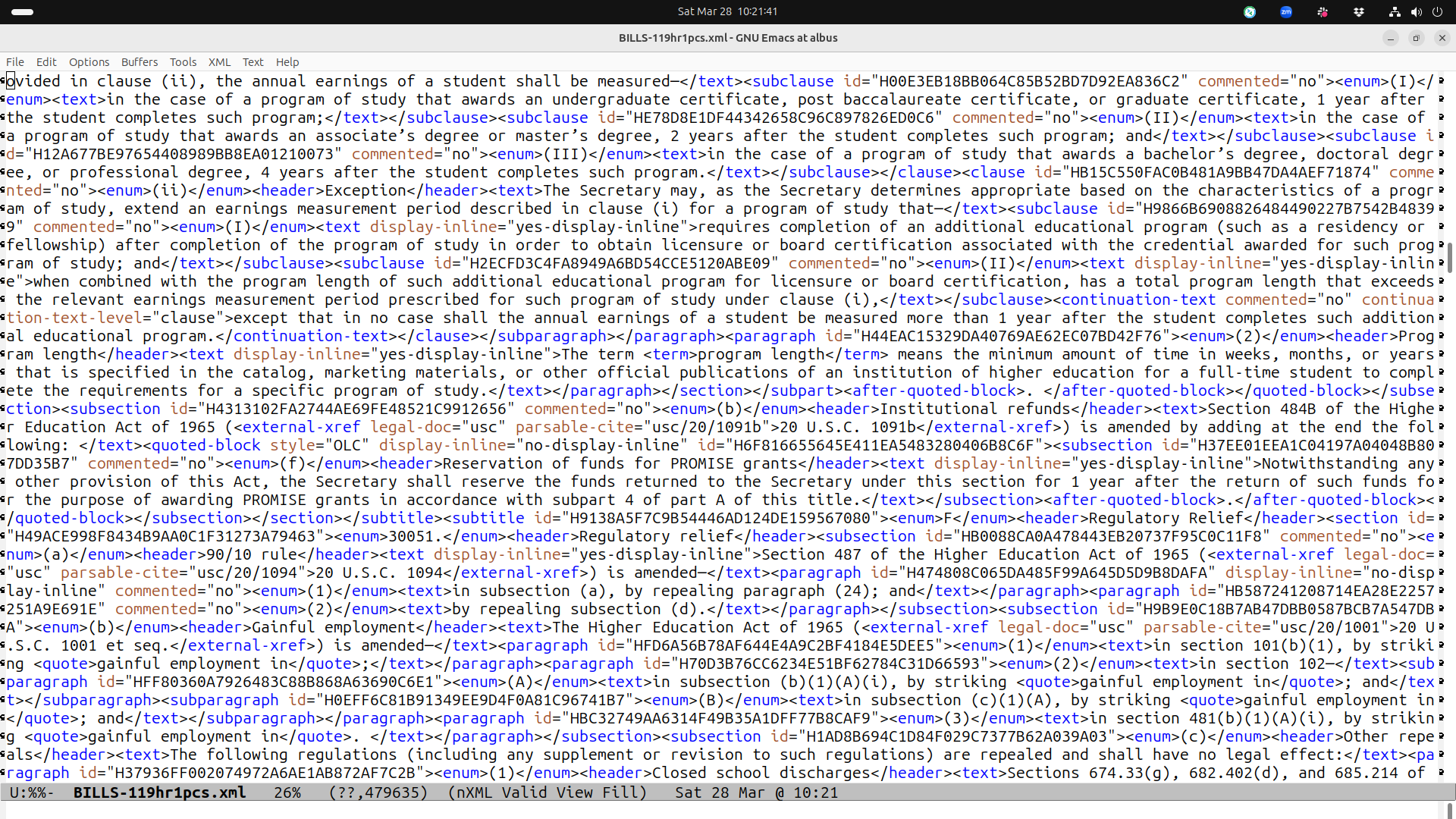
complex — see figure BHB1.
BHB1
A screenshot of ~6,120 characters worth of a single line
of XML (being edited in Emacs/nxml-mode on Ubuntu). It
contains 86 start-tags, 91 end-tags, and 50 attributes.[3]
What is not clear is whether or not there is any
agreement as to which ones are complex, or what contributes to
complexity. But “I know it when I see it” à la US Supreme Court
Justice Potter Stewart is not helpful with respect to
automated complexity detection, and is, to our knowledge,
completely untested. That is, no one has heretofore determined
either that human perception of complexity matches any
particular metric of syntactic complexity, or even measured
inter-reviewer reliability of complexity detection in
XML.
Raw counts
Which begs the question: where might we look for
metrics of syntactic complexity? Simple raw counts of
syntactic structures may well be helpful, and are easy to
produce. These raw counts could include (but are not even
close to limited to) things like the following.
The ratio of element instances to the number of characters in the file
The ratio of element instances to the number of characters in text nodes
The ratio of element instances to the number of characters in text nodes other than
whitespace-only text nodes
The ratio of element types to element instances (which, when subtracted from 1, is
what Ruellan calls “structure regularity”)
The ratio of attributes to element instances
The average length of attribute values
The average and maximum nesting depth of elements (the minimum is not interesting,
it is ‘1’ :-)
Note that we are often using ratios and averages of
simple raw counts, rather than the counts themselves, in an
attempt to reflect our intuition that filesize itself does
not contribute to complexity.
It is our instinct (so far without evidence) that no
single simple raw count, average, or ratio will effectively
represent what humans perceive as syntactic complexity, but
that some combination of a few of these may.
Fuzzy counts
By “fuzzy counts” we do not mean counts that are not
precise, but rather precise counts of less rigid
phenomena. One big problem with the simple raw counts of
precise syntactical structures is that it does not take into
account even the syntactic complexity, let alone the
semantic complexity, of some element types vs others. For
starters, those syntactic structures that are used to handle
overlap problems (e.g., the TEI’s @next &
@prev attributes) lend significant complexity
to an instance, in that the data needs to be represented as
or at least considered as more than a single simple tree
structure.
Consider the TEI <g> element; its name
is short for “gaiji” or “外字”, meaning (for our purposes) a
character that is not available in Unicode. It is in many
ways parallel to the <c> (for character)
element, but rather than contain as content a Unicode
character, it points via an attribute to an XML structure
that describes a character. This adds some semantic
complexity, sure; but just syntactically speaking, does a
<g> element count as zero characters of
content (because it is empty), one character (because it
represents one character), or however many characters are
used to describe the one character?
If you are counting words in a document, how do you
account for an acrostic? I.e., does the following have five
words or six?
It is worth noting that syntactic complexity does not
necessarily imply semantic complexity. It is not unusual
when using a major tagset like JATS, DocBook, or TEI to find
cases for which it takes quite a bit of XML syntax to
represent relatively straightforward concepts. E.g., when
encoding the libretto
for The Phantom of the Opera in TEI if one wishes to
indicate that the first letter sent by the Phantom is, in
fact, a letter, one may end up with:
  <sp who="#and">
    <speaker>ANDRE</speaker>
    <quote>
      <floatingText type="letter">
        <body>
          <salute>Dear Andre</salute>
          <l>what a charming gala!</l>
          <l>Christine enjoyed a great success!</l>
          <l>We were hardly bereft</l>
          <l>when Carlotta left</l>
          <l>otherwise</l>
          <l>the chorus was entrancing,</l>
          <l>but the dancing was a</l>
          <l>lamentable mess!</l>
        </body>
      </floatingText>
    </quote>
  </sp>
No doubt many will find it at least annoying, if not
problematic, that the assertion “he (the character) is
reading a letter” requires encoding an extra three levels
deep.
As another example, in a sample
article published on the NLM website we find:
  <p>We report on … 14 relevant papers.
    <boxed-text>
      <sec>
        <title>Summary points</title>
        <p>
          <list list-type="bullet">
            <list-item>
              <p>Longer consultations are … better patient outcomes</p>
            </list-item>
            <!-- ... -->
            <list-item>
              <p>Research on implementation is needed</p>
            </list-item>
          </list>
        </p>
      </sec>
    </boxed-text>
  </p>
Here text is encoded six levels deep to indicate a list
item that is in a separate box.
Semantic complexity
Syntax is not the only site of complexity within XML
documents — semantic complexity also has a significant impact on
writing and working with XML. These two forms of complexity
often operate independently; as we saw above, simple concepts
may require quite deep nesting. The reverse is also true — the
meaning expressed through markup might itself be complex or
deeply theoretical even if the encoding at stake is
straightforward. For instance, the Women Writers Project, a
longstanding TEI project focused on early women’s writing, uses
a custom <hyperDiv> element to contain features
that the WWP has identified as hypertextual.[4] These include
annotations, names spelled out in acrostic poems, “invented”
cast lists (for characters who speak within a drama but are not
included in the play’s printed cast list), and other phenomena that
operate hypertextually. <hyperDiv> is a single
element with a restricted set of permitted contents,[5] but it represents the WWP’s very particular theory of how texts
function as developed over decades of encoding pre-Victorian
women’s writing. <hyperDiv> may not add much to
the syntactic complexity of a document, but the semantic
complexity expressed through this theory of how texts function
is quite substantial.
Semantic complexity impacts XML project work because of
the time needed both to develop and to apply semantically rich
encoding practices. For example, the WWP collaborates with
editors Noelle A. Baker and Sandra Petrulionis on encoding the
Almanacks of Mary Moody Emerson for publication within the Women
Writers Online collection. Among the features represented in the
XML are Emerson’s famously capacious inclusions of other
authors’ language within her commonplace Almanacks. Most of
these are encoded with a custom <itg>
(“intertextual gesture”) element, with greater specificity
provided through the @type attribute. In cases
where Emerson hews more closely to her source language,
<quote> and @type are used
instead. @source is also used to indicate the
source of the referenced text.[6]
The encoding at stake is relatively simple; each instance requires only one element
and two attributes. For example:
<itg type="dialogic_reference" source="mb:Fellowes_Picture">These
<choice><abbr>tho’ts</abbr><expan>thoughts</expan></choice> have passed my
<lb/>own mind in much the same connection.</itg>
However, the nuance and the critical interpretation of Emerson’s
commonplacing practices being expressed through this encoding is
much more significant. Some values used by the project include:[7]
allusion
An implied or indirect, but deliberate, reference to another text
dialogic reference
Dialogue or direct address to authors or source material, or commentary on both in
the form of debate, argument, or pondering/musing; or placement of authors in dialogue
with each other
distillation
A synthesis of materials from a text or set of texts; may include direct quotation
paraphrase
A summary or representation of the meaning and content of material from another text
that may or may not include some direct quotation of the original language
reference
A mention, typically brief, of material from another text
repurposing
A representation of material from another text that deliberately changes the meaning
of the original
As the list above suggests, this encoding draws quite fine
distinctions among the different ways that Emerson weaves the
ideas and writing of others into her Almanacks. Application of
this encoding is only possible after considerable research on
the parts of the editors, with careful comparison between
Emerson’s Almanacks and the language in her (many) sources. With
two elements and a @type attribute, this markup
expresses a semantically rich reading of Emerson’s multivalent
commonplacing practices. The simplicity of the syntax for this
encoding belies the rich editorial expertise that was necessary
to develop and apply this list of values.
Of course, it is also possible for syntactic and semantic
complexity to appear in tandem — our point here is that one is not
a predictor for the other. Perhaps the simplest way to
demonstrate this insight is to consider the possibility that the
same meaning might be expressed with completely different
markup. For instance, it is generally agreed that
<msg level="error" code="XTTE0570" text="An empty sequence is not allowed as the value of variable $fn"/>
is semantically precisely the same as
  <msg>
    <level>error</error>
    <code>XTTE0570</code>
    <text>An empty sequence is not allowed as the value of variable $fn</text>
  </msg>
Any measure of syntactic complexity that focuses on counting
elements will find that the second example is more complex,
since it uses four elements instead of one to express the same
meaning. Along the same lines, the TEI element
<placeName> means the same thing as the
<name> element with a value of place on
@type. The things that make
<placeName> harder or easier for an encoder to
understand are separate from the things that impact how long it
will take an encoder to type <placeName> or to
type <name> and add a @type
attribute and value. The syntactic complexity does change,
depending on which option is used, but the semantic complexity
stays the same.
For the kinds of complexity we are interested
in — those that impact human work on XML
projects — it is helpful to keep both semantic and
syntactic complexity firmly in view. Moreover, we can broaden
our view even further and consider the systems that surround XML
documents. The next section discusses complexity within the
processing, application, and versioning of XML files.
In the schema
Schemas, of course, can both be complex (or not) themselves,
may describe complex (or simple) XML languages, and may claim as
valid various simple and complex instances. And it is not
necessarily the case that simple schemas describe simple languages
or that complex schemas describe complex languages, although both
of those scenarios are not just possible, but outright likely.
But here is a demonstration of the opposite. Consider the
following schema (represented in RELAX NG compact syntax):
zero_or_more_in_alternation = ( a | b | c | d | e | f | g | h | i | j )*
start = element confusing { zero_or_more_in_alternation }
a = element a { zero_or_more_in_alternation }
b = element b { zero_or_more_in_alternation }
c = element c { zero_or_more_in_alternation }
d = element d { zero_or_more_in_alternation }
e = element e { zero_or_more_in_alternation }
f = element f { zero_or_more_in_alternation }
g = element g { zero_or_more_in_alternation }
h = element h { zero_or_more_in_alternation }
i = element i { zero_or_more_in_alternation }
j = element j { zero_or_more_in_alternation }
That’s a pretty simple schema. Only 11 patterns defined, and only
two different content models (although one of them appears 10
times). But (presuming different semantics are applied to each of
the elements) it can result in extremely complicated valid instances:
It is interesting to consider the case of a schema expressed
in XML (e.g., RELAX NG or XSD; or XML-Data, XDR, DCD, SOX, XDUCE,
TREX, etc.; or even Schematron or X-Definition, we
suppose) — does measuring any of the “simple” counts
or averages tell us anything about the complexity of either the
schema or the instances that conform to it? We suspect the answer
is that while there is some loose correlation, there is no cause and
effect relationship. However, we do not investigate this question
further in this paper.
A schema may also make things more complex by defining two
different syntactic structures that convey the same
semantics. Many languages, for example, allow either an attribute
or a child element for the same concept (The ant
build.xml file allows this often, but as far as we can tell there
is no schema for it.) For example, in TEI a person’s name might be
encoded using an <rs>, a <name>,
or a <persName> element. While there are
advantages to this flexibility, it adds complexity to the schema
itself and to any generic processor.
Tommie Usdin hit this particular nail on the head in 2002:
I remember a table model … that allowed users to model a
table as either a series of rows that contained cells
(implicitly creating columns) or as a series of columns which
contained cells (implicitly creating rows). … the specification
… allowed either encoding because they were logically equivalent
and there was no rational reason to require people to use one or
the other. From either encoding the same matrix could be
constructed for display or computation and the guidelines did
not want to be unnecessarily restrictive. … So this meant that I
could receive the same data in dramatically different sequences
and had to know that it was the same. This meant that there were
not guidelines on which to use, and that tools that were to
read, process, even compare document content had to be very
complex. This was not cool. It was putting an unreasonable
burden on text encoders (deciding which orientation to use
without guidance) and an onerous burden on those intending to
receive content from several sources and re-use it.
It is worth noting that human schema authors will often put
effort into making their schemas less complex, sometimes even at
the expense of allowing the schema to be somewhat looser or
stricter than would be preferred. Thus there is often a trade-off
between complexity in the schema vs the risk of complexity in the
instances.
On the other hand, schemas generated by software, at least
those generated by current software systems like the TEI’s
oddbyexample or oXygen’s Generate/Convert Schema, tend to be more
complicated than that which a human author would generate. Whether
the valid instances described by such a generated schema may be
more complex than desired or not is in large part a function of
the desired complexity.
Extreme schemas
Consider the following encoding of a poem, a mild
simplification of that which we frequently use in our introduction
to encoding classes:
<?xml version="1.0" encoding="UTF-8"?>
<lg type="limerick" rhyme="aabba" n="3">
  <head>Warp Speed, Ms Bright!</head>
  <l>There was a young lady named Bright,</l>
  <l>Who travelled much faster than light,</l>
  <l>She departed one day,</l>
  <l>In a <term xml:id="t17">relative</term> way,</l>
  <l>And returned on the previous night.</l>
  <note target="#t17">See
    <ptr target="http://en.wikipedia.org/wiki/Theory_of_relativity"/>.</note>
</lg>
Given the task “write a RELAX NG (compact syntax) schema that
validates this poem”, one can easily imagine that a human might
write a schema that would validate the above document or any
similar document, i.e., one that contained a limerick preceded
by a heading or title, either of which might contain technical
terms glossed with footnotes, and for which the rhyme scheme may
be encoded explicitly, etc. For a sample of one such, see limerick schema 1.
But similarly, one can imagine that either a human or
software program might generate a schema that would accept as
valid any XML file that used any combination of
<head>, <lg> (line group),
<l> (metrical line), <term>,
<note>, and <ptr> elements, each
which may have none or all of @label,
@n, @rhyme, @target,
@type, or @xml:id. For a sample of
such, see limerick schema 2. Such a
schema is not much better than useless for a project trying to
encode poetry.
Conversely one can imagine that either a human or software
program might generate a schema that would accept as valid
pretty much only the sample document. For a sample of such, see
limerick schema 3. We believe such a
“1-document” schema is utterly useless for a project trying to
encode limericks, as evidenced by the lack of them in
existence.
limerick schema 1: Reasonable
start = lg
lg = element lg {
  attr.type?,
  attr.rhyme?,
  attr.n?,
  head?,
  l, l, l, l, l,
  note*
  }
attr.type = attribute type { token }
attr.rhyme = attribute rhyme { token }
attr.n = attribute n { xsd:nonNegativeInteger }
head = element head { stuff }
l = element l { stuff }
term = element term { text }
ptr = element ptr { target, empty }
note = element note {
  target,
  stuff
  }
target = attribute target { xsd:anyURI }
stuff = ( text | term | note | ptr )*
An at least somewhat reasonable schema for limericks
limerick schema 2: Extremely loose
start = lg
lg =     element lg    { attrs, ( text | lg | head | l | term | note | ptr )* }
head =   element head  { attrs, ( text | lg | head | l | term | note | ptr )* }
l =      element l     { attrs, ( text | lg | head | l | term | note | ptr )* }
rhyme =  element rhyme { attrs, ( text | lg | head | l | term | note | ptr )* }
term =   element term  { attrs, ( text | lg | head | l | term | note | ptr )* }
note =   element note  { attrs, ( text | lg | head | l | term | note | ptr )* }
ptr =    element ptr   { attrs, ( text | lg | head | l | term | note | ptr )* }
attrs = ( attr.type, attr.rhyme, attr.n, attr.target )
attr.target = attribute target { text }?
attr.type =   attribute type   { text }?
attr.rhyme =  attribute rhyme  { text }?
attr.n =      attribute n      { text }?
An extremely loose schema against which the sample
limerick, and all sorts of bizarre encoding, is valid
limerick schema 3: Extremely strict
start =
  element lg {
    attribute type { "limerick" },
    attribute rhyme { "aabba" },
    attribute n { "3" },
    element head { "Warp Speed, Ms Bright!" },
    element l { "There was a young lady named Bright," },
    element l { "Who travelled much faster than light," },
    element l { "She departed one day," },
    element l {
      mixed {
        element term {
          attribute xml:id { "t17" },
          "relative"
        }
      }
    },
    element l { "And returned on the previous night." },
    element note {
      attribute target { "#t17" },
      mixed {
        element ptr {
          attribute target {
            "http://en.wikipedia.org/wiki/Theory_of_relativity"
          }
        }
      }
    }
  }
An extremely strict schema for the given limerick
In the system
Processing complexity
In many cases markup that is syntactically simple can be
quite difficult to process. Soft hyphens, for example, are not
particularly difficult for humans to mentally process, and are
very easy to encode. But to resolve them while leaving
surrounding markup intact is extraordinarily difficult (Bauman (2016)).
In many cases, markup is deliberately made more complicated
in order to diminish the complexity of processing. Consider the
simple case of transcribed dates. While providing a standardized
version of the date in the encoding makes the encoding more
complicated, it can make processing much easier, or, in cases of
ambiguity, possible.
Here, the use of the TEI @when attribute
means that a processor which needs to, say, sort dates or put
them on a timeline does not have to be able to parse both of the
formats that Catherine Williams uses in a single paragraph of
her Biography of Revolutionary Heroes:
<p>The first wife of <persName>Captain Olney</persName>, and mother of
  <lb/>his children, died on
  <date when="1813-12-13">13th of <name>December</name> 1813</date>.
  …
  On <date when="1830-03-25"><name>March</name> 25th,
  <lb/>1830</date>, he addressed the following letter to … </p>
While we concede that it is not all that difficult write
code that differentiates between those two formats and will
parse either, the point is that a) a small increase in
complexity of the XML can significantly decrease complexity of
the processor, and, more importantly b) this added complexity
also resolves any ambiguity. E.g., “3/4/1797” is ambiguous: it
might indicate 04 March 1797, when George Washington peacefully
relinquished his role as the first President of the United
States to John Adams, ushering in a 223¾-year span of peaceful
transfer of power in the USA; or it might indicate 03 April
1797, when in a letter to James McHenry he wrote “We get so many
details in the Gazettes, and of such different complexions, that
it is impossible to know what credence to give to any of
them.”
Sometimes the reverse is the case, though: XML users
sometimes tolerate or place heavy burdens on the processing in
order to keep the markup simple. We think of the
@select attribute of XSLT as a marvelous
example. Consider <xsl:sequence select="if ( $title eq
'') then string-join( distinct-values(
rdf:Description/System:Directory ), ', ') else translate(
$title, '_',' ')"/> The syntax of the XML is dead
simple: an empty element (in a particular namespace) with one
attribute (in no namespace). All the complexity is inside the
one attribute. XSLT did not have to be designed that way; it
could have been designed to minimize the work needed to parse
and thus process the XPath, at the cost of adding complexity to
the XML structures used:
We consider it a good thing that it was designed the way it
was.
Another example of shifting the burden of complexity to
processing is a project that permits the content of
<persName> to be in either “surname, given_name”
order or “given_name surname” order. This may make life easier
for the encoder, but now requires processors to figure out and
parse the format.
In TEI P5 the elements used to mark cases in which an
addition or deletion, damage to the writing surface, or any one
of various other manuscript interventions span across other XML
hierarchical boundaries use a @spanTo attribute on
an empty element (e.g., <delSpan
spanTo="#del03end"/>) to point to the end of the
feature. But the element pointed to can be any element, most
commonly an <anchor>. This may make less work
for an encoder, but it also makes work for the proofreader a bit harder,
makes work for the processor that is dealing with the overlap problem
from the start of the overlapping virtual element mildly more
difficult, and makes it very difficult for a processor to work
on an overlap problem from the end of the overlapping virtual
element. (This becomes more readily apparent when you consider
that the portion of XML being handed to the processor may not be
the entire document.)
One way to look at complexity of markup within a processing ecosystem is to (arbitrarily,
we admit) divide both into high and low, for lack of a better word, “precision”. More
precise markup not only chops the text up into smaller bits, but also asserts what
those bits are, semantically. Less precise markup leaves more parsing and semantic
creativity to the processing. So, for example,
<l>Whil'<choice><sic>f</sic><corr>ſ</corr></choice>t the fair Nymphs Eyes apace</l>
is quite precise, whereas
<l><choice><sic>Whil'ft</sic><corr>Whil'ſt</corr></choice> the fair Nymphs Eyes apace</l>
is somewhat less precise. The former may be a bit harder on the
encoder and is certainly harder on the proofreader. For a
processor that is counting the total number of words with errors
in a text, or always printing only the corrected version, it
does not matter which encoding is used; the level of complexity
of the processing is roughly the same. But if your processor is
trying to figure out how many letters were in error in the
source, the latter is much harder to process.
It is our assertion that, with exceptions, and presuming
that the desired processing matches the encoding, the following
table represents the general case.
Table I
desired processing ⇒ markup ⇓
low precision
high precision
low precision
simple
complex
high precision
complicated by the need to strip some encoding
(which, in some rare cases, is very
difficult; e.g., the aforementioned soft hyphens)
simple
Another example of low precision encoding occurs within
the TEI with its teidata.authority datatype. The value of this
datatype may be either a) any URI that does not contain a space,
or b) a single string composed of one or more characters other
than those with a Unicode property of Space or Other. If the
value is a URI it is a pointer that should be followed, and if
it is a string its meaning should be defined in the TEI
customization. But since the only characters allowed in a URI
are the digits 0–9, the letters A–Z
and a–z, and the characters
:?#/+-.@_~[]!$&'*,;=, none of which have the
Unicode property “Other”, any URI is also
allowed as a string that meets the criteria. I.e., an
application cannot, in general,
differentiate which it is being handed. While it is true that at
any given project it is almost guaranteed that those writing
code to read the TEI files will be able to tell easily which is
which, a generic processor that is supposed to be able to read
in any TEI file is stuck. (Being able to read the schema may get
it unstuck, though.)
An example of syntactically simple markup that is
semantically ambiguous (and thus complex) is the TEI
<q> element, especially in TEI P3 & TEI P4
which explicitly asserted that <q> could be used
for “words or phrases attributed to other voices within the
current work” while <quote> would be used for
“passages cited from other works”; or <q> might
be used for both purposes. So a generic processor reading a P3
or P4 document that has <q> elements but no
<quote> elements has no idea whether the
document happens not to have any passages cited from other
works, or if it does have some, how to discriminate them from
passages attributed to other voices. The P3 & P4 Guidelines
recommend that “The editorial policy in this respect should be
stated in the encoding description of the TEI Header”, but do
not say where in the <encodingDesc> this
information should be put. What would seem the obvious choice,
encodingDesc/editorialDecl/quotation, is about the
quotation marks, not what the quotation elements are used
for.
Application complexity
In some cases, complexity may manifest when XML encoding is
applied to the data. The markup at stake may not be particularly
dense, and may not involve especially thorny semantic
conceptualizations, but the application of that markup to human
languages may prove complex. For example, the TEI’s
<placeName> (place name) element is defined
briefly enough in the Guidelines as: “contains an absolute or
relative place name” (TEI <placeName>). While more
detailed markup is possible, <placeName> can be
applied quite simply as, for example:
<placeName>Haverhill</placeName>
This element might seem straightforward: it’s called
<placeName>, it’s used to tag names of places, and
it doesn’t require any additional layers.
However, the application of <placeName> can
raise complex questions. For instance:
How to handle names of places that have more than one
level of specification (is “Sanbornville, New Hampshire” one
place name or two?)
How to handle anonymized place names (is “Mount —” the
name of a place? What about “—”?)
How to handle combined place names (If “North and
South Hampton” should be tagged as two places, is the name
of the first town simply “North”?)
How to handle abbreviated place names (“N. York” might
reasonably be a place name, but what about something like
“she could walk to the Seminary in only 30 minutes” as an
abbreviation for “the Exeter Female Seminary”?)
How to handle cases where it is unclear from context
whether a text is referencing an entity as a place or
an organization (What to do with “Eleanor went to Dartmouth”
if we can’t know whether Eleanor drove to the town or
matriculated at the college?)
How to handle abstract, religious, or fictional places
(is Heaven a place, whether on Earth or otherwise?)
And so on, and so forth. Of course, projects can (and do!) make
and consistently apply decisions about how to handle all the
instances noted above. The point is not that these questions are
impossible to answer — the point is that questions
like these demonstrate the complexity that can occur at the
point of application, even in cases where the markup itself
might appear straightforward.[8]
This form of complexity cannot be measured by counting the
phenomena within XML files, but it might become visible through
an examination of a project’s internal documentation. Any
element whose documentation requires extensive explanation or
numerous examples would likely be an element
with a high degree of application complexity.[9]
Version complexity
Finally, complexity may manifest in the systems that
surround XML documents through a file’s version histories. Here,
again, the density of the XML files themselves can be quite
separate from complexity within systems for creating or using
those files. Imagine, for instance, a file that was
created in SGML and later converted to XML,
updated through multiple different encoding systems and new practices over a project’s
history,
revised and re-encoded to correct significant errors in the original markup, and
initially conceived of as multiple documents but later combined into one (or vice
versa).
To measure complexity of this sort, we might consider version
histories either within or associated with XML files. For
instance, we could look at commit messages within a version
control system or markup such as the TEI’s
<change> element, which “documents a change …
made during … the revision of an electronic file” (TEI <change>). We could also compare versions of the files
themselves — any files that demonstrate
significant differences between the current iteration and the
originally completed copy are likely sites of version
complexity.
As we are seeing, an examination of these
extra-documentary sources of complexity can provide a fuller
picture of the ways that complexity impacts the operations of an
encoding project. In the next section, we will explore
complexity as perceived by the humans creating and interacting
with XML files.
In your brain
One final location of complexity exists inside the minds of
the humans interacting with XML files. Complexity within XML files
is highly perspectival for human readers — the more
familiar individuals are with the markup systems at stake, the
less significant both semantic and syntactic complexity are likely
to seem. There are some upper thresholds on this
phenomenon. Systems that have very large numbers of element types
will need to contend with the fact that most human encoders can
keep only so many encoding features in their heads at any given
time. If a project is applying hundreds of different elements,
they will have to help encoders to remember that those hundreds of
elements exist. Of course, this is one of the reasons that
measurements of syntactic complexity care about things like the
number and diversity of elements in a file or corpus. Along the
same lines, applications involving semantic complexity are
challenging precisely because they require human encoders to parse
fine degrees of nuance repeatedly and consistently.
For an example of a particularly human experience of
complexity, we can consider visual
complexity. Indentation and whitespace can have a
dramatic impact on how readable files are to humans. But forms of
whitespace that are usually completely meaningless to a program
nevertheless can render documents all but unreadable to some
people. From a computational perspective, whether or not “format
and indent” has been applied to a document generally has
absolutely no impact on its complexity. From a human perspective,
files with unconventional or inconsistent whitespace will often
feel much more complex.[10]
If one is interested
in predicting or containing complexity’s impacts on a project’s
work practices, sustainability, and productivity, then the forms
of complexity that occur within human brains cannot be ignored. In
the next section, we will consider some ways that human
experiences of complexity are interestingly or usefully distinct
from purely computational ones.
Complications of complexity
Now that we have established an inventory of the many sites
of complexity in XML projects, let us situate some actual encoding
practices within this framework. Here, we will focus on instances
where the obvious forms of syntactic complexity are not what makes
markup difficult to work with.[11] We will examine the forms of
complexity that increase human time needed for:
writing documentation (for encoders, for programmers, for readers),
data capture,
proofing and reading XML data, and
processing XML files.
The first case study
will focus on how complexity impacts project management, as
considered through the example of renditional defaults. The second
will consider impacts of complexity for data processing.
Our analysis is situated within the perspective of digital
humanities project work — and TEI encoding in
particular — and we are far from being able to offer
any Grand Unified Theory of Complexity for XML Encoding. But, we
do hope that this paper can help to move toward a fuller
understanding so that projects will be better able to predict and
manage the impacts of complexity on their work.
Case study: project management and renditional defaults
TEI projects often wish to provide information about the
rendition, or appearance, of the source texts they encode. There
are several mechanisms within TEI for providing this
information — below is a sample from the Women Writers
Project:
<epigraph rend="post(#rule)align(left)indent(1)">
  <quote rend="pre(“)post(”)" source="b:IT02328.4" xml:id="q001">
    <lg type="indeterminate">
     <l>—All beneath th' unrivall'd rose,</l>
      <l>The lowly daisy sweetly blows;</l>
      <l>Tho' large the forest monarch throws</l>
      <l rend="indent(2)">His army shade,</l>
      <l>Yet green the juicy hawthorn grows,</l>
      <l rend="indent(2)">Adown the glade.</l>
    </lg>
  </quote>
  <bibl rend="align(right)case(smallcaps)" source="b:IT02328.4" xml:id="b001"><author><persName ref="p:rburns.fgh">Burns</persName></author>.</bibl>
</epigraph>
The WWP uses what are called “rendition ladders” in which
each rung is a keyword immediately followed by zero or more
arguments in parentheses. For example, the ladder for the
<bibl> element above has the align keyword
with an argument of right and the case keyword with an
argument of smallcaps. This system allows the WWP to provide
detailed information about the appearance of the texts in the
Women Writers Online collection.[12] As the
example above suggests, this markup also adds substantial
syntactic and operational complexity. Rendition ladders can be
quite verbose, this encoding requires several proofing
passes,[13] and processing encoded files for
publication requires the software to be able to parse the syntax
of the rendition ladders and act accordingly.
Even with simpler mechanisms for specifying rendition, the
textual phenomena at stake are diverse (in terms of the number
of renditional features that projects may choose to encode) and
frequent (in terms of the numbers of instances in each document)
enough that many projects will experience challenges similar to
the WWP’s. From a syntactic perspective, then,
renditional encoding can make a project’s markup much
more complex. One mitigating factor is that rendition is often
repeated consistently on the same textual phenomena. For
example, quotations and spoken dialogue may be enclosed in
quotation marks for all or most of the instances within a file,
the first lines of paragraphs may be indented, and headings may
be aligned center. Thus, it is possible for projects to provide
information about rendition at the document — or even
project — level, rather than the instance level. The TEI provides
a <rendition> element that “supplies information
about the rendition or appearance of one or more elements in the
source text” (TEI <rendition>). This
element is contained in a <tagsDecl> (“tagging
declaration”) element that is itself contained within the
<teiHeader> with other metadata. This allows an
encoder to specify default rendition for all the elements (or
combinations of elements and attributes) within a file. For
instance, the three examples noted above would be expressed as
follows within the WWP’s files:
Renditional defaults like these can reduce the
amount of markup within the files themselves, thereby also
reducing syntactic complexity as measured through features like
element counts and the ratios of markup to content. From a
project management perspective, renditional defaults also
reduce opportunities for error. If, for instance,
an encoder repeatedly enters indent(1) when they mean
first-indent(1) or occasionally types aling(center) then
this system may remove thousands of opportunities for these
errors to arise. With a focus on pure syntax, renditional
defaults clearly reduce complexity.
However, renditional defaults substantially add to
operational complexity. One key aspect of renditional defaults
is that they remain in place whether or not the
encoder — or any subsequent readers and
proofreaders of the document — remembers they are
there. For encoders, this means that they must remember any
defaults they have set and override these locally wherever the
default is not accurate. It can be harder to encode things that
are not there than things that are — noting and
encoding the presence of indentation requires a different kind
of attention than noting and responding to its
absence.[14] Even though renditional
defaults reduce the work necessary for encoding, they also
complicate the encoding task. And, the same is true for anyone
else who interacts with the document. Imagine a proofreader who
corrects a mis-encoded <label> to a
<head>; they will have to check the renditional
defaults to make sure that these match the instance they are
correcting. Any changes to elements within a project that uses
renditional defaults will require such a verification.
Renditional defaults can dramatically reduce the amount of
markup within documents, but they also double the time necessary
to locate and thereby act on any revisions that involve
rendition or that require changes to the elements in a
file. Removing local encoding also complicates the retrieval of
information through XPath and related operations. For instance,
if a project manager wishes to review all of the instances in
which certain elements are italicized, they will need to take
renditional defaults into account. And, of course, renditional
defaults must also be handled when processing texts for
publication or other purposes. In many ways, renditional
defaults do not reduce complexity, but instead move it from a
project’s encoders to its developers and project
managers.[15]
Our point here is not that renditional defaults cause more
problems than they solve — this is manifestly not
true. Instead, we wish to use renditional defaults to illuminate
the ways that different forms of complexity interact with each
other in a project’s work environment. Renditional defaults
decrease syntactic complexity, but increase complexity within
systems for proofing and processing documents, as well as within
the minds of human encoders and proofers. Thus, if one wishes to
measure complexity with attention to predicting its impact on
the full range of a project’s publication processes, one must
look beyond syntax.
Case study: sequence vs containment
In almost all cases in TEI, information items are
associated with each other through XML containment. E.g., if you
were reading the TEI-encoded version of the credits to Toy
Story 2 you would likely find:
Here, the fact that the role “animation software engineer” is
associated with the name “Ronen Barzel” is indicated by the XML
hierarchy — the elements in question are siblings,
children of the same parent. If you had found the
<persName> for Ronen, to determine what he did you
would ask for ../resp. There is (almost) no danger
that having found Ronen’s name a program would inadvertently
extract the <resp> associated with Michael
Shantzis (software engineer) or Gaylin Susman (supervising
technical director).
However, the TEI handles <publicationStmt>
quite differently from <respStmt>. If this paper
had been written in TEI (as opposed to the Balisage tagset 1.3,
and thus a subset of DocBook 5.0CR7) the publication statement
would likely list Balisage as the publisher, but also the Women
Writers Project as a separate distributor:
      <publicationStmt>
        <publisher>Balisage</publisher>
        <idno type="fn">Bal2026con0503</idno>
        <idno type="DOI">10.4242/BalisageVol31.Connell01</idno>
        <date when="2026-10-01"/>
        <distributor>Northeastern University Women Writers Project</distributor>
        <address>
          <addrLine>SL 371</addrLine>
          <addrLine>Northeastern University</addrLine>
          <addrLine>360 Huntington Avenue</addrLine>
          <addrLine>Boston, MA  02115-5005</addrLine>
          <addrLine>USA</addrLine>
          <addrLine>url:mailto:wwp@northeastern.edu</addrLine>
        </address>
        <date when="2026-12-11"/>
      </publicationStmt>
The information here is arranged by sequence, not by
containment. The rule is that you list each publisher,
distributor, or release authority with information
about that publisher, distributor, or release
authority (or about the document as published, distributed, or
released) immediately following the name of the publisher,
distributor, or release authority encoded in
<publisher>, <distributor>, or
<authority>. So in the above example the
<idno> elements are associated with the
<publisher>, but the <address> is
not; it is associated with the
<distributor>. Thus, having found an
<address>, <date>, or
<idno>, to find out which entity it is associated
with, you would ask for
(preceding-sibling::publisher|preceding-sibling::distributor|preceding-sibling::authority)[1]. While
this is not particularly difficult, it is mildly more complicated
than would be the case if containment instead of sequence were the
organizing principle, in which case you would ask for something
like ../name.
We are not claiming that
using sequence as an organizing principle is so much more
complicated that documents become complex. We do claim that using
both methods of association for similar kinds of data in the same
document makes almost every stage of document
production — training, documentation, data capture,
processing — just that much more difficult. This is
similar to the problem of reading large chunks of center-justified
text. When reading, the human eye wants to pop from the end
of one line right back to the same horizontal position as it was
before. That is, in a left-to-right written language like English
it is easier to read left-justified text; in a right-to-left
written language like Arabic it is easier to read right-justified
text.
The fact that TEI uses both methods of
association demonstrates that TEI in particular, and (we claim)
markup languages in general, are also social phenomena: they are
constructed by individuals or groups of people over time, and they
reflect that history. The TEI’s use of both sequence and
containment does add some complexity for processing documents,
training new encoders, etc., but it also reflects the language’s
history. And, while the TEI has continued development at its
heart, a change to this practice would itself cause some
downstream complexity for those who have become used to the
current system. (That said, the authors do actually think this is
a change the TEI should make (Bauman & Connell).) This is
just another way of showing how you need to keep the full system
in mind when you are thinking about complexity.
It is worth noting that the ISO workgroup that maintains
Schematron is considering switching Schematron Validation Report
Language (SVRL) from sequence-based to containment-based (Sales (2026)).
Concluding thoughts
While there clearly must be a line between simplicity and
complexity, it is also clear that to a large extent what will be
considered complex (particularly as opposed to complicated)
differs from person to person. We have demonstrated here, though,
that complexity comprises all sorts of issues in addition to
straight-forward syntactic complexity, including the complications
involved in applying semantics to markup (both at the stage of
initial capture and on reading or processing the marked-up
document), constraining markup, processing documents, and
reading (by humans of) encoded files.
While we have argued here that syntactic measures cannot
provide a full picture of the impacts complexity will have on a
project’s use of XML, we are also interested in the ways that
syntax interacts with other forms of complexity, especially
complexity as experienced or perceived by humans. The 2026
Balisage conference itself is an excellent opportunity to learn
more about how humans perceive complexity, and our presentation
will therefore include an “experiment” asking the audience to
weigh in on the complexity of several source documents. We plan to
share several sample documents and ask participants to rank these
by complexity, based solely on a visual review of the texts (that
is, without using XPath or other methods for direct
measurement). Since we expect that participants will find familiar
markup languages less complex (even if asked to set aside personal
familiarity for the moment), we will select from a range of
languages: JATS, DITA, DocBook, Akoma Ntoso, and TEI. We will then
compare the human rankings to a “raw counts” method of determining
complexity.
The final version of this paper will report on the results
from this experiment and will share any insights it can support on
whether specific forms of syntactic complexity have stronger
correlation with perceived complexity.
References
[Basci & Misra (2009)]
[Bascii] Basci, Dilek and Sanjay Misra. “Measuring and
Evaluating a Design Complexity Metric for XML Schema Documents.”
Journal of Information Science &
Engineering 25 (2009): 1405–1425. doi:https://doi.org/10.6688/JISE.2009.25.5.7.
[Bauman (2016)]
Bauman, Syd. “The Hard Edges of Soft Hyphens.” Presented at
Balisage: The Markup Conference 2016, Washington, DC, August 2 -
5, 2016. In Proceedings of Balisage: The Markup
Conference 2016. Balisage Series on Markup
Technologies, vol. 17
(2016). doi:https://doi.org/10.4242/BalisageVol17.Bauman01.
[Bauman & Connell]
Bauman, Syd and Sarah Connell. Reducing interoperability with
(unnecessary?) complexity. To be presented at TEI 2026
Creating Connections, Unsettling Practices, Vancouver, BC,
August 13, 2026.
[Ruellan (2012)]
Ruellan, Hervé. “XML Entropy Study.” Presented at Balisage: The
Markup Conference 2012, Montréal, Canada, August 7–10,
2012. In Proceedings of Balisage: The Markup
Conference 2012. Balisage Series on Markup
Technologies, vol. 8
(2012). https://doi.org/10.4242/BalisageVol8.Ruellan01.
[Sperberg-McQueen (2021)]
Sperberg-McQueen, C. M. “Catastrophic complexity.” Presented at
Balisage: The Markup Conference 2021, Washington, DC, August
2–6, 2021. In Proceedings of Balisage: The Markup Conference
2021. Balisage Series on Markup
Technologies, vol. 26
(2021). https://doi.org/10.4242/BalisageVol26.Sperberg-McQueen02.
[Stührenberg and Wurm (2010)]
Stührenberg, Maik and Christian Wurm. “Refining the Taxonomy of
XML Schema Languages. A new Approach for Categorizing XML Schema
Languages in Terms of Processing Complexity.” Presented at
Balisage: The Markup Conference 2010, Montréal, Canada, August
3–6, 2010. In Proceedings of Balisage: The Markup
Conference 2010. Balisage Series on Markup
Technologies, vol. 5
(2010). https://doi.org/10.4242/BalisageVol5.Stuhrenberg01.
[2] The relevance of
which is reinforced by the fact that 67% of the peer reviews of
our paper recommended that we reference it.
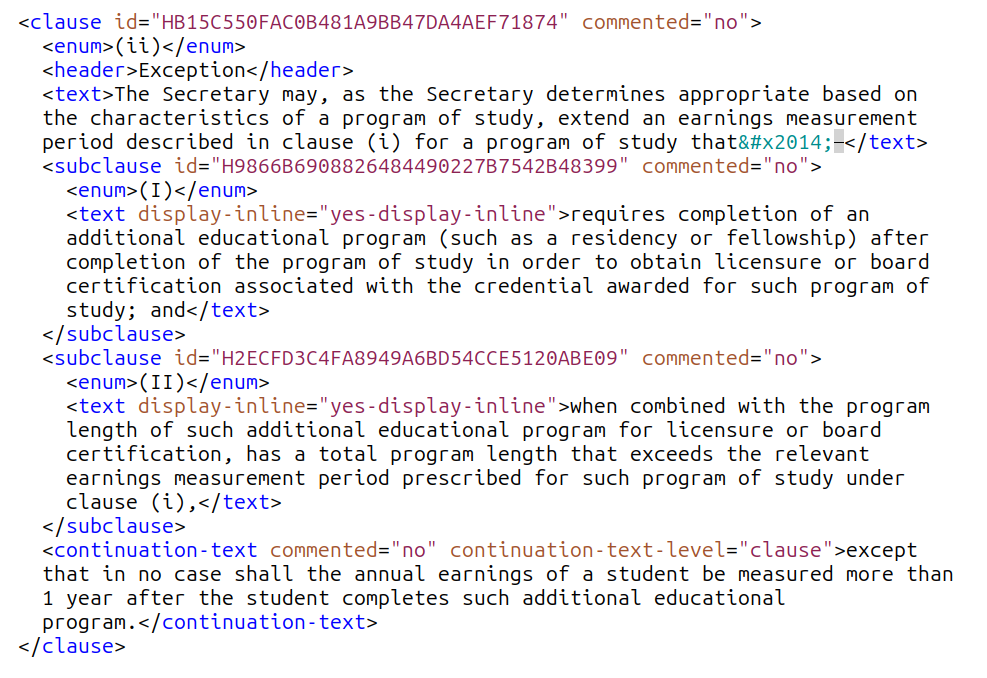
[3] Although to be fair, and to provide some
foreshadowing, this XML does not seem to be nearly as
imposing (at least to us) after some formatting that
introduces ignorable whitespace:
BHB2
A 1,360-character subset of the XML from
figure BHB1, which
contains a single <clause>
element, and has been formatted for human
readability by the insertion of ~100 space and
newline characters.
[4]<hyperDiv> functions similarly to the
TEI’s <standOff>
element, which was added many years after the WWP developed
<hyperDiv>.
[5] Currently only seven elements are permitted as
children of <hyperDiv>.
[6] Adding @source and linking to a bibliography
does add some syntactic complexity. Nevertheless, while this
encoding is useful for analyzing Emerson’s sources, it is not
necessary to produce the semantic complexity inherent in
identifying and describing her intertextual gestures with
<itg> or <quote> and
@type.
[8] As has been widely discussed, application complexity also
occurs when the precise edges of XML encoding are applied to
phenomena that have much less precise boundaries. In the TEI,
for instance, the @ana attribute can be used to
apply a project’s interpretive annotations to and within
texts. It can be extraordinarily useful to tag things like
“language related to imperialism” or “figurative language.”
However, it can also be extraordinarily difficult to determine
whether @ana should be applied to individual words,
phrases, paragraphs, or entire divisions. Imagine, for instance,
tagging irony within A Modest Proposal or the theme of “Man
vs. Nature” in On Walden Pond.
[9] Because the WWP’s documentation is encoded in XML, this
question can be investigated through the markup. The WWP uses an
<eg> element to tag examples in its internal
documentation. From a set that contains 139 documentation
entries (as of summer 2026) the mean number of
<eg> elements is 2.44 and the median is 2. The
entries with the largest numbers of examples are:
<name> (16), <orgName> (11),
<placeName> (10), <persName>
(10), and <date> (9), suggesting that these have
particularly high degrees of application complexity relative to
the other elements the WWP uses.
[10] Syntax highlighting is also
relevant here — for some humans, it dramatically
improves readability, while others may find it a
distraction.
[11] Of course, if you
are primarily interested in how long it will take to parse a
document, syntactic complexity is the thing that
matters.
[12] The WWP uses 23
different keywords as of summer 2026.
[13] Because the number of potential valid
values for @rend in this system is very, very high, the WWP does
not validate rendition ladders during data entry, but instead in
a set of post-encoding checks using Schematron and
XQuery.
[14] Few things are more terrifying to a
project manager than discovering that an encoder apparently
forgot they had declared a renditional default halfway through
encoding a document.
[Bascii] Basci, Dilek and Sanjay Misra. “Measuring and
Evaluating a Design Complexity Metric for XML Schema Documents.”
Journal of Information Science &
Engineering 25 (2009): 1405–1425. doi:https://doi.org/10.6688/JISE.2009.25.5.7.
Bauman, Syd. “The Hard Edges of Soft Hyphens.” Presented at
Balisage: The Markup Conference 2016, Washington, DC, August 2 -
5, 2016. In Proceedings of Balisage: The Markup
Conference 2016. Balisage Series on Markup
Technologies, vol. 17
(2016). doi:https://doi.org/10.4242/BalisageVol17.Bauman01.
Bauman, Syd and Sarah Connell. Reducing interoperability with
(unnecessary?) complexity. To be presented at TEI 2026
Creating Connections, Unsettling Practices, Vancouver, BC,
August 13, 2026.
Beale, Dean, Francesco Dazzi, and Theo Tryfonas. Unweaving the
Definitions of Complexity.IEEE Transactions on
Systems, Man, and Cybernetics: Systems 54 (2024):
682-692. https://doi.org/10.1109/TSMC.2023.3300753.
Ruellan, Hervé. “XML Entropy Study.” Presented at Balisage: The
Markup Conference 2012, Montréal, Canada, August 7–10,
2012. In Proceedings of Balisage: The Markup
Conference 2012. Balisage Series on Markup
Technologies, vol. 8
(2012). https://doi.org/10.4242/BalisageVol8.Ruellan01.
Sperberg-McQueen, C. M. “Catastrophic complexity.” Presented at
Balisage: The Markup Conference 2021, Washington, DC, August
2–6, 2021. In Proceedings of Balisage: The Markup Conference
2021. Balisage Series on Markup
Technologies, vol. 26
(2021). https://doi.org/10.4242/BalisageVol26.Sperberg-McQueen02.
Stührenberg, Maik and Christian Wurm. “Refining the Taxonomy of
XML Schema Languages. A new Approach for Categorizing XML Schema
Languages in Terms of Processing Complexity.” Presented at
Balisage: The Markup Conference 2010, Montréal, Canada, August
3–6, 2010. In Proceedings of Balisage: The Markup
Conference 2010. Balisage Series on Markup
Technologies, vol. 5
(2010). https://doi.org/10.4242/BalisageVol5.Stuhrenberg01.