Flanders, Julia, and Ash Clark. “Synthesis and Sustainability: The Evolution of Markup and Toolsets in the Women Writers
Project.” Presented at Balisage: The Markup Conference 2026, Washington, DC, August 3 - 7, 2026. In Proceedings of Balisage: The Markup Conference 2026. Balisage Series on Markup Technologies, vol. 31 (2026). https://doi.org/10.4242/BalisageVol31.Clark01.
Balisage: The Markup Conference 2026 August 3 - 7, 2026
Balisage Paper: Synthesis and Sustainability: The Evolution of Markup and Toolsets in the Women Writers
Project
Julia Flanders
Northeastern University
Julia Flanders (she/her/hers) is the Director of the Women Writers Project and Director
of the
Northeastern University Library’s Digital Scholarship Group. She has long-standing
research interests in markup systems and in the role they play in mediating cultural
heritage and literary history.
Ash Clark
Northeastern University
Ash Clark (e/em/eir or they/them) serves as XML Applications Developer for the Women
Writers Project and the Digital Scholarship Group. Ash uses XQuery, XSLT, and XML
databases to create data-gathering tools, generate metadata, and serve out websites.
Eir current focus is on designing sites that are easily maintainable and accessible
to all kinds of users.
In 1988, the Women Writers Project (WWP) started out on its very long history of working
with markup systems. In 1999, the WWP began working with XML publication tools as
well. In
both cases, markup and tools, the WWP has treated the work as an active research
undertaking: not only seeking to build a stable, sustainable working system, but also
keeping pace with new developments and exploring their implications for research on
early
women’s writing. The intertwined history and co-evolution of these two sets of practices
within the WWP’s nearly 40 years of work thus far can contribute a valuable perspective
on
the history of scholarly usage of markup in the humanities. This paper will explore
the
evolution of the WWP’s theory and practice of markup, from its pre-TEI origins to
our
present-day usage; as well as the evolution of the project’s publication systems,
from its
first forays into digital publication through DynaWeb to our planned implementation
of a
static-site framework that responds to the recommendations of the Endings Principles.
We
will also consider the reciprocal pressure that tools and markup exert on each other,
and
the nuanced ways in which markup responds to the changing intellectual paradigms proposed
by
successive generations of tools and technologies (and vice versa).
The Women Writers Project (WWP) has been working with text markup for nearly 40 years,
as part of its founding mission to recover and republish the works of early women
writers. Founded at nearly the same time as the establishment of the SGML standard
and of the Text Encoding Initiative (TEI), the WWP has by necessity treated its work
as long-term active research undertaking that concerns not only these evolving markup
systems but also the complex web of tools through which text markup can be created,
assessed, and put into practical use for publication and analysis. The WWP has sought
not only to build a stable, sustainable working system, but also to keep pace with
new developments in both markup and tools, and explore their implications for research
on early women’s writing. The intertwined history and co-evolution of these two sets
of practices within the WWP’s many decades of work thus far offers a valuable perspective
on the history of scholarly usage of markup in the humanities. This paper will explore
the evolution of the WWP’s theory and practice of markup, from its pre-TEI origins
to our present-day usage; as well as the evolution of the project’s publication systems,
from its first forays into digital publication through DynaWeb to our planned implementation
of a static-site framework that responds to the recommendations of the Endings Principles.
We also consider the reciprocal pressure that tools and markup exert on each other,
and the nuanced ways in which markup responds to the changing intellectual paradigms
proposed by successive generations of tools and technologies (and vice versa).
Evolution of the WWP’s theory and practice of markup
The WWP’s earliest markup practices were anchored in typesetting tools: student encoders
starting in 1988 used Waterloo Script to capture functional textual units and formatting
details. This approach was not guided by an explicit theory of markup, but it did
embody
certain assumptions about the role that markup could play in representing primary
source
documents (still a somewhat novel role for markup at that time). The now fundamental
idea that
markup should emphasize semantics rather than solely formatting was already present
in the
ways that Waterloo Script supported the identification of textual components (headings,
paragraphs, etc.) in a way that was separable from their appearance, and this was
especially
crucial for primary source materials whose actual appearance on the page might vary
considerably from text to text. And although this first stage of the WWP’s practice
did not at
all anticipate what the TEI would come to be, it did lay a groundwork that was at
least
amenable to an eventual transition to the TEI once P1 and P2 were available to demonstrate
what a more thoroughly semantic approach could look like.
We can see early traces of this shift from typesetting (and an initial orientation
towards ideas of a “digital facsimile”) in the WWP’s initial debates about whether
a
glyph in the source text should be represented using a character that resembles it
visually,
or represents it informationally. For instance, the earliest WWP transcriptions used
the letter I to represent the numeral 1 (which in older typography has horizontal
serifs) on the theory of greater visual correspondence to the original. This practice,
which was quickly discarded, yielded a valuable clarification that seems obvious in
retrospect: the appearance of the original glyph is separable from (and for the WWP,
less informationally important than) the meaning of that glyph within the overall
notational system. Interestingly, early modern typesetters themselves sometimes used
a character that resembled the one intended—either accidentally (if a piece of type
had made its way into the wrong box), or deliberately if they had run out of the appropriate
character: for instance, the letters “u” and “n” (which when inverted are often indistinguishable
from each other), the substitution of zero for a capital O, or the use of “vv” for
“w”. In these cases, the WWP chose to retain the original glyphs (even though they
were in effect a “facsimile” of something else) while also providing a regularized
transcription reflecting the intended meaning.
The WWP’s thinking about these kinds of cases was shaped by
concerns among humanities scholars about loss of information about the physical source,
and a
resulting desire for visual fidelity to the text. Seen from that perspective (and
in the
absence of Unicode), the use of a capital I to represent a numeral 1 could appear
defensible
on visual grounds. But very early on, the project identified that resemblance (unsurprisingly)
as a fallacy—dependent on typeface and likely to lead to all sorts of future practical
and
conceptual problems. The idea of markup as a “digital facsimile” gave way quickly
to the idea
of markup as a more informational representation of document structure—an approach
which has served us well in the longer term because of its greater robustness of display
and behavior. The project continued
to be concerned with ways of representing the material aspects of documents, with
each encoded
transcription derived from an identifiable physical copy, and capturing aspects of
formatting
and material structure. But the TEI model demonstrated how that could be done explicitly
through the markup itself: for example, through the @rend attribute or through
mechanisms like <sic>:
Figure 1
<sic corr="O">0</sic>
This P3-era TEI encoding indicates that the typesetter used the zero character in error (or out of necessity).
The transcriber indicates that the correct character is the capital letter “O”.
The WWP’s early work on rendition ladders provided an opportunity to explore how far
the
material and visual properties of texts could be formalized for descriptive (rather
than
output) purposes.
In the early days of the TEI in the 1990s, the WWP was a typical early adopter in
two
senses. With its mission of creating a large collection of early women’s writing in
English,
the project emphasized both comprehensiveness and the recovery of inaccessible materials.
But
these two goals proved over time to pull in different directions, as the evolution
of the TEI
as a scholarly technology revealed different ways for digital
resources to function as research objects. The idea of creating reference corpora
or
comprehensive research collections was an early and significant driver for the TEI
and is
exemplified by projects like Perseus, ARTFL, and the early documentary editing projects that
constituted the Model Editions Partnership. Such efforts signalled the importance of data
interoperability and of markup systems that could work towards that end: schemas that
could
strongly reinforce consistency and “conformance” and provide a clear model for tools
to
operate on. The WWP’s work was certainly animated to some degree by motivations towards
interoperability; the project explored collaborative approaches to the encoding of
personal
names with several other projects focused on women’s writing, and placed a high value
on
following emerging standard practices when possible. But an important early element
of the
project’s mission was to treat early women’s writing and early printed books as potential
sources of complication and resistance to standardization.
With the release of TEI P5 in 2007, the function of customization changed fundamentally:
no longer as
a laborious way of departing from the standard, but as a more or less required aspect
of using
the Guidelines, a tool that was in everyone’s hands.
As the “Design Principles” section of TEI Guidelines, “About These Guidelines” describes the shift:
In brief, the TEI Guidelines define a general-purpose encoding scheme which makes
it possible to encode different views of text, possibly intended for different applications,
serving the majority of scholarly purposes of text studies in the humanities. Because
no predefined encoding scheme can possibly serve all research purposes, the TEI scheme
is designed to facilitate both selection from a wide range of predefined markup choices,
and the addition of new (non-TEI) markup options. By providing a formally verifiable
means of extending the TEI recommendations, the TEI makes it simple for such user-identified
modifications to be incorporated into future releases of these Guidelines as they
evolve.
This shift coincided exactly with an
increased visibility of “digital humanities” within traditional scholarly spaces,
and an
interest in interpretive and critical uses of data modeling. For the WWP, the question
of
where early women’s writing might depart from canonical or standard models shifted
at this
point to become: how does the modeling of early women’s writing constitute a scholarly
argument about that writing? And, by extension, the project took an approach to pedagogy
(through its encoding seminars) that asked participants to undertake TEI encoding
as an
exercise in scholarly interpretation and reciprocal communication, rather than an
effort to
follow an established model in a strictly conformant manner.
Another crucial step in the evolution of the WWP’s use of markup—also connected with
the
release of TEI P5—was the availability of markup structures akin to linked open data:
the
’ographies[1] and their relationship to the emergence of RDF and technologies like XPath that
enabled linking to precise locations within XML documents. For the WWP, this launched
a shift
away from a sole emphasis on documents, to representing a larger universe of entities
in which
those documents are one meaningful component. The WWP had already begun using internal
authority control to manage a database of persons referenced in WWP texts, starting
in 1996
with a formal keying system developed by Syd Bauman. In 2008 the WWP received an NEH
Digital
Humanities Start-up grant to explore the complexities of managing personographies
in the
context of early modern women’s writing (see Melson and Flanders 2010). Over time, the WWP
has developed systematic data on people (with particular emphasis on authors featured
in Women Writers in Review and Women Writers in Context), texts (featured in Women
Writers:
Intertextual Networks), and even to some extent events (which are featured in timelines
as
part of Women Writers in Context). This work diversifies the role of markup for the
WWP, going
beyond modeling documents to creating data structures that are independent of documents
but
constitute an important contextualization mechanism for them.
The final niche in the WWP’s evolving use of markup brings us full circle to the roots
of
SGML as a way of modeling data in which “text” faces Janus-like towards the domains
of
document and data and operates effectively in both spaces. Over time the WWP has found
important uses for lightweight, systematic, highly consistent, “data-like” markup
that
anticipates interfaces that are focused on retrieval and analysis rather than on “reading”
in
the traditional sense (as in Women Writers Online’s presentation of primary sources).
The
project uses TEI for its encoding documentation, for the periodical review documents
in Women
Writers in Review, and for the essays in Women Writers in Context, and in all three
cases the
approach is minimalist and functionalist rather than being animated by a research-oriented
philosophy of full textual representation (as in the WWP textbase).
Note
See Appendix A for an overview of the WWP publications described here and in the following sections.
The markup of the textual
content focuses on a selection of high-value features (such as element names or quotations)
that are specifically relevant to the rhetorical context of the materials, and the
metadata
carries more of the burden of representing features of the content that will be valuable
for
retrieval. In the case of encoding documentation, that includes including topic keywords
and
an inventory of elements and attributes referenced. In the case of WWiR, it includes
thematic
keywords and an inventory of authors and texts mentioned in the review. Shifting these
aspects
of content into metadata (rather than tagging them in the running prose of the review
or
documentation entry) serves the pragmatic purpose of streamlining the encoding process,
but it
also acknowledges that these informational aspects are intended to function as retrieval
hooks
rather than as an activity of analysis or textual representation. In other words,
it posits a
different rhetorical framing for this information.
Evolution of toolsets
The WWP has had an unusually long history that traverses many generations of SGML
and XML
publication tools, and the project’s data has presented some valuable challenges and
edge
cases that have tested and revealed the limits of the tools it has used. The project’s
main
publication, Women Writers Online, has used four different platforms since its first
publication in 1999:
DynaWeb: 1999–2006 (by 2004 this system was no longer supported)
Philologic: 2005–2012 (by 2012 this system would not run on a modern server)
An in-house, modular publication system served out of XTF: 2012–2025 (by 2019 XTF
was
getting harder to maintain)
A redesign of the publication backend for eXist-DB: 2025–present
The initial digital publication of Women Writers Online in 1999 showcased Renaissance
Women Online (RWO), a subset of WWO representing works originally published between
1500 and
1670. RWO consisted of two complementary forms of interface. At the time, WWP Electronic
Publications Editor Paul Caton described these interfaces:
A plain HTML version allows relatively quick access but no searching, which suits
the
user who wants simply to read or look over a work. The other form uses Inso Corporation’s
DynaWeb software, which dynamically translates an SGML version to HTML for the browser
while retaining access to the SGML; this allows users to perform searches on the
SGML-encoded texts, at the cost of somewhat slower access.
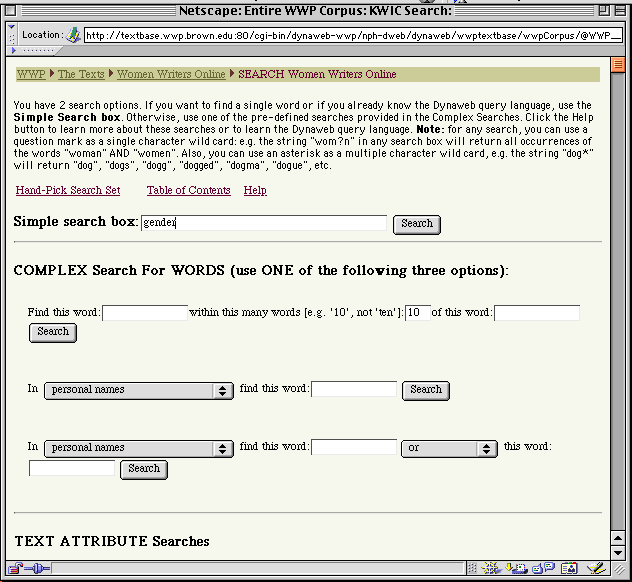
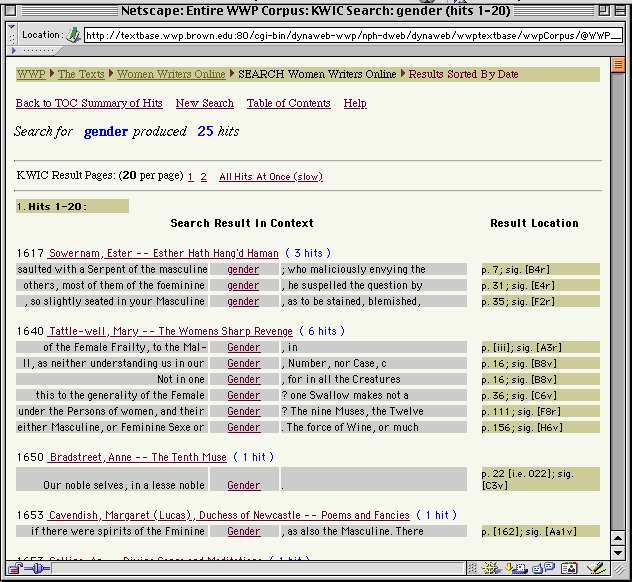
The initial WWO and RWO collections were further defined by robust search with
keywords-in-context; tables of contents for user navigation within a given work; as
well as
contextual materials such as short summaries, scholarly introductions to works, and
essays on
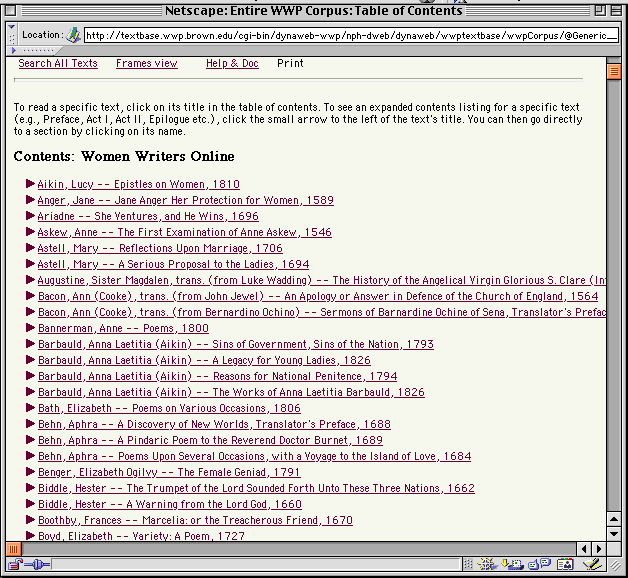
topics and collections.[2] The following screenshots show some of the details of these interface features:
Figure 2
The first version of WWO had a table of contents with expandable items showing the
major sections of each work.
Figure 3
The search interface for the first version of WWO included context-sensitivity and
wildcards.
Figure 4
The early WWO search results included a keyword-in-context option, with links to both
the inidividual hit and the text as a whole.
By 2003 the WWP began seeking a successor to DynaWeb for both technical and administrative
reasons. The Inso Corporation had been bought by another company, which altered both
the level
of support and also the license terms in ways that made it increasingly untenable
to use
DynaWeb for a small academic project. In 2004 the project began experimenting with
Philologic,
developed by Mark Olsen at the University of Chicago, and in 2005, the WWP released
an updated
WWO running on Philologic. Philologic placed its emphasis on speed and power; it was
database-driven and selective in its indexing, so that it was able to provide very
fast search
results as well as context-sensitive searching. Its search also included fuzzy matching,
which
made it adept at handling the highly variable spelling in older WWO texts. This system
served
us well for several years, but by 2011 the project was seeking a more modern XML framework
that would support more flexible experimentation with interface, responding to the
significant
expansion of interface paradigms as “digital humanities” became a widespread academic
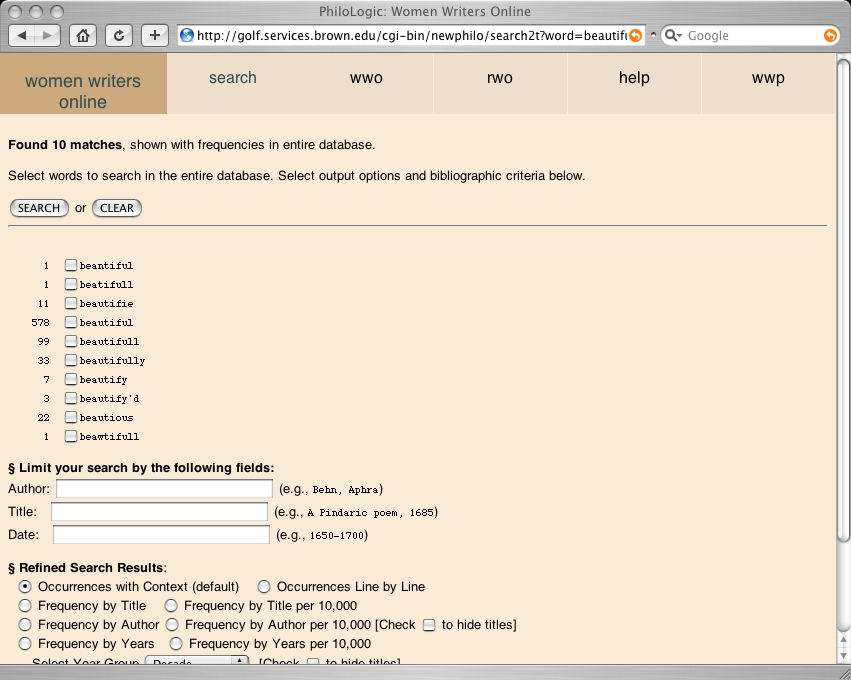
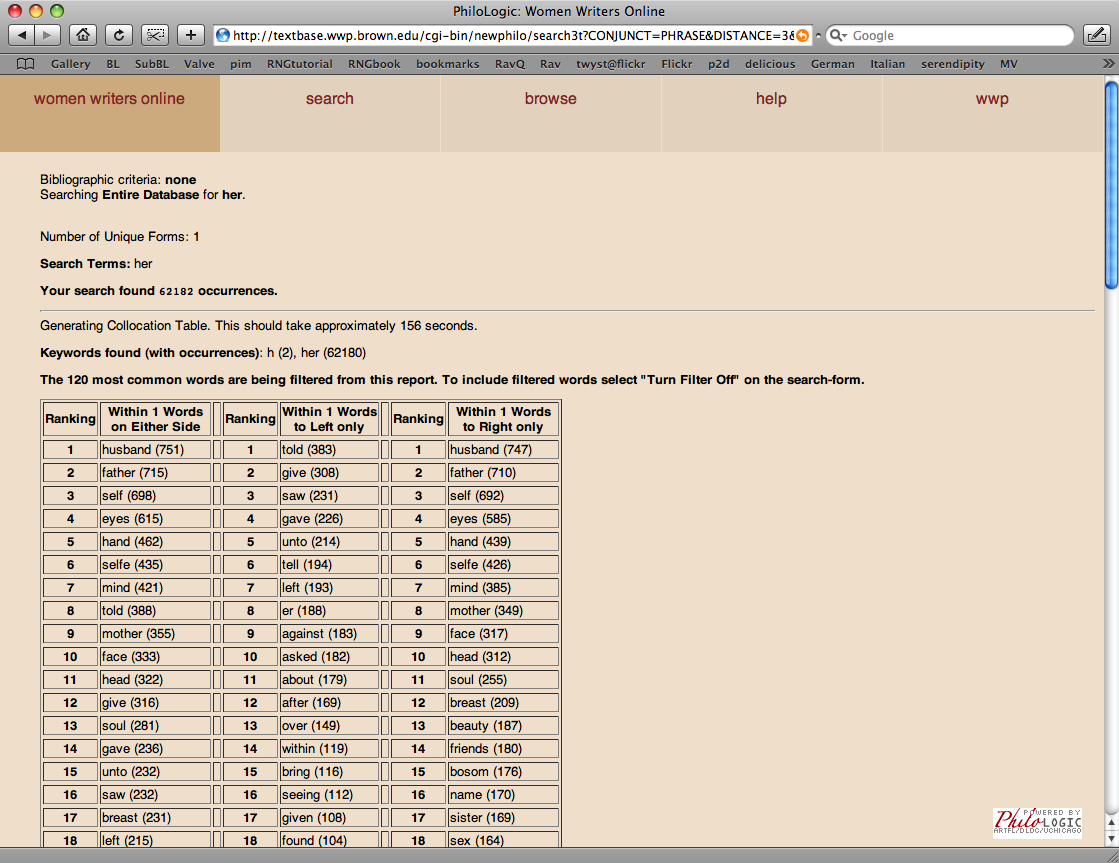
domain. The screenshots below illustrate some of these features:
Figure 5
The second iteration of the WWO search offered fuzzy matching and the ability to refine
search results.
Figure 6
The second iteration of WWO also offered collocations.
Starting in 2012, Women Writers Online was served out of XTF (eXtensible Text Framework),
a Java- and XSLT-based publication system created by the California Digital Library.
The WWP
staff heavily customized XTF’s stylesheets in order to produce indexable versions
of the WWO
documents, as well as HTML representations for display. On the front end, Women Writers
Online
was reimagined as a dynamic, three-pane interface, with users seamlessly flowing from
browsing
to searching to reading a document. Within this design, WWO offered users a sense
that
searching/filtering, visualizing, and reading are really three manifestations or framings
of
the same thing, at different levels of scale. This approach contrasted strongly with
the
traditional (at the time) search model in which users would first specify a set of
search
parameters and then execute a search to receive results—with the need to go back to
the start
of the process if the results were not what the user wanted. (A few years later, Stephen
Ramsay’s essay on “The Hermeneutics of Screwing Around” [Ramsay 2010]
captured the element of play and exploration that such “pipeline” systems foreclose.)
By
searching and filtering across WWO, one can “read” the corpus as a whole as a spread
of dots
on a timeline, or as a list of matching search results — keywords in context for multiple
WWO
documents. One can then focus in on a more specific area (e.g., a specific genre or
time
period) and finally on a specific text. Although this interface doesn’t fully implement
this
idea, it introduces it and makes it possible. And within this interactive paradigm
of usage, markup has a very significant role to play: it makes all features of the
text potentially discoverable and operable (addressable to use Michael Witmore’s term [Witmore 2012]), not only as hooks for formatting and presentation but also as informational filters
and points of correlation. However, for the WWP, the challenge has been to anticipate
and present those opportunities to users without requiring them, in effect, to write
XPath expressions.
Around the same time, the WWP universe began to expand beyond Women Writers Online.
The
WWP produced Women Writers in Context (WWiC), a collection of modern scholarly essays
providing crucial background for the documents, authors, and genres found in WWO.
Later, Women
Writers in Review (WWiR) made contemporary reviews of WWO authors’ works available,
and
referenceable from WWO itself. These two endeavors aim to flesh out the milieu of
WWO authors.
The sites link to each other to aid users’ exploration, but are not integrated directly
into a
single interface. Unlike WWO, the sister sites are public resources, available to
anyone,
regardless of WWO subscription. Their documents are lightly customized TEI, much more
geared
towards supporting collection-level metadata, presentation and quick publication turnaround
than research artifacts. Their interfaces in turn prioritize findability and the ability
of
users to follow connections between resources.
Women Writers: Intertextual Networks (WW:IN) sought to compile significant amounts
of data from
TEI sources for exploration and research. The data was drawn from two primary sources:
(1) the
WWO documents, which were marked-up to add references to (2) entries within a separate,
TEI-encoded bibliography. Unlike its sister sites, however, the WW:IN interface was
designed
to do much more work on the server-side, with Javascript limited to functions that
would make
the site more interactive. An EXPath application, housed in the XML database eXist-DB, would apply users’
desired filters to return customized datasets in full HTML responses. The same API
that
returned JSON or XML would also serve out the webpages, putting far less pressure
on users’
devices.
This succession of different tools has been challenging, in that it has required periodic
episodes of substantial redevelopment. However, those transitions have also given
the project
an important push at each point to rethink how the interface could best serve readers
and best
express the capacities of the data. And they also prevented the project from experiencing
the
publication platform as a fixed horizon of possibility to which the data should adapt.
Instead, the project has developed an extensive set of pre-publication processes that
take the
WWP’s source data and transform it as necessary for the specific foibles and requirements
of
the current tool.
For example, like many TEI projects, the WWP makes frequent use of intra-word markup
in
Women Writers Online. One example of this is the WWP’s <vuji> tag, which is
used to encode letterforms commonly substituted for each other in early typesetting,
such as
an “j” represented with an “i”. The <vuji> element is a useful shorthand for a
TEI <choice>.
The word “injurious” transcribed using standard TEI elements <choice>, <orig>, and <reg>. The encoding indicates that the word was originally printed with an “i” where modern
readers would expect a “j”.
Figure 8
in<vuji>i</vuji>urious
The same word, transcribed using the WWP’s shorthand element <vuji>. Only the originally-printed letter is transcribed. When encoded this way, the letter
“i” will only ever be regularized to the letter “j” (and vice versa).
XML publishing software consistently treats element tags as distinct words. Our
pre-publication stylesheets adapt our markup as needed to avoid this problem. Originally,
the
original letterform represented in <vuji> was converted to its modern
equivalent, and the tag itself was removed.
More recently, when WWO introduced a feature allowing users to toggle between modern
and
original typography, the pre-publication stylesheets retained <vuji>.
When the TEI was transformed into HTML, <vuji> became an HTML <span>, and its text content flipped to the modern version.
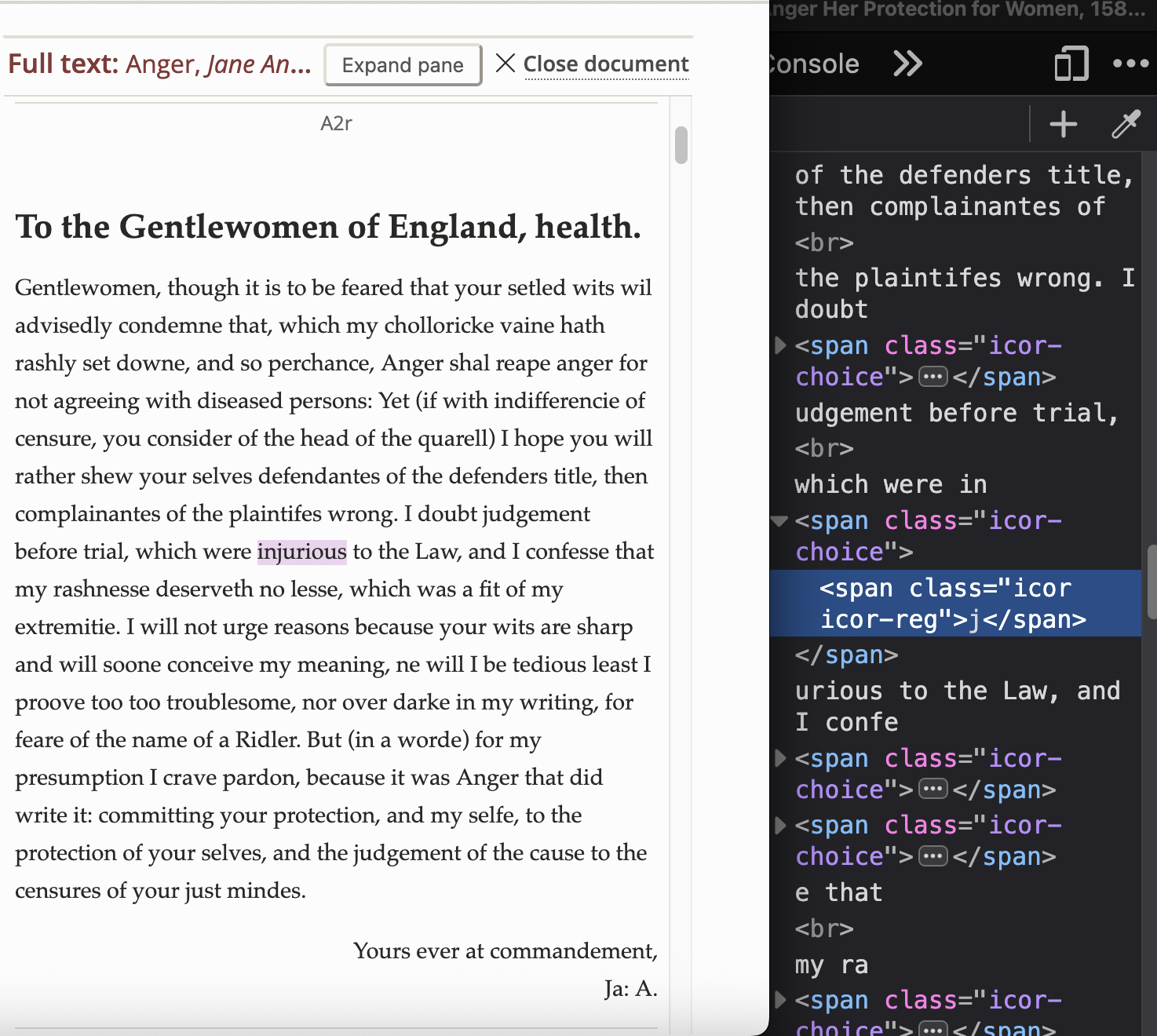
Figure 9
Jane Anger Her Protection for Women, as it first appears in Women Writers Online. The word “injurious” has been highlighted.
The browser’s Inspector tool shows that the letter “j” is encoded in HTML as <span class="icor icor-reg">j</span>.
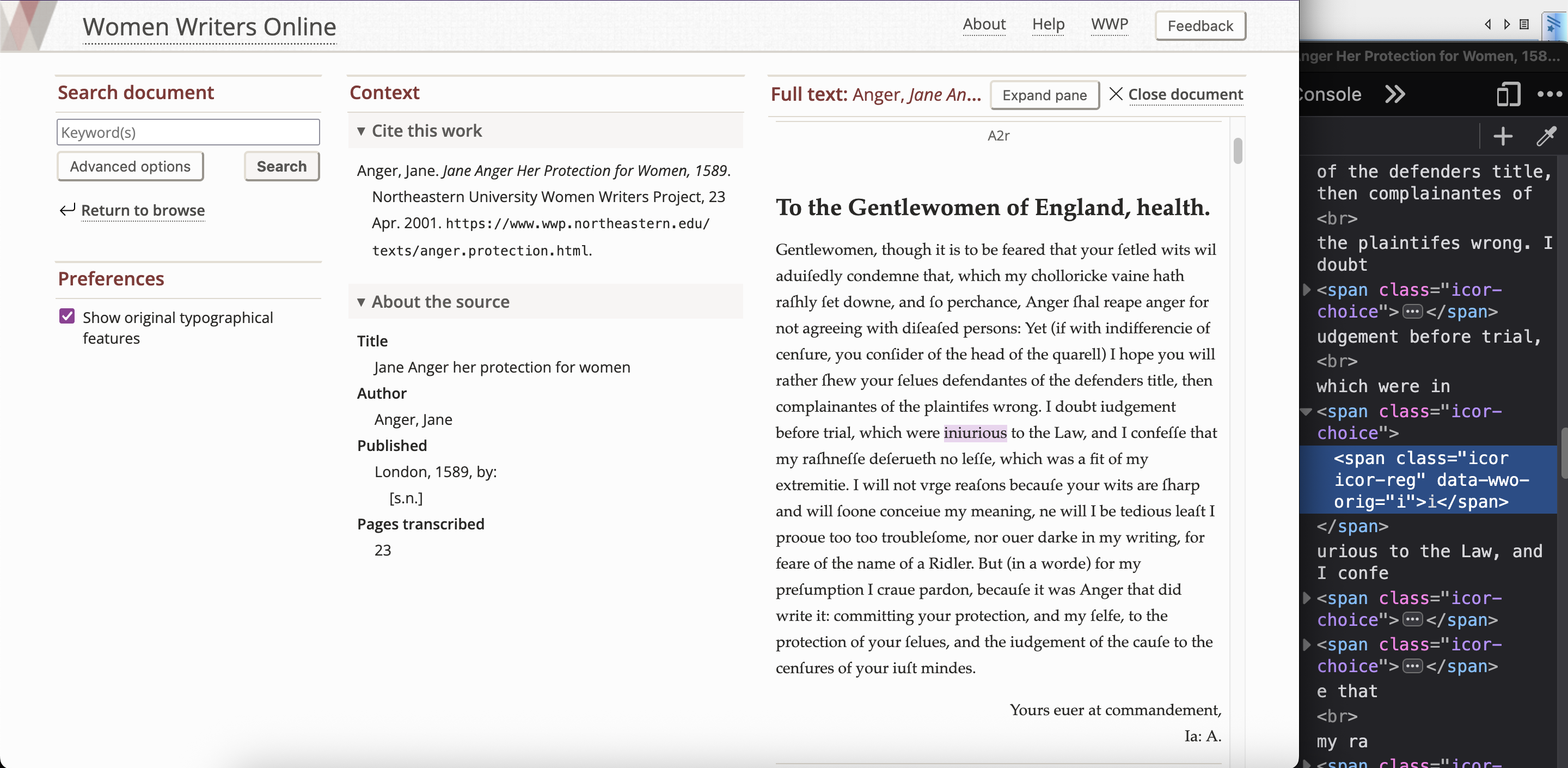
Figure 10
Jane Anger Her Protection for Women with the “Show original typographical features” preference toggled on. The highlighted
word now reads “iniurious”, as it did in the 1589 publication. The browser’s Inspector
tool shows that the letter “j” was changed to <span class="icor icor-reg" data-wwo-orig="i">i</span> in the Document Object Model.
Unfortunately, the new feature had the unfortunate side effect of reducing XTF’s ability
to index and search older documents, because a
single word would be broken up by tags.
Figure 11
in j urious
A plain-text representation of how XTF would parse the word “injurious” as encoded
in Figure 8. XTF would introduce spaces in place of the start and end tags of <vuji>.
In order to retain both the toggle feature and the collection’s searchability, Women
Writers Online was moved out of the XTF platform and into an eXist-DB database. While
eXist-DB’s Lucene index also treats tags as word boundaries by default, eXist does
provide a way to
define elements like <vuji> as “inline,” or, implying no word break. As such,
a search in eXist for the word “injurious” will lead to Jane Anger
Her Protection For Women, where XTF would have come up short.
Importantly, while the code for the WWO site was updated and adapted for use in eXist,
the WWO documents themselves stayed the same.
The relationship between the markup and the publication tool is thus very indirect.
The
markup represents a durable, evolving expression of our analysis of the source texts,
based on
the project’s editorial principles and expectations about the kinds of research questions
this
data should support in the very long term. The publication platform, on the other
hand,
represents a particular manifestation of the potential of that data, under particular
circumstances of resource constraints and technological capability. Even in the WWP’s
other
publications (see Appendix A) where the encoding is more deliberately
aimed at producing a specific kind of outcome, the source markup remains tool-agnostic
and
could be published through varied systems to produce varied user experiences.
Read broadly, this history reveals several important points. First, the lifespan of
monolithic tools was comparatively short: the first two iterations of Women Writers
Online
(DynaWeb and Philologic) each lasted about six years, whereas our current system has
evolved
more or less gracefully over the past 14 years with incremental modifications. Second,
although the WWP never “coded to the tool” in the sense of altering our data to match
what a
given tool could or could not do, our publication tools have definitely put their
stamp on
what Women Writers Online as a publication could express about that data. The centrality
of
the keywords-in-context display in DynaWeb, the excellent division-level context-sensitive
searching in
Philologic, and the dynamic relationship between global and local reading views in
the current
interface all reflect, at a macroscopic level, the platform’s understanding of what
“XML
publishing” means (inflected as well by the WWP’s own intentions for the data).
Project sustainability
In July 2023, the Women Writers Project staff held a retreat to discuss plans for
the next
ten years of the WWP — what would the Project need in order to continue on indefinitely,
in
areas such as staffing, technology, and administration. The retreat focused on staff
analysis of
various aspects of the Project. Our markup and publication processes seemed stable
for the
moment, but analysis revealed that these systems were potentially at risk to events
for which
we had no contingency or recovery plan.
For example, many of the WWP’s web resources are
dependent on eXist-DB. For years, the eXist database had its own divergent implementations
of XQuery
standards, such as XPath functions, XQuery Update, and output serialization.[3] eXist-specific code requires
eXist-specific knowledge to use and maintain it — a high barrier to entry and a high
barrier
to exiting. Northeastern’s Digital Scholarship Group — of which the Women Writers
Project is a part — had
already adopted BaseX as its XML database of choice for TEI and other XML projects,
due to
BaseX’s lightweight footprint, excellent documentation, and adherence to the XQuery
standard. At this time, the WWP is the only DSG project which uses eXist. The WWP’s
dependency on eXist is also a dependence on continued staffing with
eXist-specific skills.
Note
To their credit, eXist’s development team has also identified specification compliance
as a significant goal, and they have been making incremental progress since at least
2016.[4]
As we prepared to revise our paper in June 2026, they announced a beta version of
7.0.0, the next major version of eXist — and with it, a 90% success rate against 31,815
tests, a commendable increase from version 6.4.1’s 80% success rate. (eXist-db release 7.0.0-beta3)
By the close of the retreat, we decided it would be prudent to familiarize ourselves
with
the outcomes of the Endings Project. Convened in 2016 by the
University of Victoria’s Humanities Computing and Media Centre, the Endings Project’s
goal was to
develop and recommend practices that would aid the longevity of their digital artifacts.
In 2018, the team
released their first version of the “Endings Principles for Digital Longevity” (Endings Principles 2023).
These principles describe the foundations of a digital project which can be
used, cited, reproduced, and archived. By building for open use, the Endings Project
argues,
the digital products are far more likely to be reused and maintained, and thus, more
likely to
survive.
The Endings Project promotes the use of standalone, static websites, with no server-side
processing or backend components. The HTML markup is not programmatically built out
after the
page loads; all content is available and all dependencies are satisfied simply by
accessing
the file (Endings Principles 2023). This greatly aids those who intentionally set out to archive the project materials,
such as a digital repository or the Internet Archive’s Wayback Machine. The static
site
approach also makes it easy for researchers and other users to become casual archivists.
It is
not necessary to use extensions or software to generate a WARC file from the page; saving the
page as an HTML file is enough to obtain your own working copy.
Crucially, the Endings Project does not intend for digital humanities projects to
pursue
archival solutions on their own. The survival of the original publication
on the web is paramount. As Ending Project technical leads Martin Holmes
and Joey Takeda explained, We have therefore focused on building digital editions which
can run on any web server, anywhere, without any specific dependencies. If spinning
up a new site
requires nothing more than copying a collection of files to a server and circulating
the URL,
there is a far greater chance that functional copies of the products of your work
will survive in
a usable form. Every server-side dependency is a barrier to replication and therefore
to
survival (Holmes and Takeda 2023). It is important for the Internet Archive to be
able to create WARC files from a digital humanities project’s site, but it is just
as important
for the project to be able to transfer ownership of the site to a repository or library
for
hosting and long-term maintenance.
Though the WWP puts much of our emphasis on the markup — without which, there would
be no
publication — the Endings Project counsels against considering our data alone as enough
for
project preservation. Dynamic products such as website interfaces are arguably the most
recognizable and least preservable part of a digital project (Holmes, Jenstad, and Huculak 2023).
A website is the most public expression of a project’s data, and an invitation for
users to
participate in the products’ use and reuse.
Just as we offer repurposable XML versions of our documents, we try to provide HTML
pages which can also be pulled out of the project and reused easily. While TEI XML
is a
widely-used and trusted archival format for digital scholarly work, compared with
HTML,
its audience is tiny. As we have noted elsewhere, the many billions of HTML pages
already
created constitute many times the number of printed books produced in the entire history
of humanity, and the variety of purposes already served by HTML (not only websites
but
mobile applications, archival storage, and others) will ensure that if anything from
the
current era of digital communication survives, it will be HTML. So our HTML is more
likely
to be reused than our XML in the long term.
In our pursuit of maintainability, the WWP is working towards greater synthesis between
markup, documentation, and website, especially for Women Writers Online. We intend
to make it
easier for users to download WWO’s TEI, packaging the files as part of the interface.
With careful design, the WWO interface can demonstrate the capabilities of the markup,
as well as
catering to those who just want a clean, readable text.
For instance, we plan to give users more control over how features of the markup are
presented
in the interface. The “original typographic features” toggle (Figure 10)
is one example. Another toggle could show the lineation of the original publication,
making
<lb>s (line beginnings) and <pb>s (page beginnings) visible as HTML <br>s.
However, the highest priority for the WWP is refactoring our current publication processes
for sustainability, and to produce static websites. Step one — currently in progress
— is to migrate our apps from eXist-db
to BaseX, as well as documenting and automating the publication processes.
This step mostly consists of rewriting XQuery code so that a BaseX environment can
produce the same JSON output that eXist currently does. The goal of this step is to
ensure more people can publish new records and maintain the site, but where possible,
we are also trying to make it easier to accomplish the work to come.
For Women Writers in Review and Women Writers in Context, the next step will be to
shift away from single-page Javascript applications
and towards giving the user a complete HTML page on request.
Note
Women Writers in Review and Women Writers in Context each have a single index page.
On
page load, their Backbone.js apps request and consume data
from the XQuery API in eXist. That data is used to construct a web page to match the
user’s request. As a user navigates one of these sites, its Javascript application
builds
and rebuilds the Document Object Model within the browser, adjusting the URL address
and browser history as
new “pages” load.
We will adjust the site for web accessibility and universal design features,
limiting Javascript to facilitating interaction. This will also require updating existing
URLs, since Backbone.js applications previously maintained the browser’s history once
the user
entered the site. Women Writers Online already went through this process during the
migration
to eXist. As preparation for this step, web content generated in Javascript may be
extricated and placed in
either an XQuery response, or the HTML page.
Step three is to generate static HTML. The current hope is that we will use the migrated
XQuery code to generate HTML out of BaseX. Rather than serving the BaseX endpoint
directly,
we will save each page as a separate HTML file, in
directories mapping onto the URL paths. When a user requests a web page, the server
will respond
with the static HTML file. We may still incorporate search through BaseX, but because
it will no longer be required to respond to all requests, its workload (and perhaps
response time) will be lessened.
Throughout the process, we are also working to make our web content more accessible.
For
example, the Women Writers Online interface includes a standard “Search” feature,
implemented
as a form. When a user clicked the “Search” button, the Backbone.js application would
prevent
the browser from navigating the user to a new page with their query parameters applied.
Instead, the application requested the search results and populated the current page
with
them. From a sighted user’s standpoint, this was convenient and useful. From a blind
user’s
perspective, however, nothing would happen after they clicked the button; the WWO
application
did not alert them that the page had changed. If the request had been allowed to go
through
the browser, a screen reader would have informed the blind user that they had gone
to a new
page as a result of their request, with the search results found within the content
of the
page. By removing usability barriers, we extend our invitation for use and reuse to
people of
all abilities. And by preferring semantic HTML markup over CSS formatting, we bring
the full
semantics of the markup into focus.
It is worth situating this work against the Principles that we are using as our
foundation. The Endings Principles are written in technical language: prescriptions
for each
component of a digital project. The Principles are also an enactment of a philosophical
framework designed by the UVic Humanities Computing and Media Centre. As we considered
the
Endings Principles, we sought to understand the framework behind the Principles, and
to map
that framework onto the WWP’s own ethos. There are no accompanying Endings Principles
for the
accessibility of the interface, and the UVic team may have taken it for granted that
the data
should be embodied in the design and features of the interface, not just served alongside.
These ideas are, however, natural extensions of Endings Project’s philosophical framework,
and
part of the WWP’s framework. As publications and user-facing tools, web interfaces
are the
most prominent manifestation of our markup.
Conclusions and Next Steps
Michael Sperberg-McQueen, in his 2012 keynote at the Knowledge Organization and Data
Modeling conference, said that modeling is a way to make explicit our assumptions about the nature of a text/artefact (Sperberg-McQueen 2012). These assumptions are often complexly layered and may even represent divergent
perspectives or possibilities in the text. The tools that express the potential of
our modeling also participate in making those assumptions explicit, by enacting some
of the practical or analytical consequences of those assumptions: if the modeling
tells us that certain passages are endnotes, our page generation can gather them at
the end of the text; if the modeling tells us that certain readings are typographical
errors, our search tool can ignore them. We might thus think of tools as an intensification
of the rhetorical aspect of markup: the space where the provisional, suspended potential of descriptive markup for action is realized, within a specific set of rhetorical
conditions: audience, purpose, context. Because of its long history, the WWP has had
an unusual opportunity to express the potential of its markup in a changing set of
rhetorical contexts, and through tools that realize the basic activities of reading,
searching, and analysis in somewhat different ways. What these experiments have revealed
is the durability and adequacy of the TEI’s general approach, and of implementations
like the WWP’s, which emphasize abundant, semantically rich markup that has a focused
methodological orientation but is open-ended as to the specific activities through
which reading and analysis will be practiced—and also a continued experimentation
with how interfaces can support the evolution of those practices.
Interfaces serve as manifestations of markup and as an invitation to the user to interact:
not only with patterns of tokens or with structures inferred from them but also with
human readings. This is particularly significant for historical materials because
the meaning of what they present to us is not transparent or unimportant: reading
such texts is a process that has to remain frictional and critical. The markup retains
that critical friction; it documents the process of observation; this is what makes
such data valuable to scholarly readers. And for those readers, interfaces and analytical
tools do their work best when they provide a view of that friction as well. In a sense,
this is the strongest case we can make for markup, and we consider it important for
researchers of the current generation to be reminded how important markup is, at a
time when the ubiquity of machine-learning approaches may seem to eclipse this kind
of durable annotation. The WWP came of age at a time when theorizing markup was a
core digital humanities research concern, considering fundamental questions about
how markup’s formalisms function in relation to human description and argumentation,
how markup systems can be designed to balance interoperability with extensibility,
how formal models exist in relation to material manifestations (such as book structures
or typography), how formal models are instantiated through tools, and many more. We
see a renewed opportunity for research that explores markup from a perspective of
labor politics, agency, minimal computing, accessibility, and other areas in which
it contrasts strongly with machine learning approaches, even as there may also be
areas where the two are complementary. The potential of markup systems and markup-based
tools for transparency and accountability remain among their enduring strengths.
The WWP’s collection of 18th- and 19th-century reviews and other texts which respond
to the works of early women writers.
WWiR is the product of “Cultures of Reception,” a 2011–2015 research project funded by the National Endowment for the Humanities.
WWiR was first published in 2016 as an eXist-based API and a Backbone.js web application.
A bibliography and extracts from WWO, surfacing the sources of quotations, allusions,
and citations in the Women Writers Online textbase.
WW:IN came out of the grant-funded research project Intertextual Networks, which began in 2016 by augmenting the WWO markup. WW:IN was first published in 2022 as an application hosted entirely from an eXist-db instance. Since its launch, it
has been taken down periodically due to overzealous scraping.
[Holmes and Takeda 2023] Holmes, Martin, and Joey Takeda. “From Tamagotchis to Pet Rocks: On Learning to
Love Simplicity through the Endings Principles.” Digital Humanities
Quarterly, vol. 17, no. 1, 2023. doi:https://doi.org/10.63744/dr2uaqdau4tz.
[Ramsay 2010] Ramsay, Stephen. “The Hermeneutics of Screwing Around; or What You Do with a
Million Books.” In Pastplay: Teaching and Learning History with
Technology, edited by Kevin Kee, 111-20. Ann Arbor: University of Michigan Press,
2014. Originally presented as a talk at Brown University, April 17, 2010.
[Sperberg-McQueen 2012] Sperberg-McQueen, C. M. Keynote Address. Knowledge Organization and Data Modeling
in the Humanities, 16 March 2012, Brown University, Providence, RI. youtu.be/2F98I3bbOVM.
[1]’Ographies is our shorthand for collections of data which add context for the primary TEI transcriptions.
A separate document which lists all the persons named in the collection would be a
personography, a list of all the events would be an eventography, etc.
[2] Later, these contextual essays were republished in Women Writers in Context.
Endings Project Team. “Endings Principles for Digital Longevity.” Version 2.2.1.
The Endings Project, University of Victoria, 3 Mar. 2023. endings.uvic.ca/principles.html.
Holmes, Martin, Janelle Jenstad, and J. Matthew Huculak. “Introduction to Special
Issue: Project Resiliency in the Digital Humanities.” Digital Humanities
Quarterly, vol. 17, no. 1, 2023. doi:https://doi.org/10.63744/g7c3rkvm5bzr.
Holmes, Martin, and Joey Takeda. “From Tamagotchis to Pet Rocks: On Learning to
Love Simplicity through the Endings Principles.” Digital Humanities
Quarterly, vol. 17, no. 1, 2023. doi:https://doi.org/10.63744/dr2uaqdau4tz.
Ramsay, Stephen. “The Hermeneutics of Screwing Around; or What You Do with a
Million Books.” In Pastplay: Teaching and Learning History with
Technology, edited by Kevin Kee, 111-20. Ann Arbor: University of Michigan Press,
2014. Originally presented as a talk at Brown University, April 17, 2010.
Sperberg-McQueen, C. M. Keynote Address. Knowledge Organization and Data Modeling
in the Humanities, 16 March 2012, Brown University, Providence, RI. youtu.be/2F98I3bbOVM.