Broeder, Daan, Oliver Schonefeld, Thorsten Trippel, Dieter Van Uytvanck and Andreas Witt. “A pragmatic approach to XML interoperability – the Component Metadata Infrastructure
(CMDI).” Presented at Balisage: The Markup Conference 2011, Montréal, Canada, August 2 - 5, 2011. In Proceedings of Balisage: The Markup Conference 2011. Balisage Series on Markup Technologies, vol. 7 (2011). https://doi.org/10.4242/BalisageVol7.Broeder01.
Balisage: The Markup Conference 2011 August 2 - 5, 2011
Balisage Paper: A pragmatic approach to XML interoperability – the Component Metadata Infrastructure
(CMDI)
Daan Broeder
Max Planck Institute for Psycholinguistics, Nijmegen
Daan Broeder works at the Max-Planck Institute for Psycholinguistics in Nijmegen
(NL). In the institute's TLA unit he is head for the group developing the core LTA
archiving software that is also used by several other organizations and institutes.
He is
currently involved several EU infrastructure projects and collaborations on Language
Resource management as the European CLARIN
project and its Dutch national pendant CLARIN NL. In both projects the CMDI
metadatda infrastructure, for which he is the coordinator, plays an essential role.
He is
part of national and international standardization groups on language resources.
After first working on the development of signal analysis software packages for
phonetic research, he switched to developing support for Language Resource data
management. He played a major role in the development of the IMDI metadata infrastructure
within a number of EU and national projects that is one of the first domain specific
metadata sets for the linguistic domain
Currently his major research interests are developing sustainable e-infrastructures
and tools that will effectively eliminate the institutional and organizational boundaries
for linguistic research.
Oliver Schonefeld works at the Institut für Deutsche Sprache (Institute for the
German Language) in Mannheim and is involved in the projects CLARIN and TextGrid.
He studied computer science with specialization in text technology at Bielefeld
University until 2005. After graduating he worked as a researcher at Bielefeld University
and later at Tübingen University's collaborative research center Linguistic Data
Structures.
His major research interests are the limitations of markup languages (especially
overlapping markup) and the use of markup languages in linguistic description of language
data.
Thorsten Trippel works at Tübingen University in a project on sustainability of
language resources called
NaLiDa.
This national project aims at providing a platform for linguists to
locate resources they need and to enable them to produce long time usable data by
introducing them to relevant metadata descriptions and standards. He is part of national
and international standardization groups on language resources.
His major research interests are directed towards language resources in general and
specifically in terminology and lexicography/lexicon theory (PhD Thesis: The Lexicon
Graph
Model: A generic Model for multi-modal lexicon development) including other types
of
resources such as speech corpora and involving other modalities. He has conducted
research
in speech technology and textual corpus linguistics, has been working with (XML-)databases
for information retrieval over highly structured data and run research projects on
interface design for such data.
Work at his previous affiliation Bielefeld University involved research projects
in
Brazil, transforming archives of handwritten texts into web-usable multi purpose sources
for computational linguists and historians. Additionally he taught at Bielefeld
University, and various institutions and summer schools, for example in introducing
text
technological and computational linguistic backgrounds to field linguists and language
documentarists in West-Africa.
Dieter Van Uytvanck
Max Planck Institute for Psycholinguistics, Nijmegen
Dieter Van Uytvanck studied computer science and linguistics,
and has been involved since 2008 in the technical part of the CLARIN
research infrastructure. He mainly focuses on XSD, XSLT and
flexible metadata schemas.
Witt received his Ph.D. in Computational Linguistics and Text Technology from the
Bielefeld University in 2002 (dissertation title: “Multiple Informationsstrukturierung
mit
Auszeichnungssprachen. XML-basierte Methoden und deren Nutzen für die Sprachtechnologie”).
After graduating in 1996, he started as a researcher and instructor in Computational
Linguistics and Text Technology. He was heavily involved in the establishment of the
minor
subject Text Technology in Bielefeld University's Magister and B.A. program in 1999
and
2002 respectively. After his Ph.D. in 2002 he became an assistant lecturer, still
at the
Text Technology group in Bielefeld. In 2006 he moved to Tübingen University, where
he was
involved in a project on “Sustainability of Linguistic Resources” and in projects
on the
interoperability of language data. Since 2009 he is senior researcher at Institut
für
Deutsche Sprache (Institute for the German Language) in Mannheim.
Witt is and was a member of several research organizations, amongst them the TEI
Special Interest Group on overlapping markup, for which he was involved in the writing
of
the latest version of the chapter “Multiple Hierarchies”, which is included in
TEI-Guidelines P5.
Witt's major research interests deal with questions on the use and limitations of
markup languages for the linguistic description of language data.
XML has been designed for creating structured documents, but the information that
is
encoded in these structures are, by definition, out of scope for XML.
Additional sources, normally not easily interpretable by computers,
such as documentation are needed to determine the intention of specific tags in a
tag-set. The Component
Metadata Infrastructure (CMDI) takes a rather pragmatic approach to foster interoperability
between XML instances
in the domain of metadata descriptions for language resources. This paper gives an
overview of this approach.
XML documents are commonly used to exchange data. The strict definition of the
Markup-Language resulted in a variety of tools and every XML instance (given it is
well-formed) can be processed by of-the-shelf tools. XML has been designed for
creating structured documents, but the information that is encoded in these structures
are, by definition, out of scope for XML.
Therefore, generic identifier like p can have different meanings, depending
on which concrete markup language (or here: XML tag-set) is used. For example, in
the case of
HTML it denotes a paragraph while it may denote something completely different in
another
tag-set. An XML schema language, e.g. like DTD, XML Schema or RelaxNG, define a
grammar for a given markup language and thus valid XML instances can be told apart
from
invalid ones, but they do not provide any inherent semantics to “understand” the XML
instances. The necessary knowledge to interpret a markup language usually exists in
the form
of human-readable documentation and is “out of reach” for the computer. However, when
trying
to exchange (more or less) arbitrary XML instance some form of knowledge is needed
to
interpret these documents. The topic of the semantics of markup has been mostly discussed
from
an academic point of view, see e.g. Sperberg-McQueen & Huitfeldt 2011.
The Component Metadata Infrastructure (CMDI) takes a rather pragmatic approach towards
adding some semantics to XML to allow exchange of metadata descriptions encoded in
various
metadata formats in a (slightly adapted) XML encoding. This is done by linking generic
identifiers to semantic concepts in a data category registry and thus allow more profound
interpretation of the markup. The CMDI approach is set in the domain of metadata descriptions,
but may be generalized to be used within other domains.[1]
Component Metadata Infrastructure
The Component Metadata Infrastructure is developed in the context of the CLARIN project
(Váradi et al. 2008). CLARIN aims at building an integrated and interoperable
research infrastructure for language resources. The goal is to provide a stable, persistent
and accessible infrastructure for the eHumanities. One important aspect of CLARIN
is to enable
easy sharing of language resources. This will allow researchers to use existing resources
as a
basis for their work, e.g. by optimizing their existing or new tools, by building
derivative
resources or expose their resources to a broader audience. Therefore, to make this
infrastructure more usable, resources need to be easily accessible, in particular
easily
findable. The most common approach towards achieving this is to provide descriptive
metadata
about these resources and use these information to find resources of interest for
a particular
researcher.
Part of this context is also an already large installed base of metadata descriptions
available using fixed metadata schemas as IMDI and Simons et al. 2008.
Although the quality of the metadata is sometimes questionable, it would be unacceptable
to put
a new framework into place that would lock out these existing metadata resources
Since CLARIN is a rather large, diverse project, different project members have different
opinions on how to adequately model the metadata for their types of resources. For
a lot of
existing resources extensive amounts of metadata descriptions are already available.
It seems
naïve to assume that agreement on a common metadata schema for a large-scale project
like
CLARIN can be achieved and will most likely result in the least common denominator,
e.g. Dublin
Core (Dublin Core, Baker 1998), losing a lot of the express power that is used in
existing metadata, as would using a “pivot” schema, both would result in information
loss.
CLARIN tries to solve the problem by the Component Metadata Infrastructure (CMDI),
which is
basically a framework to accommodate for different XML-based metadata formats. CMDI
provides,
supported by various tools, a framework and work flows for creating metadata formats
and
metadata descriptions as well as semantic foundation for processing metadata descriptions.
Framework overview
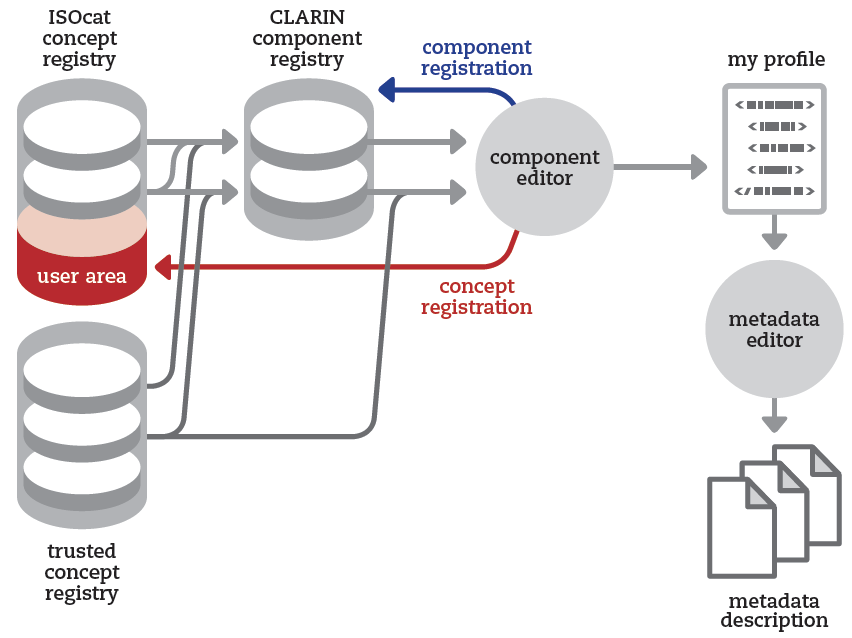
CMDI is a framework (see Figure 1) to build component based
metadata descriptions. A metadata component is basically a collection of atomic metadata
fields or data categories (DatCats) and describes a specific aspect or dimension of
a
resource, e.g. the title of a document, the creator or the native language of a subject
in a
video recording. Components can have a recursive structure, i.e. in addition to atomic
fields, the components can also contain other components. Thus, components serve as
small
building blocks or reusable templates for a specific aspect of a resource. Together
with a
header, these components are combined into metadata profiles, each of which can be
used as a
schema for metadata instances. Both, components and profiles can (and should) be stored
in a
component registry, which is a directory of components to be reused in different contexts.
Users can either reuse existing profiles for their metadata descriptions or create
new
profiles by reusing or creating new components, either manually or with a specialized
component editor. Various profiles already exists in the component registry, e.g.
for IMDI,
OLAC, Dublin Core or the TEI header.[2]
The storage of the schemas in a centralized infrastructure is common practice for
metadata schemas,
though of course this adds the problem of sustainability to the process, inasmuch
as the repository
of schemas needs to be constantly available.
Though this could be seen as problematic in principle for pragmatic reasons it seems
more appropriate
than to use local copies with modifications, because it makes sure that tools can
operate on the centrally
stored files. For a metadata archive, a local store of schema copies could be instantiated,
but this would
result in the requirement to adjust the schema reference, for interoperability this
could cause an additional
problem. Hence the use of a central infrastructure is probably the safest solution
and in the context of an
infrastructure of data and services most likely to be sustainable. This is also consistent
with the approaches
described by Rehm et al. 2011.
Each metadata field is linked to exactly one data category in a data category registry
(DCR)
using a persistent identifier. The DCR indicates how the content of the field in a
metadata
description should be interpreted. If the same data category is used in various metadata
schemas, the reference to the DCR will still be the same. This is also independent
of the
concrete naming of the XML element, including names, cases and orthographic variants.
For example, the field title in titleStmt in the TEI header is linked
to the same category as the title in Dublin Core.
In the CLARIN project the preferred concept registry is the ISO data category registry
ISO-DCR. This registry is an
implementation of the ISO 12620 standard model for data categories and offers ample
functionality for the needs of the CMDI framework. For the CMDI framework it makes
no
essential difference if another registry such as for instance the
DCMI is used. However the ISO-DCR does have a tight integration with other CMDI software
components such as the component editor, for efficient searching for suitable data
categories
or even combining metadata modelling with defining new data categories.
The component registry contains CMDI components and profiles. If a metadata creator
needs to describe a (for him) new type of resource, he can browse through the available
profiles and see if there is one that suits his needs. If there is no suitable profile
available he can create a new one, based on existing components or he can create new
components and work these with existing ones into a new profile.
When creating metadata elements in new metadata components users can browse and search
for entries in the ISO-DCR to find a concept that matches the semantics of the metadata
element. The identifier of the concept is then automatically inserted in the metadata
component specification.
To create metadata descriptions users load profiles into the metadata editor, which
then
can automatically generate forms based on the metadata profile. The user then fills
out these forms
to enter the data. Of course users may also use an XML editor to create metadata descriptions
directly and use the provided XML schemas (see below) to validate the XML documents.
The resulting metadata records are offered for harvesting by
OAI-PMH
and gathered in one or more central repositories.
Multiple ways to exploit the collected metadata are foreseen ranging from systems
doing
simple keyword search to those using faceted browsing or structured search. In all
of these
semantic mapping using the ISO-DCR plays a crucial role. When a user specifies a metadata
query, the ISO-DCR then allows to expand this query into set of equivalent ones that
will be
able to retrieve metadata records where a different terminology than specified in
the
original query. The identifiers of the terms in the query are used to find equivalent
terms
and these are then used to generate an additional query. E.g. when a user queries
for
titleStmt an additional query is generated for title,
since titleStmt is linked to title via the ISO-DCR.
Figure 1: Overview of the CMDI framework.
As mentioned before, a metadata component describes various aspects or dimensions
of a resource.
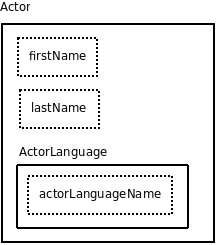
Figure 2 shows a schematic representation of a very simple example
metadata component “Actor”.
It contains two atomic fields “firstName” and “lastName” and refers to another component
“ActorLanguage”,
which contains a repeatable[3] atomic field “actorLanguageName”.
An entity “Actor” therefore consists of a first name, a last name and a list of languages.
In CMDI components are expressed in XML files. Figure 3 displays the “Actor”
component in the CMDI component XML specification tag-set. CMD_Component elements define new components,
CMD_Element elements new atomic fields. The ConceptLink attribute is the most important aspect
in terms of interoperability, because it stores the link to a DCR, or more specific
the PID of a data category.
Software interpreting the component definitions can use this concept link to draw
further conclusions from information,
like establishing an equality relation be between different field in different metadata
schemes and use this,
e.g. for smart searching. The component descriptions are normally transformed to XML
Schema using an XSLT transformation.
These XML Schemas are available from the component registry and can e.g. be used in
special metadata editors or plain XML
editors to aid the user in creating metadata records. Figure 3 shows an example instance
of an “Actor” component. In a complete CMDI metadata record the component together
with and one or more links to the
described resource are wrapped with a header.
Especially in connection with the standardization efforts mentioned in section “Conclusion”, TEI ODD
will be evaluated as an alternative apparatus for defining metadata components.
Other representation formats such as RDF, OWL and Topic Maps do not seem appropriate
for the description of the metadata in comparison to CMDI. It is obvious,
that CMDI due the recursive structure of defining components can become rather complex,
but the structures are at least assumed to be human readable and structured
according to a human prose text on a resource.
In contrast to this, the RDF-family is not requiring the linear order, presenting
the RDF-triples in arbitrary order.
Though CMDI documents can be rendered in RDF (and probably in OWL and Topic Maps),
the struture of CMDI is more transparent and usable to human users. CMDI is also
not a form of knowledge representation, in which the concepts of a resource are described,
but it is intended to provide structured information about a resource for
human users.
Figure 2: Schematic representation of the metadata component for “Actor”
Figure 3: XML representation of a metadata component for “Actor”
For the use of the Component Metadata Infrastructure, various tools exist, some being
reused from other contexts, others were explicitly developed in this context. Among
them are
editors, registries and search applications, which will be described briefly.
ISOcat: the Data category registry for ISO TC 37
The data category ISOcat ISO 12620 stores data categories and
implements ISO 12620:2009. It is a specialized concept registry, historically developed
for data categories used in terminology exchange. However, the concept was so flexible
and
useful that it was extended to further areas, including linguistic resource management
with all required metadata categories.
As a web-based registry for data categories and concepts, ISOcat can be extended by
additional data categories as required by users to cater for the individual project
needs. Data categories can be defined privately or publicly, submitted for
ISO-standardization or not.
Each data category in ISOcat receives a Persistent Identifier (PID) which is used
to
reference to it, especially suited to be included in metadata and schemata of linguistic
resources to foster semantic interoperability. Some schema languages, e.g., TBX XCS
and
TEI ODD, have built-in support to embed these PIDs into the schema. However, more
generic
schema languages such as Relax NG and W3C XML Schema do not, but with the definition
of
attributes schemas in these languages can easily be extended to include them.
The CMDI Component Registry
The Component Registry is also a web-based service, but currently not part of an ISO
standard. Within the Component Registry, users of CMDI can store their metadata components
and profiles. But it not only allows storage, but also contains editing functionalities.
In the CMDI Component Registry each component is also assigned an identifier that
is unique
in the context of the component registry, in order for other components to integrate
it.
Additionally this component identifier can be used as a reference for the profiles,
that is,
the instances document type declaration and namespaces can point to the component
registry
for their XML Schema.
Arbil: The CMDI supporting metadata editor
A special challenge for any metadata framework is the creation of instances, which
needs to be easy
and user friendly. As CMDI is highly adjustable and flexible, this poses additional
complications. With the metadata editor Arbil, there is an XML-Editor that is aware
of
CMDI-structures and connects to the component registry downloading the available (schematized)
CMDI profiles. Since there can be very many, the user can limit the number of CMDI
profiles that
are actually shown in the user interface
Relation Registry
The CMDI Relation Registry (RR) is designed to augment a limitation in ISO-DCR and
allow
the metadata search user to create (temporary) simple relations between different
data categories in the ISO-DCR.
The ISO-DCR can overcome “accidental” semantic overlap between different terms, i.e.
two metdata
developers used different terms but agree on the same definitions. The RR can be used
by users searching
the metadata to overcome intentional semantic overlap, i.e. the metadata modelers
decided that two terms
actually mean different things, but where the user decides that this difference is
irrelevant for
him. He would specify the relation “Term1” == “Term2” and the semantic mapping machinery
of the metadata search would expand every query with “Term1” with one that also uses
“Term2”.
Joint Metadata Repository
The joint metadata repository (JMDR) is the place where all the harvested CMDI metadata
records are stored.
The harvesting method is the well-known OAI-PMH, currently there is not yet a registry
where the
CMDI metadata providers are registered, but such a registry is under consideration.
There may be several of such joint metadata repositories, each specializing in one
type of metadata search service.
Considering the (expected) great variety of metadata schemas, it was thought advantageous
to use native XML
database to allow searching through the collected CMDI records.
Currently no semantic normalization is done when the records are stored in the JMDR,
this is to allow a query
to retrieve only those records that actually use a profile specific terminology.
Searching over structured CMDI data
Added value of highly structured and rich metadata descriptions can be achieved if
the
search process is more elaborated, leading to more precise and fast results than a
full-text search, without lowering the recall. Two examples of such search interfaces
are
the Virtual Language Observatory and the NaLiDa Faceted Search. Both harvest the CMDI
metadata from data providers, but they have a different functionality.
The Virtual Language Observatory started of with earlier metadata versions. It
presents a number of different facets, from which a user selects the interesting data
categories.
The NaLiDa faceted browser is slightly more elaborated as it implements conditional
facets, i.e. additional facets appear based on earlier selections. For example the
facet
“corpus type” is irrelevant for non-corpora, hence is only shown if the resource type
“corpus” is selected. However, the NaLiDa faceted browser focuses on resources in
a
national context.
Conclusion
XML encoding is a solid foundation to encode metadata descriptions. In the past,
various
different metadata schemas emerged based on XML technology, like IMDI,
Simons et al. 2008 and DCMI.
Several technologies, like OAI-PMH have been created for the easy dissemination of
XML encoded
metadata descriptions. However, XML is not sufficient to exchange data. One either
has to
agree on a common schema or transform their data into pivot formats. Especially with
rich and
elaborated metadata schemas these approaches are cumbersome and most often lead to
loss of
information. A level beyond XML is needed to convey semantic information about the
markup,
which allows to draw further conclusions on the information encoded in XML documents.
The
CLARIN project takes a rather pragmatic approach towards this problem by adding registries
for
metadata components and data categories. The information of both registries combined
allow to
perform, at least to some extend, reasoning about the information encoded in metadata
descriptions. For example, more sophisticated searches are possible. To some extend,
this
approach can be generalized and applied to other scenarios to foster XML document
interchange
without nervelessly requiring to agree on a common XML markup schema. At the time
of this
writing, CMDI has been proposed as a work item in ISO/TC 37/SC 4.
[ISO 12620] ISO 12620.
“Computer Applications in Terminology – Data Categories – Specification of Data
Categories and Management of a Data Category Registry for Language Resources”.
ISO, Geneva, Switzerland, 2009.
[Rehm et al. 2011]
Rehm, G., Schonefeld, O., Trippel, T., Witt, A.
“Sustainability of Linguistic Resources Revisited”.
In: Proceedings of the International Symposium on XML for the Long Haul: Issues in
the
Long-term Preservation of XML. Balisage Series on Markup Technologies, Vol. 6, 2010.
doi:https://doi.org/10.4242/BalisageVol6.Witt01
[Sperberg-McQueen & Huitfeldt 2011]
Sperberg-McQueen, C. M. and Huitfeldt, C. “Ten
Problems in the Interpretation of XML Documents”. In: Proceedings of the Conference of Processing Text-Technological Resources 2008, Bielefeld
(to appear).
[1] The authors are well aware, that providing a sound semantic foundation, e.g. an
ontology or alike, for less closed domain will be, at least, a challenging task.
[2] The metadata schemas of these sets have been decomposed into components and then recomposed
into
profiles, while as many components were reused.
[3] This is not yet marked clearly in the figure, we'll
find a better graphical notation for the final paper.
ISO 12620.
“Computer Applications in Terminology – Data Categories – Specification of Data
Categories and Management of a Data Category Registry for Language Resources”.
ISO, Geneva, Switzerland, 2009.
Rehm, G., Schonefeld, O., Trippel, T., Witt, A.
“Sustainability of Linguistic Resources Revisited”.
In: Proceedings of the International Symposium on XML for the Long Haul: Issues in
the
Long-term Preservation of XML. Balisage Series on Markup Technologies, Vol. 6, 2010.
doi:https://doi.org/10.4242/BalisageVol6.Witt01
Sperberg-McQueen, C. M. and Huitfeldt, C. “Ten
Problems in the Interpretation of XML Documents”. In: Proceedings of the Conference of Processing Text-Technological Resources 2008, Bielefeld
(to appear).
Váradi, T.,
Krauwer, S., Wittenburg, P., Wynne, M. and Koskenniemi, M. “CLARIN: Common language resources and technology infrastructure”.
In: Proceedings of LREC 2008, Marrakech, Morocco, 2008. pp. 1244–1248.
http://www.lrec-conf.org/proceedings/lrec2008/pdf/317_paper.pdf